Prince Henry Palace: A Frederician Rococo Palace and Humboldt University Building in Berlin


Site at a Glance
- Rating
- 4.4
- Popularity
- Low
- Country
- Germany
- Primary era
- Early Modern
- External website
- Open
- Eras represented
- Early Modern, Modern
- Civilizations
- German, Kingdom of Prussia
- Site type
- Civic
- Remains
- University
On this page10 sections
History
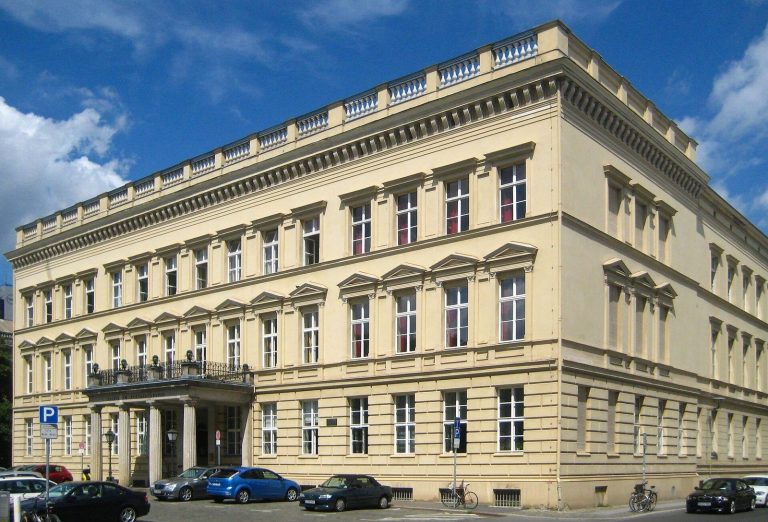
Prince Henry Palace is an eighteenth-century urban palace in Berlin, Germany, built by the Kingdom of Prussia in the Frederician Rococo style between 1748 and 1753 for Prince Henry of Prussia. It forms part of the Forum Fridericianum, Frederick the Great’s planned cultural and political ensemble around the Royal Opera House, and now houses Humboldt University of Berlin.
The planned Forum Fridericianum
The site was first intended for a large royal residence for Frederick II, known as the Palais du Roy. That plan was abandoned after the Margraves of Brandenburg-Schwedt refused to sell their existing palace, the predecessor of the present Old Palace. Frederick instead refurnished his residence in the Berlin Palace and focused much of his subsequent building activity on Potsdam.
Because the Royal Opera House had already been built on the site of former fortifications, Frederick supplied new preliminary sketches for a palace that would frame the opera house. The resulting building was unusually large for the young, unmarried Prince Henry and created a reduced version of the projected forum. St. Hedwig’s Cathedral was built behind the opera house and consecrated in 1773, while the Royal Library was constructed beside it between 1775 and 1786.
Construction and princely residence
Johann Boumann prepared the designs, reportedly drawing on preliminary work by Georg Wenzeslaus von Knobelsdorff, whose architecture also influenced the Royal Opera House. Boumann initially directed construction, but Carl Ludwig Hildebrandt assumed responsibility in 1755 after Boumann became responsible for all building work in Berlin. Construction advanced slowly and stopped during the Seven Years’ War, the major eighteenth-century conflict that disrupted much of Europe. By 1755, expenditure had reached 200,000 thalers, and another 33,000 thalers was approved in 1756.
Prince Henry and his court moved into the palace in early 1766. He had married Wilhelmine of Hesse-Kassel in 1752 for reasons of state. Henry lived at the palace until his death in 1802, apart from periods at Rheinsberg Palace and in his apartments in the Potsdam City Palace. Wilhelmine occupied separate apartments in the two side wings and remained there until her death in 1808.
University use and twentieth-century enlargement
In 1809, Frederick William III granted the palace to the newly founded University of Berlin. The building therefore changed from a princely residence into a university complex. Its interiors were adapted for academic use between 1836 and 1846 and again in 1892.
Between 1913 and 1920, Berlin building commissioner Ludwig Hoffmann extended the two side wings northward and added lateral buildings. The work preserved the original style and cornice height while changing the plan from a U shape to the H-shaped layout seen today.
War damage, reconstruction, and heritage debates
Large parts of the palace were destroyed during the Second World War, especially in Allied air raids between 24 November 1943 and 19 July 1944. Teaching resumed in 1945 in provisionally repaired rooms in the west wing. Reconstruction followed in two phases, from 1947 to 1954 and from 1958 to 1962, using historical models for the Frederician facades.
The rebuilt university building has housed Humboldt University of Berlin since the reconstruction. The institution held particular importance for East Germany’s state and party leadership because Karl Marx had studied there under Georg Wilhelm Friedrich Hegel. This political association led to the installation of a gold-lettered quotation from Marx’s eleventh thesis on Feuerbach in the central stairwell.
Prince Henry Palace has been legally protected as a historic monument since 1975 and underwent interior and exterior renovation in 2020. The palace’s surviving and reconstructed form also remains part of a cultural-heritage dispute. Original attic sculptures were destroyed during the war, and sculptures from the Potsdam City Palace were placed on the side wings in 1967. The Potsdam Palace Association, supported by the citizens’ initiative Mitteschön and cultural figures from Berlin and Brandenburg, has called for their return under Article 8 of the Venice Charter, which addresses the preservation of decorative elements belonging to monuments. Humboldt University, the Berlin State Monuments Council, and the Prussian Palaces and Gardens Foundation Berlin-Brandenburg oppose the return, arguing that the protected monument includes its historically developed form, including the sculptures now displayed there.
Remains
Urban plan and Frederician facade
Prince Henry Palace is an urban palace on Unter den Linden and part of the architectural setting of the Forum Fridericianum. Its facade follows the forms of the neighboring Royal Opera House, creating a unified composition around the square. The original building had a U-shaped plan. The northward extensions of 1913 to 1920 and the added lateral structures produced the present H-shaped arrangement while retaining the original cornice height and Frederician Rococo character.
Central interiors
The reconstructed central section contains a large vestibule on the Unter den Linden side and a representative staircase on the garden side. Reddish marble appears in wall and floor elements within the vestibule and staircase sequence. Their ordered progression of spaces is regarded as an important example of socialist classicism, the monumental East German style of the 1950s that combined classical forms with the representational needs of the socialist state.
East-wing academic spaces
The east wing on Dorotheenstrasse contains a cinema and a main lecture hall built between 1958 and 1962. The lecture-hall area includes colorful stained-glass windows designed by Walter Womacka, linking the postwar academic functions of the building to its reconstructed interior.
Inscriptions and attic sculpture
The original facade inscription honored the university’s foundation by Frederick William III in 1809. After the war, it was replaced by the inscription “HUMBOLDT · UNIVERSITAET.” The attic sculpture program, created around 1753 by Johann Gottlieb Heymüller, related to the palace’s use, the lives of Prince Henry and Wilhelmine, and themes from Ovid’s Metamorphoses.
The central projecting section of the facade originally carried the sculptural pairs Jason and Medea, Peleus and Thetis, and Atalanta and Meleager. These works were destroyed during the Second World War and replaced by reconstructions made by Albert Braun in 1953. The eastern projecting sections originally displayed Adonis and Venus together with Perseus and Andromeda, while the western sections carried Bacchus and Ariadne together with Mercury and Herse. Sculptures from the Potsdam City Palace were installed on the side wings in 1967, and these loaned works remain distinct from the original palace sculpture group.