Palazzo degli Elefanti: Catania’s Historic Town Hall



Site at a Glance
- Rating
- 4.5
- Popularity
- Low
- Country
- Italy
- Primary era
- Early Modern
- External website
- Open
- Eras represented
- Early Modern
- Civilizations
- Kingdom of Sicily, Spanish
- Site type
- Civic
- Remains
- Town Hall
On this page12 sections
History
Palazzo degli Elefanti is a historic town hall in Catania, Italy, built in the Baroque period after the 1693 earthquake destroyed its medieval predecessor. Standing beside the Cathedral of Saint Agatha in Piazza del Duomo, it remains closely associated with the city’s civic government and public religious traditions.
The medieval civic center
The earlier building was known by several names, including Palazzo Senatorio, Casa Senatoria, Loggia Senatoria, Loggia Medievale, and simply the Loggia. These names referred to the civic Senate, the former municipal council. The building housed the municipal archive, while civic representatives met in its peristyle. The Sicilian parliament assembled there on occasions between 1281 and 1566, including meetings in 1281, 1296, 1336, 1353, 1397, 1416, 1460, 1475, 1478, 1494, 1552, and 1566.
Because the building formed part of the sacred precinct beside the cathedral, it was sometimes described generically as a cathedral. In this usage, the term referred to a place where assemblies and general courts convened by the sovereign were held. Parliamentary sessions moved among Catania, Messina, and other royal cities on Sicily’s eastern coast during rivalry between Latin and Catalan factions. This conflict was intensified by members of the Chiaramonte family who opposed the Aragonese dynasty, the ruling house that controlled the Crown of Aragon and, at various times, Sicily.
Archives and destruction
During the fifteenth century, Lope III Ximénez, the viceroy of Sicily, ordered the city’s privilege books and other records connected with the Aragonese rulers and Queen Blanche of Navarre to be collected and preserved in the building’s archives. A viceroy was the monarch’s appointed representative and governor in a kingdom or major territory.
The Catania riots that began on 27 May 1647 formed part of the wider Sicilian revolt against Spanish rule. The unrest partially destroyed and depleted the municipal archive. The 1693 earthquake then completely destroyed the earlier structure, creating the need for a new civic palace.
Baroque rebuilding
Construction of the present palace began in 1696, with an initial design by Giovan Battista Longobardo and collaboration from Vincenzo Caffarelli of the Order of the Crosiers. Giovanni Battista Vaccarini took charge of the work in 1735. He designed the eastern, southern, and western façades, while Carmelo Battaglia designed the northern façade. After 1757, the project was also associated with Giuseppe Palazzotto. Vaccarini was an eighteenth-century architect closely connected with the Baroque rebuilding of Catania after the city’s natural disasters.
The palace became part of Catania’s civic and ceremonial life. It is traditionally associated with the celebrations of Saint Agatha, the Christian martyr regarded as the city’s patron and protector. Its central balcony provided a vantage point for religious festivals, songs, and fireworks held in her honor.
Twentieth-century damage and restoration
On 14 December 1944, demonstrators opposing compulsory military service, many of them young people encouraged by the Sicilian Independence Movement, burned the municipality. The fire destroyed valuable municipal historical archives and objects from the Risorgimento Museum, which occupied rooms in the palace. The Risorgimento was the nineteenth-century movement that led to the political unification of Italy.
After the fire, the interiors were refurnished in their original style. The building reopened on 14 December 1952, and additional restoration in 1953 returned it to use as Catania’s town hall.
Remains
Layout and exterior
Palazzo degli Elefanti has a rectangular plan developed mainly along a north-south axis. It rises through three levels, including the piano nobile, the principal ceremonial floor of a European palace, and faces the Baroque Piazza del Duomo. The main southern entrance opens onto Via Vittorio Emanuele II, formerly the Strada Reale, while the eastern entrance opens onto Via Etnea, formerly Via Uzeda.
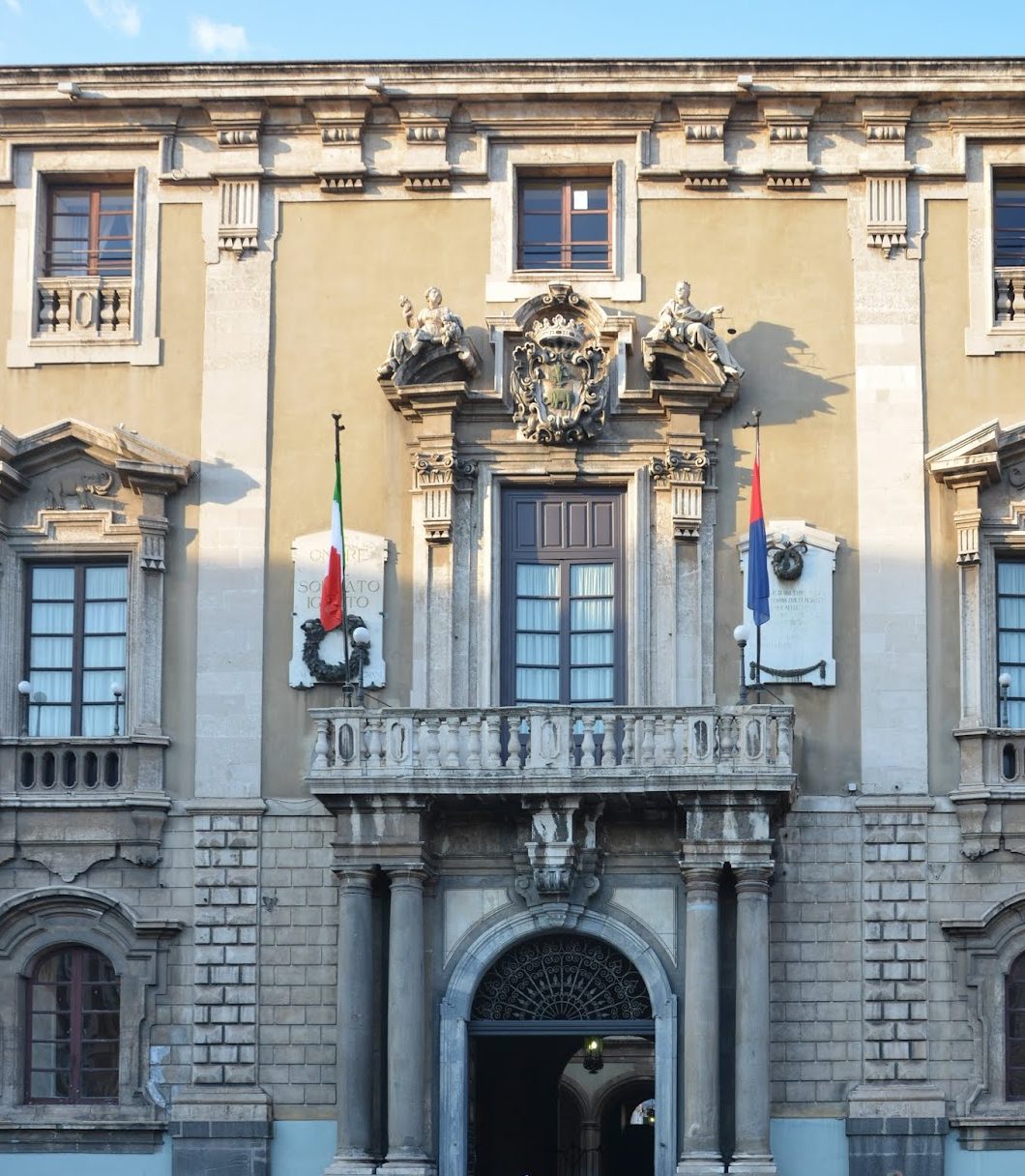
The southern and opposite elevations have three openings on each wing and level; the eastern and opposite elevations have five. Pilasters organize the façades. Ground-floor windows carry arched pediments, balcony windows have balustrades and broken triangular pediments, and the upper windows have simple frames with railings supported by small columns.
The Baroque façades combine rusticated pilasters and piers with diamond- and cushion-shaped bosses extending from the base to the first floor. Rustication is masonry or plasterwork that emphasizes joints or projects individual blocks to create a massive architectural effect. Above this zone, smooth, flat pilasters without capitals continue to the entablature. Plaster surfaces and vertical ribs in white Syracusan limestone balance the heavy rustication.
Main portal
The principal portal is framed by paired granite columns set on tall plinths. They support the large central balcony, whose monumental architrave has projecting brackets bearing sculptures of Justice and Faith. The coat of arms of Catania appears above, while two commemorative plaques are set into the wall beside the frame.
Courtyard and ceremonial spaces
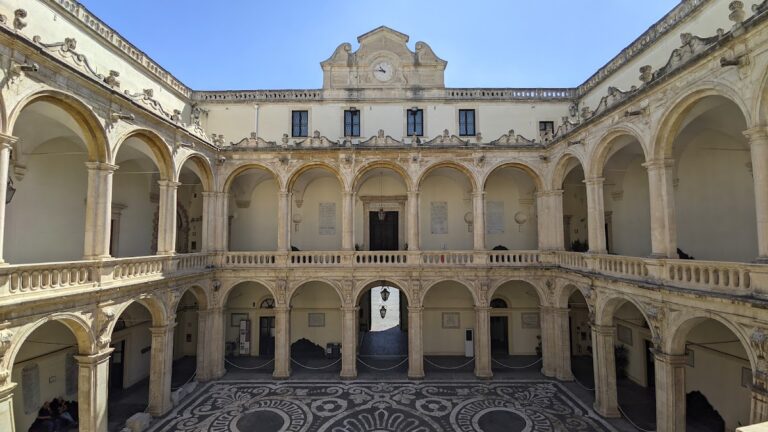
The inner courtyard extends east-west, contrasting with the north-south development of the palace perimeter. Its northern and southern porticoes each contain five arches resting on piers. The honor staircase opens onto the courtyard and was added during a later phase by Stefano Ittar.
Carriages and civic objects
The southern entrance hall contains two eighteenth-century carriages. One is a berline, an enclosed ceremonial carriage used during the celebrations of Saint Agatha to carry the mayor to the Church of Saint Agatha at the Furnace for the 3 February procession. That procession renews the offering of wax associated with the civic Senate’s vow to the city’s patron and protector.
The courtyard and other entrance halls contain archaeological finds from several periods and works of contemporary art. The western entrance hall holds the large monolithic block known as the Pietra del Malconsiglio. The building also displays a fifteenth-century bust of Saint Agatha, Antonio Calì’s nineteenth-century marble bas-relief Genio di Catania, a stone inscription concerning ceremonies observed by the civic Senate, and Antonio Brancato’s 1985 bronze medallion of Giovanni Battista Vaccarini.
Principal interior rooms
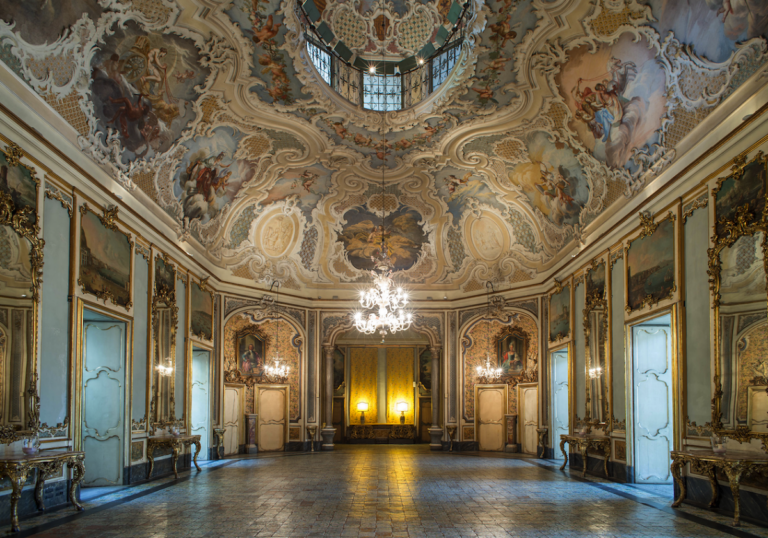
The piano nobile contains the honor staircase, the Bellini Hall, the council chamber named for Giuseppe Sciuti, and a large reception hall. The eighteenth-century Cammarone, the palace’s large ceremonial hall, contains frescoes attributed to Giovanni Battista Piparo.
Several paintings by the Catanian artist Giuseppe Sciuti are preserved in the reception hall and other first-floor rooms. They include Episode of Pisacane’s Expedition at Sapri from 1890, Restauratio Aerarii from 1894 in the Bellini Hall, Saint Sebastian after the First Martyrdom from around 1903, Julius Caesar from 1906 on the staircase landing, Nativity from 1908, and the undated The Adulteress in the council chamber. Works by Emilio Greco and Francesco Contraffatto are also present.
Elephant Fountain
The Elephant Fountain stands in the center of Piazza del Duomo between Palazzo degli Elefanti and the Palazzo del Seminario dei Chierici. Giovanni Battista Vaccarini erected it in 1736. Its central figure is a black lava-stone elephant carrying an Egyptian red-granite obelisk, a tall tapering four-sided monument with a pyramidal top. Hieroglyphs mark the obelisk, which is surmounted by a Christian cross.
The elephant was found among the ruins of the destroyed city and is attributed to the Roman period. It may originally have marked the end of a hippodrome or racetrack. The obelisk was also found by chance. Until 1620, it served as an architrave for an arch at the episcopal palace. In 1677 it was erected without the elephant in the palace courtyard, before the 1693 earthquake toppled it.
The arrangement of the elephant and obelisk was almost certainly inspired by Gian Lorenzo Bernini’s 1667 Elephant and Obelisk in Rome. Bernini was a leading seventeenth-century Italian sculptor and architect. The obelisk’s hieroglyphs refer to the cult of Isis, while the fountain’s base carries reliefs representing the Simeto and Amenano, the two rivers that formerly flowed through Catania.