Palazzo dell’Università: Historic Seat of the University of Catania


Site at a Glance
- Rating
- 4.5
- Popularity
- Very Low
- Country
- Italy
- Primary era
- Early Modern
- Eras represented
- Early Modern, Modern
- Civilizations
- Habsburg, Italian, Kingdom of Sicily, Kingdom of the Two Sicilies, Spanish
- Site type
- Civic
- Remains
- University
On this page7 sections
History
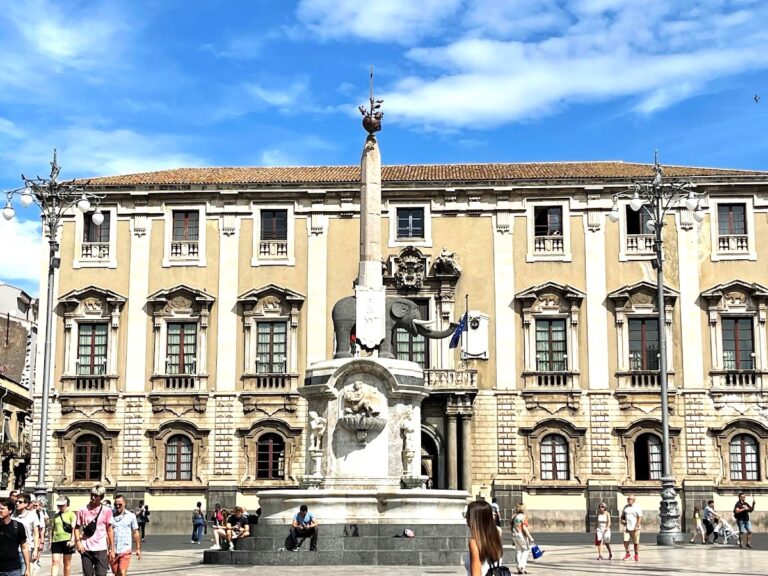
Palazzo dell’Università is a Sicilian Baroque palace in Catania, Italy, built as the principal seat of the University of Catania between the reconstruction of the city after the 1693 earthquake and its completion around 1760. Its design is associated with Francesco Battaglia, Antonino Battaglia, and Giovanni Battista Vaccarini, architects linked to Catania’s rebuilding. The palace has remained the university’s main seat since its construction.
Foundation of the University
The University of Catania was founded on 19 October 1434 through the initiative of Alfonso V of Aragon, known as Alfonso the Magnanimous. He granted it the status of a Studium Generale, a medieval institution whose degrees were recognized beyond its home city. Pope Eugene IV authorized the foundation by papal bull on 18 April 1444.
Teaching began on 19 October 1445 with six lecturers. The first faculties were theology, jurisprudence, and medical arts, and the university awarded its first degree in the same year. Its earliest premises stood beside the Cathedral of Sant’Agata, near the present Palazzo del Seminario dei Chierici. When that building was cleared to create the spaces around the cathedral, the university moved between several locations.
Construction after the 1693 earthquake
In 1684, the university moved into the former San Marco Hospital in the Fiera district. The Val di Noto earthquake of 1693 destroyed the hospital and much of Catania. Construction of the present Palazzo dell’Università began in 1696 as part of the city’s rebuilding, producing the palace that was completed around 1760.
The square before the building was first known as Piazza della Fiera del Lunedì and later took the name Piazza dell’Università. The palace became the center of the university’s institutional life and continues to contain the rectorate and other university offices.
Later alterations
The building was altered after later earthquake damage. Following the 1785 earthquake, Francesco Battaglia reinforced the principal facade with a supporting counter-wall. After the 1818 earthquake, Antonino Battaglia restored the palace and a new facing was attached to the existing masonry on the lateral elevations. In 1879, the professor and engineer Mario Di Stefano substantially changed the ground floor and the street entrances, including the portal.
Remains
Palace and courtyard
Palazzo dell’Università occupies an entire city block on Piazza Università along Via Etnea in central Catania. It stands across the square from Palazzo San Giuliano, which also houses university offices. The building is arranged around an internal cloister-like courtyard, with doors originally opening onto all four sides. The courtyard pavement uses an elaborate pattern of black and white stone. The palace’s present appearance combines the Sicilian Baroque design associated with the Battaglias and Vaccarini with the later facings, restorations, and ground-floor alterations.
Ceremonial hall and collections
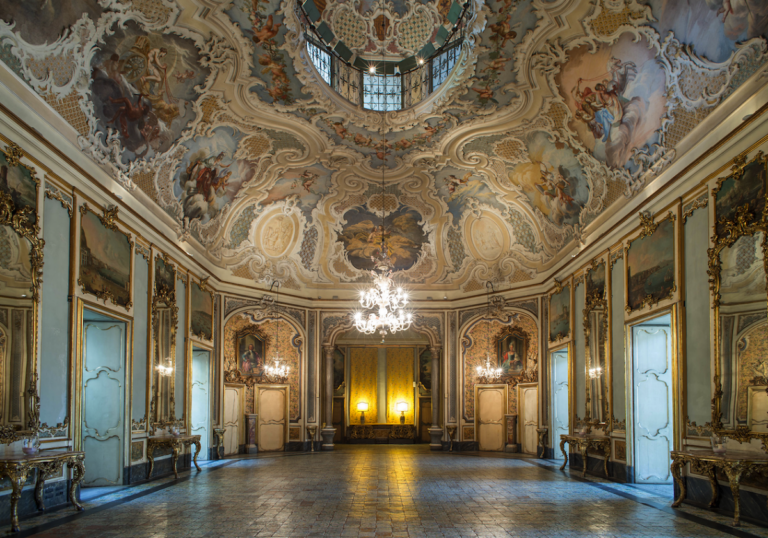
The principal upper floor, or piano nobile, contains a large Aula Magna. Giovanni Battista Piparo frescoed the hall, and a tapestry bearing the coat of arms of the Aragonese dynasty hangs behind the academic podium. At the end of the nineteenth century, the hall contained a gallery of 91 portraits of distinguished men of Catania. These portraits now belong to the Historical-Artistic Collection of the University Museum System.
The university library preserves codices, incunabula, manuscripts, and autograph letters. Incunabula are books printed in Europe before 1501, during the earliest period of movable-type printing. The library also holds more than 200,000 volumes. The palace houses the Giambattista Caruso Regional Library and a small museum of geology and archaeology, extending its institutional role beyond administration and teaching.