Faust House: A Historic Palace and Hospital in Prague


Site at a Glance
- Rating
- 4.3
- Popularity
- Low
- Country
- Czechia
- Primary era
- Early Modern
- External website
- Open
- Eras represented
- Medieval, Early Modern
- Civilizations
- Holy Roman Empire, Kingdom of Bohemia
- Site type
- Domestic
- Remains
- Elite Residence
On this page10 sections
History
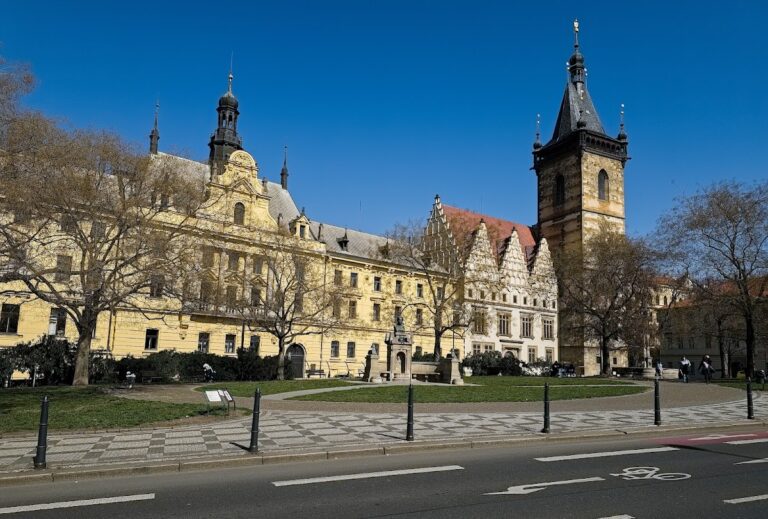
Faust House is a historic palace in Prague, Czechia, on the south side of Charles Square in the New Town. Built on the site of a fourteenth-century Gothic palace associated with the Opava branch of the Přemyslid dynasty, a medieval Bohemian ruling family, it later acquired Renaissance and Baroque forms and became linked with alchemy, experimental science, legend, and medicine.
The medieval palace and the New Town
The earliest palace was connected with the Opava branch of the Přemyslids, whose dukes ruled the territory of Opava. Duke Wenceslaus II of Opava-Ratibor, known for his interest in natural science and alchemy, is regarded as the first person associated with the legends that later gathered around the property.
In 1420, during the Hussite Wars, a series of religious and political conflicts in Bohemia, the property passed to Petr Kamenik, a burgher of Prague’s New Town. After 1434, it belonged to the New Town municipal council. From 1439 to 1464, the house was occupied by Prokop, a lawyer serving the Opava dukes, a writer on stylistics, and a teacher at the University of Prague.
Renaissance scholars and the Rudolfine court
The original Gothic building was remodeled in the Renaissance style in the middle of the sixteenth century. The work probably followed the death of the historical Faust and took place while the property belonged to Johann Kopp, court physician to Ferdinand I, a Habsburg ruler and Holy Roman Emperor. Kopp produced his best-known works at the house.
During the reign of Rudolf II, whose Prague court became a center for astrology, alchemy, and the study of natural phenomena, Faust House belonged to the astrologer Jakub Krucinek. A family crime added another layer to the property’s reputation. Krucinek’s younger son killed his elder brother over an alleged treasure hidden in the walls. The younger man was sentenced to death and hanged at the Horse Market, now Wenceslas Square.
Edward Kelley bought the house in 1590 after arriving in Prague in the circle of the alchemist John Dee. Kelley first worked for the Rosenbergs and later won broad recognition for his charlatanry, along with a noble title granted by Rudolf II. His fortunes changed after he killed Jiří Gunter, one of Rudolf II’s favorites. Imprisoned at Křivoklát Castle, Kelley broke his leg while trying to escape, was returned to custody, and died soon afterward.
The Mladota period
Ferdinand Antonín Mladota of Solopysky acquired the property in 1724. The following year he commissioned a Baroque rebuilding under the architect František Maxmilián Kaňka, and the house is also associated with a foundation date of 1726. Mladota carried out practical experiments in physics and chemistry, fields that at the time overlapped with alchemy and the study of natural philosophy. His work included optics, electricity, and magnetism.
Colored flames often appeared in the windows, while automata and other difficult-to-explain devices encouraged the house’s diabolical reputation. Mladota’s son Josef Petr continued this scientific tradition. He studied mechanics and was permitted to use the physics cabinet at the Clementinum, a historic Prague scholarly complex with scientific facilities, because his interest in science was considered hereditary. At home, he experimented with mechanically rising stairs, self-opening doors, and handles said to deliver electric shocks. He died in 1789, possibly taking some of his technical knowledge with him.
The Faust legend and later uses
The association with Faust came from the broader European tradition surrounding Johann Georg Faust, a sixteenth-century German scholar, astrologer, magician, and alchemical figure. In the literary legend, Faust makes a pact with the Devil in the Prague house and is eventually carried to Hell. A hole left in the ceiling supposedly proved difficult for masons to repair. The historical Faust probably never visited Prague, but the residence of alchemists and physicists at the property helped sustain the connection.
The legend was developed further in literary works by Alois Jirásek and Jan Kollár. The house itself stood empty for a long period before being used by a private institution for deaf people from 1838 to 1902. The institution was owned by Václav Forst, a specialist in the field.
From 1903 onward, the building housed a hospital. It is now associated with a hospital of a faculty of Charles University and is owned by the First Faculty of Medicine of Charles University. Its later reputation was also shaped by the priest Karel Jaenig, who received official accommodation there. Jaenig served at the Church of St John Nepomuk on the Rock in Prague and collected objects associated with death. He painted his room black, covered it with funeral inscriptions, slept in a wooden coffin, kept a skull beside it, and treated part of a gallows as the chief object in his collection. He died in 1914. His wishes to be buried face down and taken to the cemetery in a carriage drawn by wolves were not fulfilled.
Damage and protection
On 13 August 1925, scaffolding collapsed during repairs to the facade and injured everyone working there. Newspapers connected the accident with the building’s alleged curse. On 14 February 1945, near the end of the Second World War, a bomb struck Faust House, penetrating the roof and the ceilings of two floors. A fire followed, but hospital employees extinguished it through a prompt and coordinated response. The building is recognized as a cultural monument.
Remains
Faust House is a palace or mansion with Gothic, Renaissance, Baroque, and partly Neoclassical elements. It stands on the south side of Charles Square and is surrounded by a large garden. Its present architectural character reflects the sequence of rebuilding that began with the medieval Gothic palace, continued with the Renaissance remodeling of the sixteenth century, and culminated in the Baroque reconstruction commissioned by Ferdinand Antonín Mladota.
Renaissance and Baroque fabric
The sixteenth-century transformation replaced the earlier Gothic character with Renaissance forms, while the eighteenth-century rebuilding under František Maxmilián Kaňka gave the residence its major Baroque phase. Later changes introduced partly Neoclassical elements. The building’s fabric therefore preserves several historical periods within one palace, rather than representing a single moment of construction.
Alchemical and scientific features
Ferdinand Antonín Mladota used the building and its basement for experiments involving optical, electrical, and magnetic principles. His son Josef Petr constructed or installed mechanically rising stairs and doors that opened without manual operation. Experimental devices also produced electric shocks through their handles, features that helped connect the house’s physical spaces with its stories of unusual science.
During a later renovation, sixteenth-century frescoes were found on one of the ground-floor corbels, a projecting architectural support that carries or helps support the structure above it. The paintings contain alchemical symbols and still lifes showing various alchemical utensils. They provide a surviving visual link between the Renaissance building and the intellectual traditions that later shaped Faust House’s reputation.
Legendary alterations and wartime damage
Edward Kelley is said to have maintained a laboratory in the house, where experiments supposedly caused explosions and holes in the ceilings. The ceiling hole associated with Faust belongs to the house’s legend rather than to a documented architectural feature. The physical damage caused by the 14 February 1945 bombing is distinct from that story: the bomb penetrated the roof and the ceilings of two floors, and the resulting fire was extinguished by hospital employees.