Palazzo dei Conservatori: A Renaissance Civic Palace in Rome


Site at a Glance
- Rating
- 4.7
- Popularity
- Low
- Country
- Italy
- Primary era
- Early Modern
- External website
- Open
- Eras represented
- Iron Age, Classical, Medieval, Early Modern
- Civilizations
- Etruscan, Papal States, Roman
- Site type
- Civic
- Remains
- Palace
On this page26 sections
History
Palazzo dei Conservatori is a Renaissance palace in Rome, Italy, on Piazza del Campidoglio. Its present form emerged from the rebuilding of earlier medieval structures, while its rooms and collections preserve the history of Rome’s civic institutions and its ancient past. The palace stands beside Palazzo Senatorio and opposite Palazzo Nuovo, forming part of the Capitoline Museums together with the Tabularium.
Medieval civic government
The palace takes its name from the Conservators, Rome’s elected civic magistrates. From at least 1363, municipal statutes assigned them to assist the Senator, the city’s principal medieval civic authority. They administered financial and economic affairs, customs, municipal taxes, and aspects of urban regulation. The Public and Secret Councils also met in the building.
The Conservators represented the autonomy of Rome’s municipal elite in relation to the papal Curia. Their effective authority declined after Pope Eugene IV created the office of Governor of Rome, which provided a more direct form of papal administration. The magistracy nevertheless continued formally until 1870. From at least the fourteenth century, the palace was also associated with the Banderesi, captains of the communal militia organized as a society of crossbowmen and shield-bearers. During the Middle Ages, it served as a seat of justice.
From medieval palace to Renaissance complex
Pope Nicholas V rebuilt the palace around the middle of the fifteenth century as part of an effort to strengthen papal authority over Rome’s civic institutions and renew the city’s monumental appearance. A project attributed to Bernardo Rossellino gave the building a ground-floor portico with twelve arches and six upper-level Guelf windows.
The palace’s decorative character changed after Pope Sixtus IV donated ancient bronzes to the Roman people in 1471. A substantial fresco campaign followed during the first decade of the sixteenth century, establishing historical and civic themes that remained central to the decorated rooms. The earliest surviving parts of this campaign are in the Hall of Hannibal and the Hall of the She-Wolf.
In 1537, Michelangelo began the comprehensive redesign of the Capitoline complex. His project included Palazzo dei Conservatori, Palazzo Senatorio, Palazzo Nuovo, and the square itself. He also directed the transfer of the equestrian statue of Marcus Aurelius from the Lateran to the Capitoline. The work replaced the late-medieval facade and altered the palace’s general structure, courtyard, and staircase.
Construction began in 1563. On 8 June, the right bay of the old facade was demolished and the foundations of the new right-hand corner pier were laid. Guidetto Guidetti became Michelangelo’s site supervisor in July. After Michelangelo died on 13 February 1564 and Guidetti died later that year, Giacomo della Porta continued the project. He completed the palace in 1568, following Michelangelo’s plans closely while enlarging a first-floor reception room and its window.
Civic decoration and European history
The palace’s magistracies gradually became largely ceremonial, but its rooms continued to express Rome’s civic identity through images of the city’s foundation, republican virtues, imperial triumphs, public responsibility, and papal authority. The formal rooms were repeatedly redecorated from the sixteenth through the eighteenth centuries. Earlier decoration in rooms facing the square was lost during the construction of the monumental staircase and the reorganization of the Conservators’ Apartment.
The Hall of the Horatii and Curiatii was enlarged during Michelangelo’s restructuring and served as the meeting place of the Public Council. Its frescoes, commissioned from the Cavalier d’Arpino in 1595, depict episodes from Rome’s legendary beginnings and early history, including the discovery of the She-Wolf, the combat of the Horatii and Curiatii, the Rape of the Sabines, and Romulus marking the city boundary. The hall later acquired an international political role. On 25 March 1957, representatives of Belgium, France, the Federal Republic of Germany, Italy, Luxembourg, and the Netherlands signed the Treaty of Rome there, establishing the European Economic Community and Euratom. The hall hosted the signing of the treaty establishing a constitution for Europe on 29 October 2004 and a commemoration of the 1957 treaty in 2017.
Formation of the museum collections
The palace’s ancient collections expanded through donations, excavations, and the creation of public galleries. The Capitoline Picture Gallery was established in 1750 from holdings of the Sacchetti family and the princes Pio di Savoia. Pope Benedict XIV and Cardinal Silvio Valenti-Gonzaga were central to its creation, and more than 180 paintings from the Sacchetti collection were purchased in 1748. Later acquisitions, bequests, and donations included the Cini donation of 1880.
Augusto Castellani, a Roman goldsmith, collector, and later director of the Capitoline Museums, made major gifts in 1867 and 1876. Approximately 700 objects from Etruria, Latium, and Magna Graecia formed part of these donations, dating from the eighth to the fourth century BC. The Castellani rooms also include a selection from the Industrial Art Museum, founded in the nineteenth century through the efforts of Baldassarre Odescalchi, Augusto Castellani, and Alessandro Castellani.
Rome’s urban expansion after 1870 brought further archaeological material to the Capitoline collections. Excavations and building work on the Quirinal, Viminal, and Esquiline revealed objects and architectural decoration from the horti, elite Roman villa-and-garden estates. Virgilio Vespignani created a wooden octagonal pavilion in a palace courtyard for these sculptures. It opened in 1876 with 133 statues, expanded as discoveries continued, and was demolished in 1903. Rodolfo Lanciani later reorganized the material according to its provenance.
Conservation and present function
Modern conservation has altered both the fabric of the palace and the presentation of its collections. Restoration of the Hall of Triumphs recovered the colors of its wooden ceiling, while work in the Hall of the Geese removed later overpainting. The former chapel was reconstructed after alterations made after 1870.
After restoration completed in the 1990s, the original equestrian statue of Marcus Aurelius was moved indoors because exposure to weather threatened its conservation. A copy now stands at the center of Piazza del Campidoglio. Carlo Aymonino designed a large glazed exedra in the former Roman Garden, creating a protected central space for the monumental remains of the Temple of Jupiter Capitolinus. Palazzo dei Conservatori is owned by the Italian state and functions as part of the Capitoline Museums.
Remains
Facade, courtyard, and major sculpture
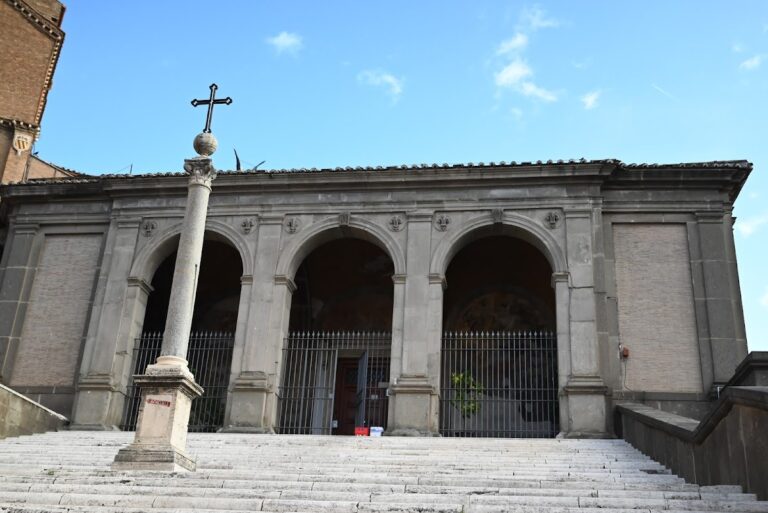
Palazzo dei Conservatori is a broad, relatively low, two-storey building set against the taller Palazzo Senatorio. Its Renaissance facade is organized by a colossal Corinthian order of pilasters extending through both storeys. The pilasters support a large entablature, cornice, and balustrade bearing statues. Open loggias occupy the lower level, while large windows fill the upper storey.
The Renaissance facade
The facade combines a colossal Corinthian order with an Ionic order of columns. The ground-floor openings are framed by Ionic columns, whose entablatures support the smaller orders around the upper windows. On the rear wall of the loggia, pedimented doors correspond to the windows above, and alternating low and triangular pediments frame large shell motifs. The system replaces arcades with architraved piers, while the columns act as subsidiary supports. Concealed relieving arches and iron clamps helped protect the stone beams from structural failure. Della Porta completed the capitals and entablature and inserted a larger central window with a triangular pediment, interrupting the regular rhythm of the facade.
The courtyard sculpture
The courtyard contains major ancient fragments arranged around the portico built by Alessandro Specchi. On the right are fragments of the Colossus of Constantine, found in 1486 in the western apse of the Basilica of Maxentius and Constantine. The enthroned emperor was conceived according to a Jupiter-like model as an acrolith, a composite statue with marble flesh and a separate supporting structure covered by drapery. The colossal head dates broadly between AD 313 and 324.
Reliefs of the provinces of Egypt, Libya, Moesia, Dacia, Gaul, Hispania, and Mauritania stand on the left, together with weapon trophies from the Temple of Hadrian in Piazza di Pietra. The temple was dedicated in AD 145 by Antoninus Pius to the deified Hadrian. At the rear, a group of the seated goddess Roma and two colossal barbarian prisoners in grey marble came from the Cesi collection and was acquired by Clement XI in 1720. The prisoners’ heads were added in modern times, and their forms are comparable with the Dacian prisoners of Trajan’s Forum.
The courtyard records and waterworks
The earlier courtyard was more spacious toward the facade and included a deep brick portico with pointed arches, granite columns, Ionic travertine capitals, and travertine bases. A cistern stood at its center. Domenico modified it in 1522, the courtyard was paved in brick two years later, and the cistern received a marble vase bearing a Latin inscription about rainwater.
Fragments of the Capitoline Fasti, Rome’s consular and triumphal records, were discovered in the Roman Forum in 1546 and placed in the courtyard. Michelangelo designed a sober marble setting for them, with a large tympanum and a Corinthian aedicule emphasizing the central texts. In 1586, the entire structure was moved to the Hall of the Ancient Fasti.
Decorated civic rooms
Hall of the Horatii and Curiatii
The Hall of the Horatii and Curiatii contains walnut doors made in 1643, decorated with coats of arms, allegorical panels, and scenes associated with Rome’s foundation and early kingship. The fresco cycle by the Cavalier d’Arpino presents the discovery of the She-Wolf, the Battle between Veii and Fidenae, the combat of the Horatii and Curiatii, the Rape of the Sabines, Numa Pompilius establishing the cult of the Vestals, and Romulus marking the city boundary. Atlantes, red curtains, floral and military trophies, vases, and a faux-marble frieze frame the scenes like woven hangings.
Hall of the Captains
Tommaso Laureti painted the frescoes of the Hall of the Captains between 1587 and 1594. They depict Mucius Scaevola and Porsenna, Horatius Cocles on the Sublician Bridge, the Justice of Brutus, and the Victory at Lake Regillus. Inscriptions and statues honor military leaders including Alexander Farnese, Marcantonio Colonna, Carlo Barberini, Gian Francesco Biandrate di San Giorgio Aldobrandini, and Tommaso Rospigliosi.
Hall of Triumphs
The Hall of Triumphs has a frieze painted in 1569 by Michele Alberti and Iacopo Rocchetti. It represents the three-day triumph of the consul Paulus Aemilius Macedonicus over Perseus of Macedon in 167 BC. The procession ascending to the Capitoline is shown against a representation of the newly completed Palazzo dei Conservatori in place of the Temple of Jupiter Capitolinus.
Flaminio Bolonger made the hall’s wooden ceiling in 1568. Its recessed panels and carved military trophies were restored to their original colors. The room also contains paintings by Paolo Piazza, Giovanni Francesco Romanelli, and Pietro da Cortona, together with the bronze Camillus, the Thorn Puller, and the Capitoline Brutus. The Camillus, donated by Sixtus IV, has silver-inlaid eyes and is now understood as a first-century AD classicizing image of a young ritual attendant.
Hall of the She-Wolf and Hall of the Geese
The Hall of the She-Wolf formerly opened toward the city through a three-arched loggia. Its early sixteenth-century frescoes were badly damaged when the Capitoline Fasti and later military inscriptions were installed. The remaining scenes have been cautiously identified as the Triumph of Lucius Aemilius Paulus and a campaign against the Tolistobogii. Its coffered ceiling dates from 1865.
The Hall of the Geese takes its name from small bronze objects donated by Benedict XIII in 1727. Its decoration includes a frieze of flowers, fruits, and weapons, scenes of ancient games, and a view of Piazza del Campidoglio before the interventions of Paul III. Eighteenth-century stucco frames, ancient marbles, a bronze vase in the form of Isis, and a marble-inlaid table with scenes from the life of Achilles occupy the room. Bernini’s Medusa, donated in 1731, represents the goddess at the moment of transformation as she observes her reflection in an imaginary mirror.
Halls of the Eagles, Tapestries, and Hannibal
The Hall of the Eagles has a painted frieze of grotesques beneath a richly decorated wooden ceiling, whose alternating panels contain painted scenes and carved, gilded rosettes. The Hall of Tapestries was transformed in 1770 to house the papal throne canopy. Its walls received tapestries from the Roman workshop of San Michele, while gilded door decoration and Sicilian jasper panels completed the room. The tapestries by Domenico Corvi reproduce works in the Capitoline collections, including Romulus and Remus and the Roma Cesi statue. A fresco frieze from 1544 shows episodes from the life of Scipio Africanus and is traditionally attributed to Daniele da Volterra or to his school.
The Hall of Hannibal retains the palace’s only complete fresco decoration from the first decade of the sixteenth century. Its scenes show the Triumph of Rome over Sicily, Hannibal in Italy, peace negotiations between Lutatius Catulus and Hannibal, and a naval battle traditionally identified as the Battle of the Egadi Islands. The attribution to Jacopo Ripanda remains uncertain. The hall’s wooden ceiling, made between 1516 and 1519, is the oldest in the palace. A bronze crater bearing the name of Mithridates VI, found at Nero’s villa at Anzio, entered the museum through a donation by Benedict XIV.
Former chapel
The former chapel was dedicated to the Madonna and Saints Peter and Paul, protectors of Rome. Michele Alberti and Iacopo Rocchetti produced its frescoes and stuccoes between 1575 and 1578. The original slate altarpiece, painted by Marcello Venusti in 1577 and 1578, shows the Madonna with Saints Peter and Paul against a view of Rome. Later paintings by Giovanni Francesco Romanelli and a transferred fresco of the Madonna and Child with angels complete the decoration.
Archaeological and artistic collections
Castellani rooms
The Castellani rooms contain ceramics, bronzes, silver objects, faience, and other archaeological material from Etruria, Latium, Magna Graecia, Greece, Egypt, and the Near East. The collection includes Attic black- and red-figure pottery, Corinthian and East Greek ceramics, Etruscan impasto and bucchero, and South Italian wares.
The Aristonothos krater, bought at Cerveteri in 1869, is a seventh-century BC vessel signed by its potter. One side shows the blinding of Polyphemus, while the other depicts a naval battle between a warship and a merchant vessel. Other notable objects include a fourth-century BC ceremonial chariot with bronze plaques illustrating the Trojan cycle, a biconical vessel from the so-called Castellani Tomb at Palestrina, and Attic vessels showing Achilles and Ajax, Eros, and other mythological subjects.
A terracotta seated figure from the Tomb of the Five Chairs at Cerveteri entered the first Castellani donation in 1865. It wears rich clothing and an elaborate oriental-type fibula and formed part of a group associated with a possible domestic ancestor cult. Three grey tufa trapezophora from the Tomb of the Dogs at Tolfa show two dogs and a deer in a hunting scene. The Tragliatella oenochoe, found near Lake Bracciano and donated in 1964, dates from the late seventh century BC and carries three registers of engraved decoration probably connected with Theseus and Ariadne.
Gallery of the Horti
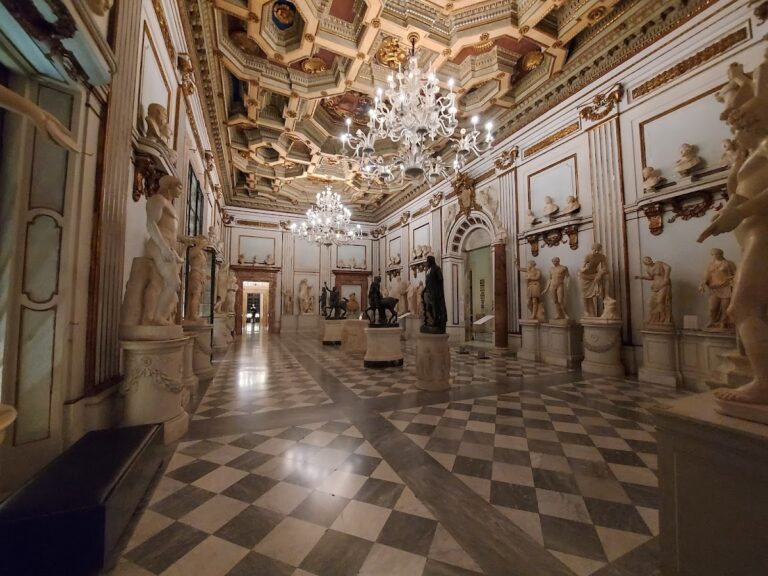
The Gallery of the Horti displays sculpture and architectural decoration recovered from Roman villa-and-garden estates. The Horti Lamiani rooms contain Greek funerary stelae, the Ephedrismos group, an alabaster floor from a subterranean gallery approximately 80 metres long, and opus sectile, a technique that forms patterns by fitting cut pieces of colored stone or marble.
Among the sculptures are the Esquiline Venus with two related female figures, Commodus as Hercules between Tritons, a statue of Dionysus, and a Roman copy of the Diadumenos of Polykleitos. The Horti Tauriani and Horti Vettiani rooms contain statues of Hygieia, Artemis, and a related female figure, together with garden reliefs, portraits of Hadrian, Sabina, and Salonia Matidia, and two large craters probably used as fountain basins.
The Horti of Maecenas rooms contain herms associated with Maecenas’ literary circle, a signed Neo-Attic rhyton fountain by Pontios, dancing maenads, an Amazon head, the pavonazzetto-marble Marsyas, figures identified as Muses, and a rare green Egyptian-marble guard dog. A fragmentary Greek funerary stele, a colossal Roman copy of Demeter, and a dynamic figure copied from a late-fourth-century BC Greek bronze are also displayed.
Late nineteenth-century excavations reunited the marble charioteer and horse now shown in the gallery. The horse was found in 1873 in a late Roman wall, while the charioteer was found in 1874 near Sant’Eusebio. The reconstructed group shows a nude male figure on a chariot drawn by two horses and has been interpreted as Theseus abducting Antiope, although the supposed Amazon figure is missing.
Picture Gallery and Modern Fasti
The Capitoline Picture Gallery occupies nine rooms on the second floor. Its paintings are attributed to artists including Titian, Caravaggio, Peter Paul Rubens, Annibale Carracci, Guido Reni, Guercino, Mattia Preti, Pietro da Cortona, Domenichino, Giovanni Lanfranco, Dosso Dossi, and Benvenuto Tisi.
The rooms of the Modern Fasti contain inscriptions recording Rome’s civic magistrates from 1640 onward. They also display two Roman copies of fourth-century BC athletes and a sarcophagus decorated with a Dionysiac procession.
Monumental remains in the glazed Exedra
Marcus Aurelius and Constantine
The glazed Exedra of Marcus Aurelius shelters the original equestrian statue of Marcus Aurelius, the gilded bronze Hercules from the Forum Boarium, fragments of the colossal bronze Constantine, and remains of the Temple of Jupiter Capitolinus. The bronze fragments of Constantine include the head, hand, and globe. They entered the Capitoline collection through Sixtus IV’s donation of 1471, and the head has been associated with portraits of Constantine late in his reign.
The gilded bronze Hercules was discovered under Sixtus IV. It probably served as the cult image in the round temple dedicated to Hercules in the second century BC and reflects fourth-century BC Greek models associated with Lysippos.
Temple of Jupiter Capitolinus
The remains of the Temple of Jupiter Capitolinus consist chiefly of massive foundations made from cappellaccio blocks. The temple was dedicated to Jupiter, Juno, and Minerva, the Capitoline triad of Rome’s principal divine protectors. It occupied a dominant position on the hill and was systematically dismantled in late antiquity for its valuable materials. Its ancient floor stood considerably higher than the present museum level, approximately at the height of the current Caffarelli Terrace.
Sant’Omobono temple
The Exedra also presents remains from an archaic temple discovered near Sant’Omobono beside the Tiber. Probably dating from the sixth century BC and perhaps dedicated to Mater Matuta, the temple preserves a podium approximately six metres below the current ground level, mud-brick construction, and polychrome terracotta roof decoration.
Its archaic Corinthian-type pedimental decoration includes plaques with felines and part of a Gorgon, together with chariot-procession plaques, large roof volutes, sphinxes, and roof statues. Terracottas associated with rebuilding under Tarquinius Superbus include a central acroterion showing Heracles being introduced to Olympus by Athena. A votive deposit behind the temple contained local impasto and bucchero vessels, imported Greek and eastern ceramics, female-associated objects, and an ivory lion cub bearing an Etruscan inscription.
Nearby sites