Palazzo Nuovo: A Renaissance and Baroque Museum Palace in Rome
Site at a Glance
- Rating
- 4.8
- Popularity
- Very Low
- Country
- Italy
- Primary era
- Classical
- External website
- Open
- Eras represented
- Classical
- Civilizations
- Ancient Greek, Egyptian, Ptolemaic, Roman
- Site type
- Museum
On this page30 sections
History
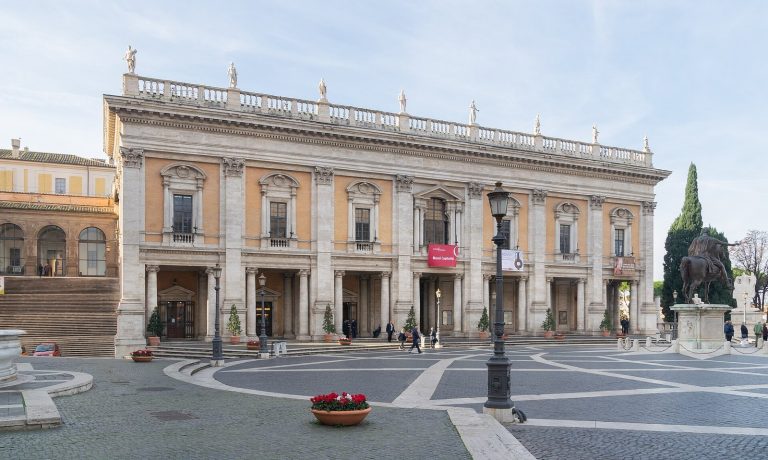
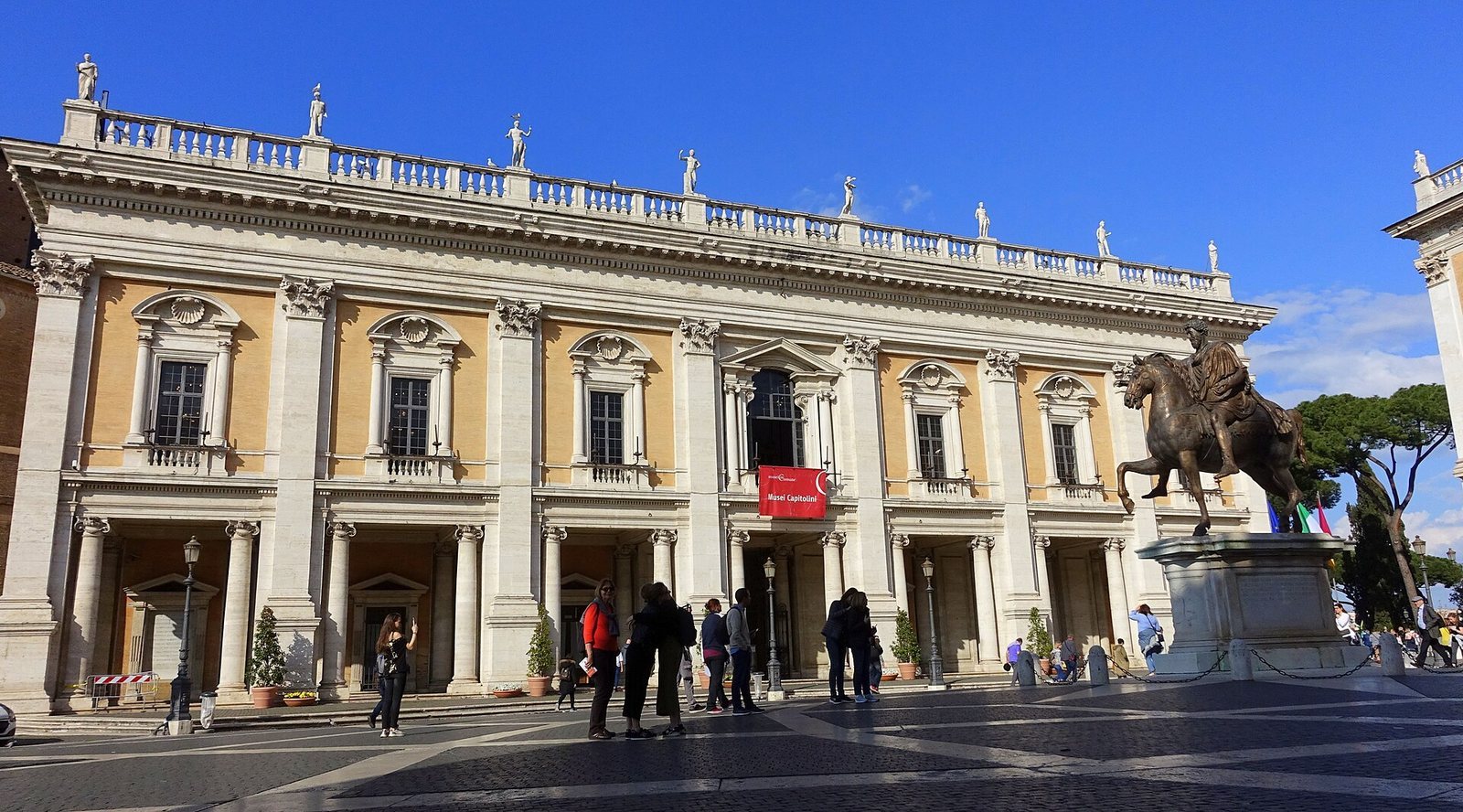
Palazzo Nuovo is a Renaissance and Baroque palace in Rome, Italy, built as the symmetrical counterpart to the Palazzo dei Conservatori on Piazza del Campidoglio. It forms part of the Capitoline Museums, Rome’s civic antiquities museums, whose collections made ancient sculpture accessible in an organized public setting.
Michelangelo’s Capitoline redesign
Michelangelo’s redesign of the Capitoline complex began in 1537. The scheme reorganized the Palazzo dei Conservatori, the Palazzo Senatorio, and the planned Palazzo Nuovo around a newly conceived square. Although Michelangelo died before Palazzo Nuovo was finished, its main facade is attributed to him.
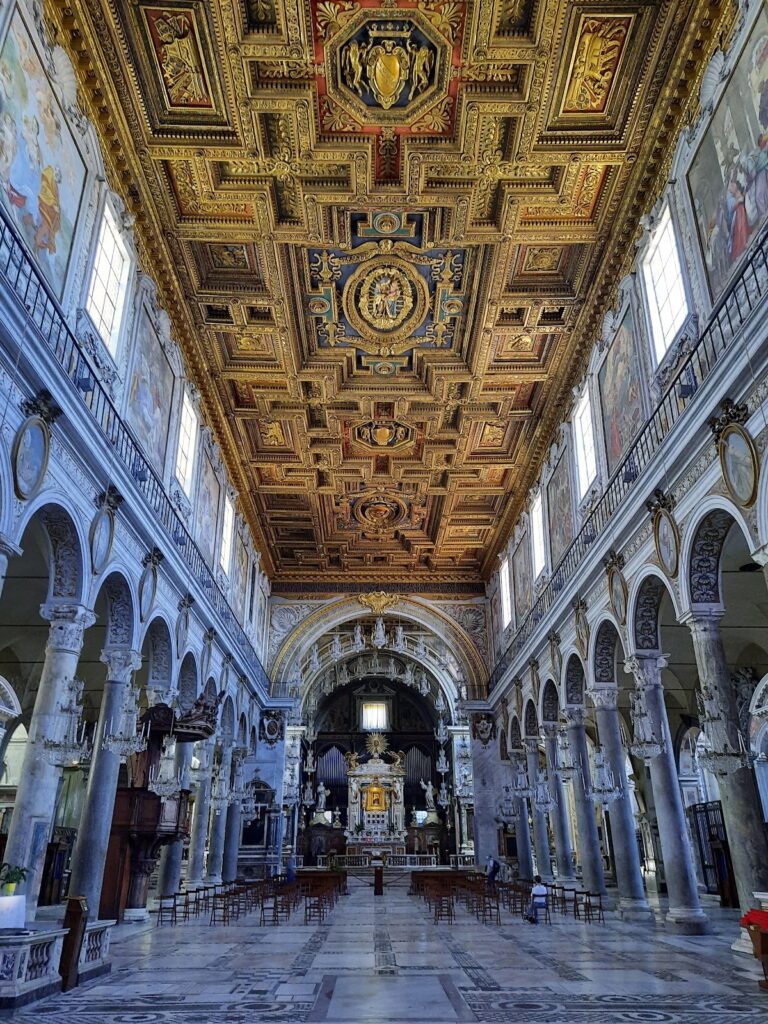
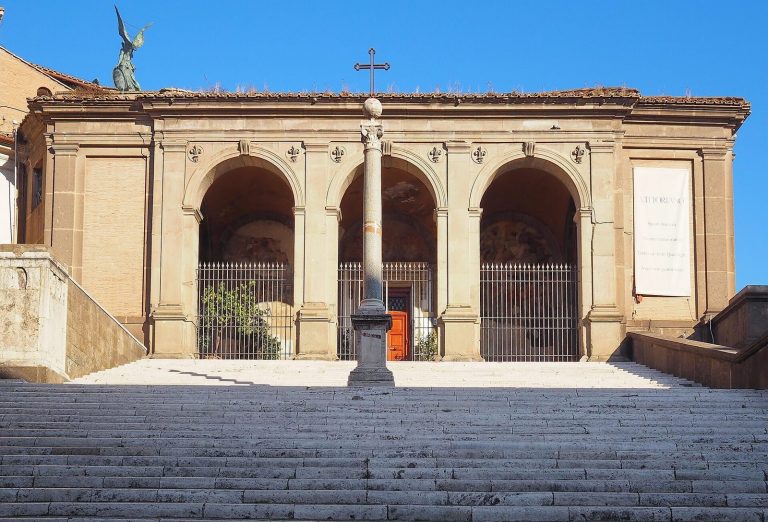
The palace was intended to mirror the Palazzo dei Conservatori across the piazza. Its slightly oblique alignment with the Palazzo Senatorio completes the trapezoidal, funnel-shaped composition of Piazza del Campidoglio and closes the view toward the Basilica of Santa Maria in Aracoeli. This position made the new building part of a larger architectural design rather than an isolated palace.
Construction and seventeenth-century development
Demolition and foundation work began in 1571. Construction was formally advanced in 1603, when Pope Clement VIII secured financing through a loan and laid the first stone. The main building campaign ended in 1654 under Pope Innocent X. Girolamo Rainaldi first directed the work, and his son Carlo Rainaldi completed the palace in 1663, when it opened as an exhibition venue.
The first phase produced the facade and the portico bay behind it. In the second phase, the slope toward Aracoeli was excavated and an embankment supporting the Marforio fountain was removed. The fountain and its statue were dismantled and reinstalled in the palace courtyard. Development continued under Pope Alexander VII and Pope Clement X, who commissioned the wooden ceilings of the principal rooms.
At one stage, the building was granted to the Corporation of the Arts of Wool and Silk. An inventory then listed 44 sculptures, and the number rose to 50 when the palace was later granted to the Arts of Agriculture in 1698. These uses preceded the palace’s lasting role as a museum.
Creation of the public museum
In 1733, Pope Clement XII established a new public collection of antiquities at the Capitoline Museums according to modern museum principles. The acquisition of Cardinal Alessandro Albani’s collection brought at least 418 sculptures gathered from earlier collections, excavations, and chance discoveries. Acquisitions and donations made under Pope Benedict XIV between 1745 and 1750 enlarged the holdings further.
The rooms were arranged as an itinerary that emphasized the documentary value of sculpture. Roman stonecutters restored many mutilated statues, sometimes reconstructing their forms according to learned interpretations. The Capitoline Museums occupied exhibition rooms in Palazzo Nuovo from 1734, and the palace’s early public antiquities collection became a model for major museums elsewhere.
Internal transfers and alterations took place from 1812 to 1818. Sculptures from Santa Maria in Aracoeli entered the collection, and in 1816 the first ground-floor room on the right became the Lapidary Room, together with a smaller room called the Urn Room. Palazzo Nuovo has continued to serve museum purposes since the nineteenth century. The original bronze equestrian statue of Marcus Aurelius has been kept there since 1990. The palace and its collections are now part of the Capitoline Museums and are owned by the Italian state.
Remains
Palazzo Nuovo preserves a facade modeled on the Palazzo dei Conservatori, a portico, a central atrium, an internal courtyard, ground-floor galleries, and first-floor exhibition rooms. The building alternates rendered and travertine-clad surfaces, with niches, aedicules, and varied display areas designed from the outset for Greek and Roman antiquities. Latin and Greek inscriptions and important reliefs were later installed among these surfaces.
Facade, atrium, and courtyard
Facade and portico
The facade reproduces that of the Palazzo dei Conservatori, including its ground-floor portico. Together, the two buildings face one another across Piazza del Campidoglio, while their oblique alignment contributes to the square’s trapezoidal plan. The palace’s recovered original color is sky blue. Terracotta floors were replaced by large marble slabs during the nineteenth and twentieth centuries, while later work uncovered original carved wooden coffered ceilings, partly decorated with stucco and frescoes.
Atrium
The Atrium contains a portico for large statues and masterpieces donated to Rome that had previously been in the Belvedere collection. Barrel and cloister vaults alter the light within the central space, which opens toward the courtyard. Large ornamental shells decorate the upper zone, and mainly funerary Roman inscriptions are set into the walls.
Courtyard and Marforio fountain
The courtyard is a small internal square reached through the atrium, an exterior passage, the main doorway, and a gate. Curved brick curtain walls frame the fountain basin and the niche containing the colossal Marforio. Four cipollino-marble columns stand beside the fountain, together with two waterspouts shaped as lion foreparts. Marble busts that once crowned the columns were moved to the museum for conservation in the middle of the twentieth century.
Marforio was found in the sixteenth century near the Forum of Mars, traditionally associated with the Forum of Augustus. The reclining figure is generally attributed to the Flavian period, probably the first century. Ruggero Bescapè restored it in 1594 with attributes of Oceanus, and the statue is commonly understood as the Tiber or another river deity. During the Renaissance it became famous as a support for pasquinades, satirical or defamatory public texts directed against political or religious authorities.
In 1734, Pope Clement XII placed a commemorative plaque for the inauguration of the Capitoline Museums on the new fountain and added his arms. Four statues once stood on the terminal balustrade before being replaced by four busts. A portrait of Pope Corsini was later placed at the center, where its scale contrasts with Marforio’s colossal size.
Courtyard sculptures
Two rectangular, travertine-framed niches contain the mirror-image Satyrs della Valle. Found near the Theatre of Pompey and formerly kept in the courtyard of Palazzo della Valle, they represent Pan carrying fruit baskets and date from the late Hellenistic period. They may once have served as architectural supports in the theatre.
The courtyard also contains a strigillated sarcophagus with hunting scenes, two busts, and two bearded herms set into small travertine-framed niches above former doorways. An inscription of Pope Alexander VII is placed above them. Three gray granite columns from Rome’s Temple of Isis stand in the courtyard. Their shafts carry relief friezes comparable to partly embedded carved columns, showing four pairs of priests on high stools. Some offer objects to a deity, while others extend sacred objects. Their shaven heads, laurel wreaths, and short garments contrast with the long-robed, veiled figures carrying canopic vessels.
Egyptian antiquities and ground-floor rooms
Egyptian Monuments Room
The Egyptian Monuments Room opens from the courtyard and is separated from it by a large glass wall. It displays substantial granite works, including a bell-shaped vessel from the Canopus at Hadrian’s Villa decorated with feline protomes, or representations of animal heads or upper bodies. Other Egyptian-related sculptures came from the Temple of Isis, Hadrian’s Villa, and Roman excavations.
The collection includes a pink Aswan-granite crocodile representing Sobek, an Egyptian crocodile deity, and two gray-granite cynocephali representing Thoth, a lunar god associated with writing and knowledge. A hawk, a scarab, and a basalt sphinx on a rectangular plinth complete the principal group. The sphinx belongs to a figurative class of the Ptolemaic period, corresponding to the first Roman imperial period. A statue of Harpocrates, the Greco-Roman form of the Egyptian child deity Horus, was found in a substructure room of the Poecile at Hadrian’s Villa in 1741 and given to the museum by Benedict XIV in 1744. The nude youth stands beside a fruit-bearing palm, raises a finger to his lips in a gesture of silence, and wears a hairstyle and crown recalling the pschent. Its treatment of the hair and irises suggests a Hadrianic date.
Small ground-floor rooms
The three ground-floor rooms to the right of the Atrium were originally connected with the portico. Between the eighteenth and nineteenth centuries they were also used for private purposes before becoming museum rooms. Their contents include fragments of post-Caesarian Roman calendars, the Fasti Minori, lists of magistrates, Roman portraits, and epigraphic monuments.
One portrait may represent Germanicus or Nero Claudius Drusus and dates to the middle of the first century. The funerary altar of Titus Statilius Aper and Orcivia Anthis, found on the Janiculum, was transferred to the Capitoline Museum by Benedict XIV in 1743. Dated to the first century, it is carved on three sides. Its unfinished back contains a cavity for ash vessels, its inscriptions identify the deceased and their relationships with the dedicator, and its sides show Statilius’s working tools.
An Attic klinē sarcophagus, whose couch-like lid shows the deceased reclining, was found near the Porta San Giovanni between the ancient Via Latina and Via Labicana in or shortly before 1582. Reliefs cover all sides and depict episodes from the life of Achilles, including his discovery at Skyros, his preparation to fight Hector, and Priam’s request for the return of his son’s body. The unfinished low-relief back may have been intended to stand against a tomb wall.
Gallery and first-floor sculpture
Gallery
The Gallery runs along the full length of the first floor and connects the exhibition rooms. Its eighteenth-century arrangement emphasizes architectural symmetry and ornament rather than a historical or archaeological sequence. Small inscriptions are set into wall panels, including a substantial group from the columbarium of Livia’s freedmen and freedwomen. A columbarium was a Roman funerary structure containing niches for cremation urns. Sarcophagus reliefs are incorporated into the wall behind the double staircase.
The Gallery displays a heavily restored fragment of Hercules’s leg, a wounded warrior whose ancient portion is the torso, Leda with the Swan, a statuette of the infant Heracles strangling a serpent, and Eros Stringing His Bow. Pierre-Étienne Monnot reworked the wounded warrior between 1658 and 1733 from a torso related to Myron’s Discobolus. The infant Heracles has at different times been identified as the young Caracalla and, more recently, as Annius Verus, son of Marcus Aurelius. Leda may derive from a group attributed to Timotheos, while Eros is an early imperial Roman copy of a work by Lysippos.
Colossal Hercules
The colossal Hercules was discovered during rebuilding at Sant’Agnese in Agone and extensively restored by Alessandro Algardi in the seventeenth century. The restoration changed the subject from Heracles taming the hind of Ceryneia to Heracles fighting the Lernaean Hydra. The statue is generally dated to the second century and derives from a Greek creation attributed to Lysippos.
Hall of the Doves and the Cabinet of Venus
Hall of the Doves
The Hall of the Doves retains much of its eighteenth-century arrangement and takes its name from the Doves Mosaic, a floor emblema discovered at Hadrian’s Villa in Tivoli. The room was first called the Room of Miscellanies and was called the Vase Room in 1817 after a large vegetal-decorated marble vessel was installed there. Portraits stand on shelves in an eighteenth-century display, while Roman funerary inscriptions placed high on the walls in the mid-eighteenth century remain in their original arrangement.
The room contains a third-century bronze tablet recording the college of the Fabri of Sentinum granting Coretius Fuscus the honorary title of patron. The first-century BC Tabula Iliaca, a miniature-style relief fragment, shows scenes from the Iliad with explanatory inscriptions. A bronze inscription from the Aventine records a dedication to Septimius Severus and the imperial family made in 203 by the vigiles of Rome’s Fourth Cohort. Other documents include Pompeius Strabo’s decree granting privileges to Spanish equestrians who supported Rome at the Battle of Asculum during the Social War of 89 to 90 BC, and a nearly complete senatorial decree concerning Asclepiades of Clazomenae and his allies, dated to 78 BC.
Mosaics and genre sculpture
The Girl with a Dove shows a child hiding a dove from a snake beneath her cloak. The snake is a modern restoration, and the statue is a Roman copy of a Hellenistic original concerned with childhood and daily life. The Doves Mosaic shows four doves on the rim of a bronze vessel, with one bird drinking. Its polychrome emblema uses extremely fine marble, stone, and glass tesserae within an astragal border. The composition closely follows a work by Sosos of Pergamon, active in the second century BC. A former outer garland from the Albani collection is now in Dresden.
The Theatre Masks Mosaic was found in 1824 in a vineyard on the Aventine, opposite Santa Prisca, at the site of baths built by the emperor Decius. Acquired by Pope Leo XII, it is a second-century, probably Hadrianic, mosaic of marble tesserae showing female and male types of New Comedy, with two masks and two flutes casting shadows. A statue of an old woman clutching a wine vessel belongs to a Hellenistic series depicting people overwhelmed by vice and the hardships of daily life. It may copy a third-century BC work made at Smyrna by a sculptor named Myron.
Cabinet of Venus
The polygonal Cabinet of Venus resembles a nymphaeum, an ornamental fountain room inspired by ancient settings associated with nymphs. It houses the Capitoline Venus, reportedly found near the Basilica of San Vitale during the pontificate of Clement X. Benedict XIV acquired it from the Stazi family in 1752, and it returned permanently to the museum in 1816 after the disruptions associated with the Treaty of Tolentino.
Portrait halls
Hall of the Emperors
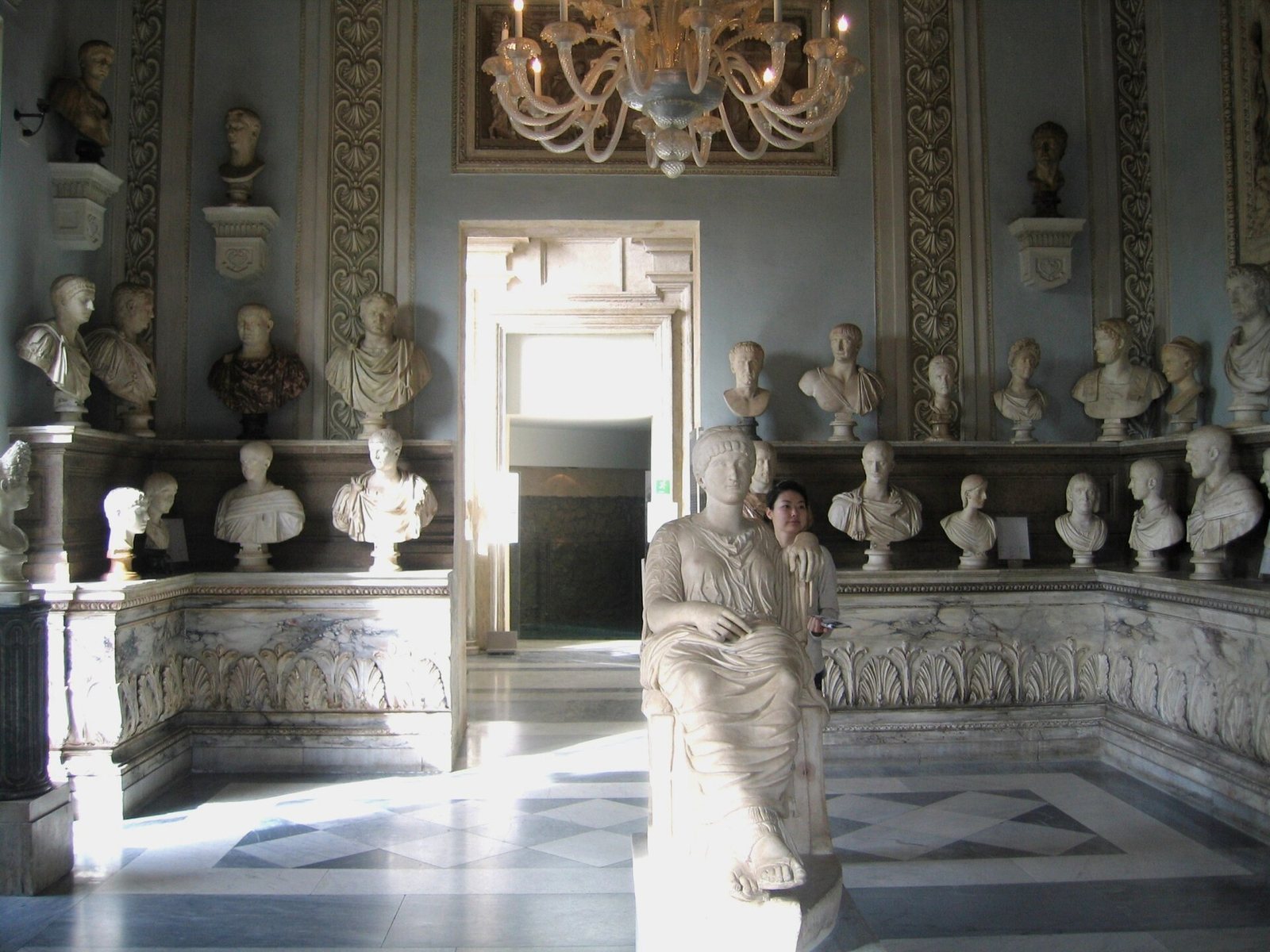
The Hall of the Emperors contains 67 portrait busts, a seated female statue, eight reliefs, and a modern honorary inscription. The busts stand mainly in two rows on marble consoles, creating a chronological survey of Roman portraiture from the Republic to late antiquity. The sequence ends with Flavius Honorius, son of Theodosius I, and follows a clockwise, spiral-like route through the room.
The portraits include Augustus in youth and maturity, Livia, Agrippina the Elder, Nero, Vespasian, Titus, Nerva, emperors from Trajan to Commodus, members of the Severan dynasty, Plotina, Faustina, and Julia Domna. They show changing male hairstyles and beards, as well as elaborate female coiffures, wigs, and curls. The Flavian dynasty ruled from AD 69 to 96, while the Severan dynasty ruled from AD 193 to 235.
Hall of Philosophers
The Hall of Philosophers contains 79 portraits, busts, and herms of Greek poets, philosophers, and rhetoricians, together with some Roman portraits. Homer, Pindar, Pythagoras, Socrates, Aeschylus, Sophocles, Euripides, and Cicero are represented. Some portraits are later reconstructions rather than accurate likenesses, while others reproduce their subjects with greater precision.
Salon and major mythological sculpture
Salon
The Salon is the most monumental room in the Capitoline complex. Its four walls are divided into vertical sections corresponding to the room’s architectural composition. A large portal designed by Filippo Barigioni in the first half of the eighteenth century connects the Salon with the Gallery, and the portal carries two winged Victories.
The room displays Apollo with the Omphalos, Harpocrates, Apollo Citharoedus, the Wounded Amazon of the Sosikles type, and the large bronze statues of the Old and Young Centaurs. Busts of Caracalla or Geta, Marcus Aurelius, Augustus, and Hadrian occupy a higher level. Apollo Citharoedus was acquired by Clement XII from the Duke of Palombara in 1734. It is a Roman copy of the Lycian Apollo associated with Praxiteles, altered by replacing the bow with a kithara resting on a tripod. The type may represent a later variant by Timarchides.
Apollo with the Omphalos is a Roman copy of a Greek original attributed to Calamis. Its name comes from the omphalos preserved on a related copy in Athens. The statue may represent Apollo Alexikakos or the prototype of an Apollo by Onatas. Its large anatomical forms, benevolent expression, and tightly braided hair mark a transition from the Severe Style, an early fifth-century BC Greek style between Archaic and Classical art, to the Classical style.
Wounded Amazon
The Wounded Amazon, also called the Sosikles type after the signature on the copy, is slightly larger than life-size and is generally attributed to Polykleitos. One raised arm may originally have held a spear, while the other lifts the drapery to reveal the wound. The figure was completed by Napoleoni.
Old and Young Centaurs
The Old and Young Centaurs were discovered at Hadrian’s Villa by Cardinal Giuseppe Alessandro Furietti and acquired for the Capitoline Museums by Clement XIII in 1765. Made of gray marble and signed by Aristeas and Papias of Aphrodisias, they probably date to Hadrian’s time. The young centaur appears joyful and playful, while the old centaur is sick and suffering. Their hair, beards, and tails imitate metallic effects and may derive from bronze originals.
Faun and Galata halls
Hall of the Faun
The Hall of the Faun contains inscriptions arranged in eighteenth-century groups, including brick stamps and the Lex de imperio Vespasiani, a first-century decree conferring special powers on Vespasian. The text was written during the casting of the bronze rather than engraved, and its presence on the Capitoline is recorded from the fourteenth century.
The Faun statue was found in 1736, restored by Clemente Bianchi and Bartolomeo Cavaceppi, and acquired by the museum in 1746. It has a dancing pose, a fawn skin tied over one shoulder, a furry tail, strongly modeled musculature, and empty eye sockets probably intended for metal or hard-stone inlays.
Hall of the Galata
The Hall of the Galata takes its name from the Dying Gaul, which was long and incorrectly considered a gladiator falling on his shield. Alessandro Capponi, president of the Capitoline Museums, purchased it in 1734, after which it became one of the collection’s most famous works and was repeatedly reproduced in engravings and drawings.
The Dying Gaul is displayed with the Wounded Amazon, the Capitoline Hermes-Antinous, the Resting Satyr, and the Rococo group Cupid and Psyche. The Wounded Amazon in this room was found at the Villa d’Este, formerly within the ancient area of Hadrian’s Villa. Benedict XIV gave it to the museum in 1753. It was transferred to France under the Treaty of Tolentino, the 1797 agreement by which the Papal States ceded works of art to revolutionary France, and returned in 1815. Extensive restoration by Bartolomeo Cavaceppi makes its original type difficult to determine.
Benedict XIV also gave the Resting Satyr to the Capitoline Museums in 1753. It underwent the same transfer to France and return in 1815. The figure leans on a tree trunk in a relaxed, oblique pose and has pointed animal ears. Traces of yellow preparation on the hair may indicate intended gilding. It is interpreted as a Roman copy of Praxiteles’ Resting Satyr.
Other principal works associated with Palazzo Nuovo include the Fauno Rosso, a red-marble drunken faun from Hadrian’s Villa; the Capitoline Antinous, a copy of a fourth-century BC Hermes; a bust of Augustus with a jeweled crown; and the Galata, derived from the Hellenistic series of the so-called Great Gauls.