The Patriarchate Court, Sremski Karlovci: Patriarchal and Episcopal Palace


Site at a Glance
- Rating
- 4.8
- Popularity
- Low
- Country
- Serbia
- Primary era
- Modern
- Eras represented
- Modern
- Civilizations
- Habsburg
- Site type
- Religious
- Remains
- Palace
On this page6 sections
History
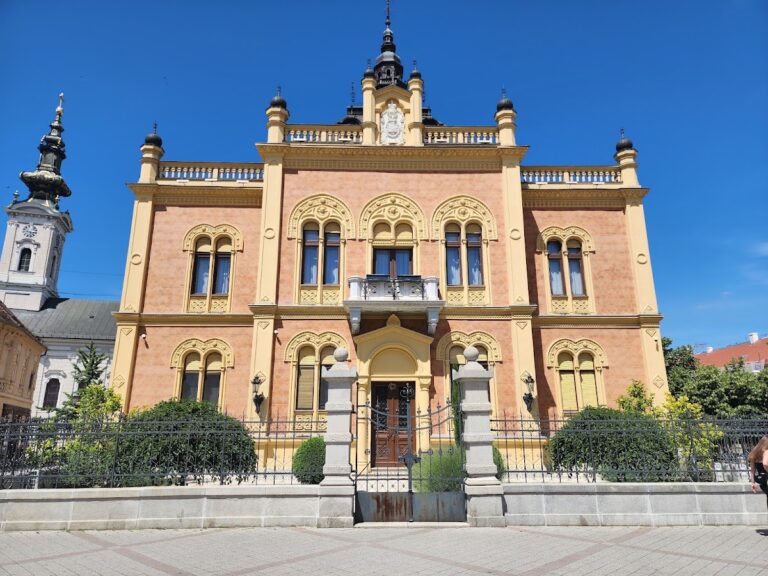
The Patriarchate Court, Sremski Karlovci, is a Serbian Orthodox palace in Sremski Karlovci, Serbia, built between 1892 and 1895 in an eclectic historicist style combining Neo-Renaissance and Neo-Baroque elements. It stands on the site of the former Pasha’s Konak, an earlier residence associated with the transfer of the head of the Serbian Orthodox Church from Peć to Sremski Karlovci.
Origins and construction
The idea of a new residence for the Serbian Orthodox patriarchate, the institutional seat of a patriarch, was initiated by Metropolitan Stefan Stratimirović. In 1817, he established a construction fund for the project. The palace was eventually built during the tenure of Patriarch Georgije Branković. Belgrade architect Vladimir Nikolić designed the building, while Peklo Bela and Karlo Lerer carried out its construction. Its Italian palace inspiration was adapted into a large ecclesiastical residence with a formal and highly articulated exterior.
An ecclesiastical and administrative seat
The palace became the seat and episcopal palace of the Eparchy of Srem, a territorial jurisdiction of the Serbian Orthodox Church governed by a bishop. It served as the seat of the Patriarchate of Karlovci from 1848 to 1920. After the unification of the Serbian Orthodox Church in 1920, it functioned as the church’s unofficial seat until 1930, when Serbian Patriarch Varnava transferred the episcopal seat to Belgrade.
From 1921 to 1944, the palace also housed the administration of the Russian Orthodox Church Outside Russia. It remains the summer residence of the patriarch of the Serbian Orthodox Church and contains the Church Museum and its treasury. The building is listed in Serbia as a Cultural Heritage Site of Exceptional Importance under designation SK 1034.
Remains
Palace plan and exterior
The palace has a basement, a ground floor, and one upper floor arranged on a plan resembling the shape of a Cyrillic letter. Its central section contains a porte-cochere, an entrance through which carriages could pass, while a high enclosure combines brickwork with cast iron. The main facade is organized around a projecting central section, a terrace or balcony, a monumental entrance staircase, and a dome. Similar projections mark the corners of the building.
The central projection is defined by columns and pilasters on the first floor, three larger central windows, and a rooftop observation post. Across the facade are seventeen window openings with semicircular tops. Shallow pilasters, Ionic consoles, and rails beneath the windows add further layers of Renaissance and Baroque-derived detail to the composition.
Chapel and ecclesiastical collections
The palace contains a chapel dedicated to Saint Dimitri, an early Christian martyr especially venerated in Eastern Christianity. Its hemispherical dome is topped by a lantern. Serbian painter Uroš Predić, known for religious and historical works, decorated the chapel’s iconostasis, the screen separating the sanctuary from the main worship space, as well as its thrones, stained-glass windows, and frescoes. He continued this work until 1896.
The museum collections include icons and iconostases belonging to the Eparchy of Srem that are no longer used for worship. Portraits of metropolitans and senior Church dignitaries, together with objects of the decorative and applied arts, preserve aspects of the institution’s ecclesiastical history. The treasury’s permanent display includes eighteenth- and nineteenth-century objects from churches destroyed in Bosnia and Croatia. Among its holdings are a Zsolnay porcelain stove and a fifteenth-century manuscript, while the library contains manuscripts, rare books, and valuable old printed books.
Nearby sites