Schloss Schöningen: A Welf Hunting Lodge and Palace in Germany


Site at a Glance
- Rating
- 4.4
- Popularity
- Low
- Country
- Germany
- Primary era
- Early Modern
- External website
- Open
- Eras represented
- Medieval, Early Modern, Modern
- Civilizations
- German, Holy Roman Empire
- Site type
- Domestic
- Remains
- Palace
On this page12 sections
History
Schloss Schöningen is a medieval castle and later palace in Schöningen, Germany, founded around 1350 by Welf duke Magnus I of Brunswick-Lüneburg as a hunting lodge and border fortress. The Welfs were a German ruling dynasty whose branches governed Brunswick-Lüneburg and related territories for centuries. The castle faced the territories of the bishops of Halberstadt and Magdeburg and later became one of the most splendid buildings near the Elm. Welf dukes and their entourages frequently stayed there during driven hunts, including one hunt in which 3,000 beaters reportedly entered the Elm.
From fortress to palace
At the beginning of the sixteenth century, the fortified complex was converted and enlarged as a palace. Until the seventeenth century, it served three Brunswick duchesses as a widow’s residence and also became the seat of the Schöningen administrative office. These duchesses substantially shaped the palace’s development.
Sophia Jagiellonica, a Welf duchess and sister of the Polish king Sigismund II Augustus, lived at Schloss Schöningen from 1568 to 1575. She commissioned a pleasure garden, which no longer survives. Elisabeth of Denmark, sister of King Christian IV of Denmark, resided there from 1613 to 1626. During her residence, she completely remodelled the principal residential building, known as the Palas, in the Renaissance style and commissioned new west and north wings.
Anna Sophia, born a Brandenburg princess, used the palace from 1628 to 1659 and ruled from there almost independently. The establishment of a Latin school in Schöningen’s market square is attributed to her. A Latin school centred on the study of Latin, the principal language of administration, scholarship, and higher education in early-modern Europe.
War, de-fortification, and courtly residence
The complex was damaged in 1542 during the Schmalkaldic War, a conflict between the Protestant Schmalkaldic League and Catholic imperial forces. The league included Protestant princes and cities, and its conflict with Duke Henry the Younger of Brunswick-Wolfenbüttel brought the war directly into the palace’s history.
In 1661, Duke Augustus II ordered the complex to be de-fortified and its arsenal demolished. Katharina of Brandenburg had previously used the palace as a residence and died there in August 1644. Before Anna-Sophie, the second daughter of Duke Anton Ulrich of Brunswick, lived at the palace from 1679 to 1683, her sister Katharina had occupied it.
Schloss Schöningen continued to host members of the ruling courts. On 25 January 1681, it was the setting for the marriage of Elisabeth Eleonore of Brunswick-Wolfenbüttel and Duke Bernhard I of Saxe-Meiningen. In 1733, the Prussian crown prince Frederick, later King Frederick the Great, stayed overnight at the palace while travelling to his wedding with Elisabeth Christine of Brunswick-Wolfenbüttel-Bevern at Salzdahlum Palace.
Administrative decline and restoration
After the Schöningen administrative seat was transferred to Helmstedt in 1815, the palace was downgraded to a domain, an estate administered as a source of state or princely revenue. The Palas and ancillary buildings subsequently fell into decay, while agricultural operations continued on the site until 1970.
In 1970, the state of Lower Saxony sold the buildings to private owners, while the town of Schöningen initially acquired only the surrounding open land. Between 1978 and 1983, the town bought three wings of the palace quadrangle, including the completely derelict Palas, as well as the former district-court garden south of the palace.
Restoration began with the Marstall, the former stable complex for horses, carriages, and related services, which was converted into a youth centre. An information centre of the Unteilbares Deutschland Committee, dedicated to German reunification, was later established at the complex. After the town acquired the palace domain’s former tenant’s house, built in 1911, the tenant’s house, Palas, and gardener’s house were restored from 1985 onward. The restored palace opened to the public in 1996. The Baroque garden was restored in 1997–1998, and the guardhouse was restored by 2000.
Remains
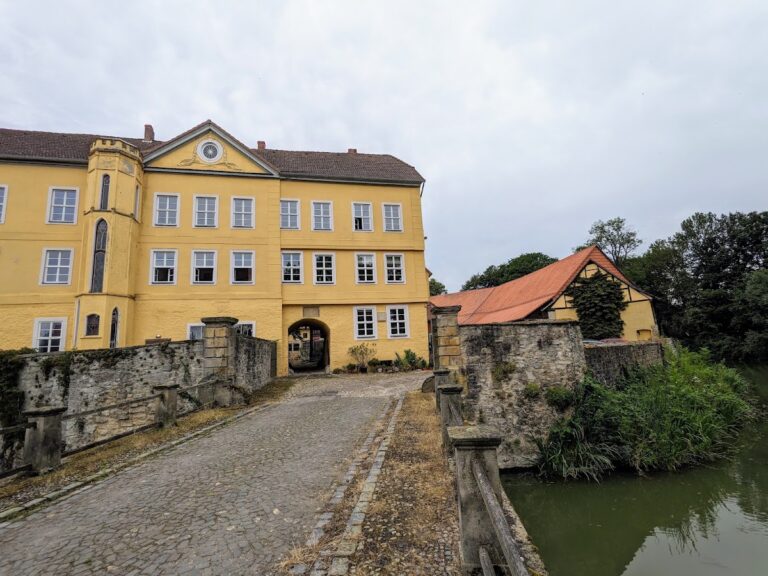
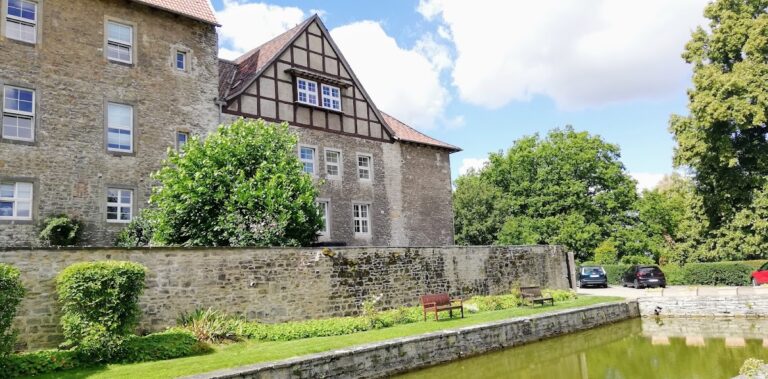
Schloss Schöningen is a lowland castle whose later palace forms a four-wing complex. Extensive alterations in the sixteenth and seventeenth centuries, followed by adaptations for agricultural use, changed the buildings, while the ground plan of the late-medieval complex remains legible. The surviving buildings and gardens include the palace wings, corner towers, former chapel, Marstall, domain buildings, and formal garden areas.
Palace quadrangle
Palas
The lower structure of the palace preserves remains of the old Palas, the principal residential and representative building of a medieval castle or palace. It was later completely remodelled in the Renaissance style. The building was among the parts of the complex that fell into severe decay after the administrative seat moved to Helmstedt, and it was restored from 1985 onward.
East wing and corner towers
The east wing is flanked at its corners by two square towers with tent roofs. The southern tower has sides measuring approximately seven metres and walls about two metres thick, giving the surviving wing and towers a clear connection with the defensive character of the earlier castle.
Former palace chapel
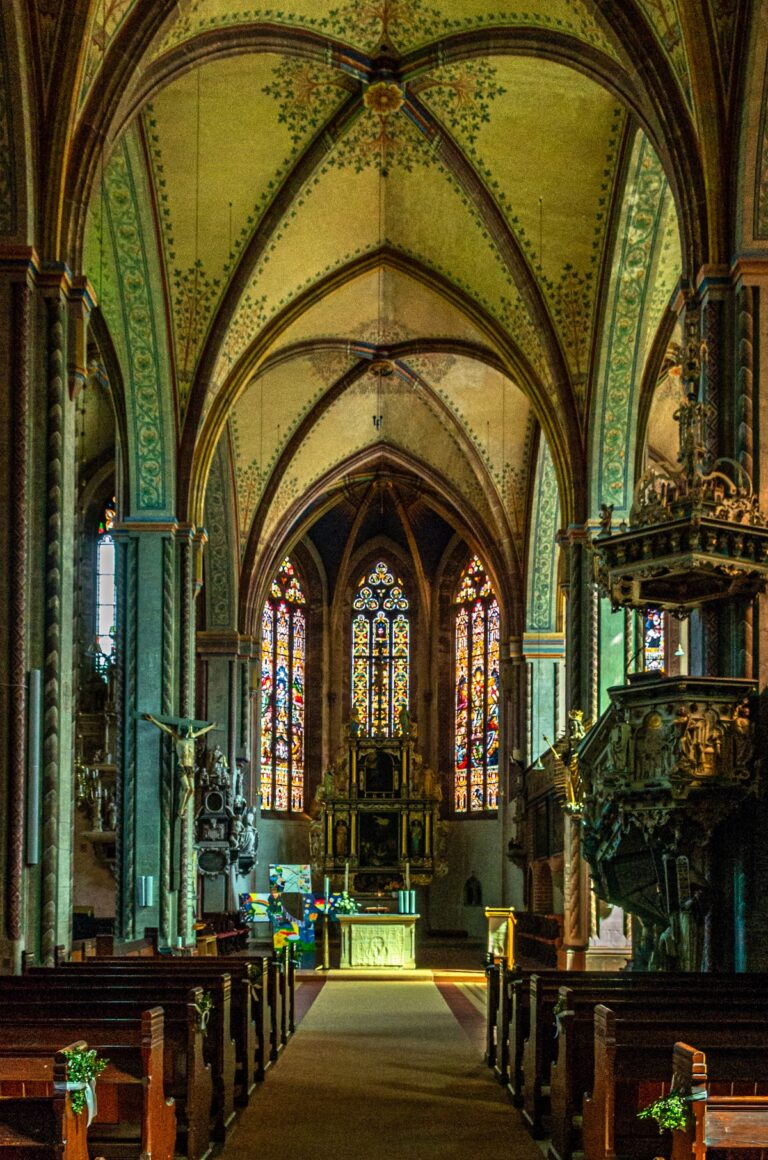
The former palace chapel is located in the south wing. Its surviving architectural feature is a ribbed vault, a ceiling formed by intersecting masonry ribs.
Gardens and ancillary buildings
Palace gardens
The palace park borders the buildings and was redesigned by 1991. A symmetrical garden south of the palace dates from the 1990s, while the Baroque garden was restored in 1997–1998. These garden areas form part of the restored setting of the palace complex.
Marstall and domain buildings
The Marstall, or former stable building, was converted into a youth centre during the restoration campaign. The complex also includes the palace domain’s former tenant’s house, built in 1911, together with the gardener’s house and guardhouse. The tenant’s house and gardener’s house were restored from 1985 onward, and the guardhouse was restored by 2000.
Nearby sites