Elmsburg: A Medieval Hillside Castle in Germany


Site at a Glance
- Rating
- 4.3
- Popularity
- Very Low
- Country
- Germany
- Primary era
- Medieval
- Eras represented
- Bronze Age, Medieval, Modern
- Civilizations
- Crusader, Holy Roman Empire, Teutonic Order
- Site type
- Military
- Remains
- Castle
On this page11 sections
History
Elmsburg is a medieval hillside castle in Germany, situated above Twieflingen in the Schöningen Forest of Lower Saxony. Established from the eleventh century within a prehistoric ring-wall complex on the Elm ridge, it occupied a defensible position at approximately 270 metres above sea level.
Foundation and ecclesiastical ownership
The castle included a church by around the year 1000, when the earliest of three successive church buildings was in existence. In 1213, Emperor Otto IV transferred the church to the collegiate foundation at Scheverlingenburg, Walle. After that institution ceased to exist, Otto donated both the church and the castle to St. Blaise’s collegiate foundation in Braunschweig, a religious collegiate institution, in 1218.
Teutonic Order administration
In 1221, Count Palatine Heinrich transferred Elmsburg to the Teutonic Order, a medieval religious-military order that administered territorial estates through local commanderies. The Order established a commandery at Elmsburg, and under Duke Otto the Child its holdings expanded around 1240 to include forest and additional land.
The commandery continued acquiring property, but limited space at Elmsburg probably encouraged its transfer to Lucklum in 1264. This created the Teutonic commandery at Lucklum, while a smaller house commandery with its own commander remained at Elmsburg until 1318. Elmsburg was last recorded as a castle of the Order in 1364.
Decline and archaeological investigation
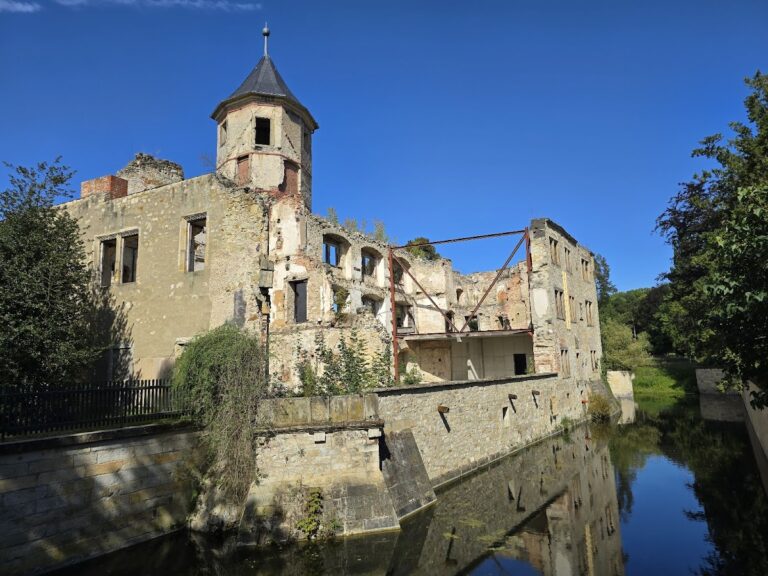
After the Teutonic Order’s period of ownership, Elmsburg was granted as a feudal holding to the noble von Ampleben family and later to bourgeois families. A major fire in 1572 was followed by the castle’s decline, and the site was abandoned during the sixteenth century. Stones were later taken from the remains to improve forest roads and for construction in Twieflingen.
A forester measured the site around 1840 and compared it with other castles on the Elm. Archaeological excavations followed from 1959 to 1962. A further investigation in 2018 exposed the complete ground plan of the church. Afterward, a heritage project partially reconstructed the church foundations, raising some foundation walls to as much as 90 centimetres, and reconstructed the altar.
Remains
Elmsburg lies within an oval prehistoric ring-wall enclosure measuring approximately 270 to 300 metres across. A ditch runs outside the earthwork, whose wall was built from earth without a stone core. The medieval castle occupied a smaller oval area about 114 to 137 metres in diameter. Its defenses included a southern wall, a ditch to the northwest, and a steep northeastern slope, while the prehistoric ring wall formed an outer defensive barrier.
Church foundations
Early castle chapel
The earliest church was a square castle chapel dating from around the year 1000. It measured 8 by 8 metres and ended in a semicircular apse, the rounded termination of a church. Its foundations form the first of three successive church buildings identified through excavation.
Eleventh-century Romanesque church
During the eleventh century, the chapel was enlarged into a Romanesque church, a medieval style associated with massive construction and rounded forms. The building measured 24 metres in length and 8 metres in width. It consisted of a nave, a semicircular apse, and two side wings, and was built with soft red sandstone obtained from a nearby quarry.
Thirteenth-century church
During the Teutonic Order’s period at Elmsburg, a new church was constructed largely over the earlier foundations. The later building used limestone from the Elm. Eight graves containing skeletons were found in the church floor. The exposed foundations were partially raised during the post-2018 heritage work, and the altar was reconstructed within the former church interior.
Castle features
Larger depressions in the castle grounds mark the collapsed cellars of earlier buildings. A castle well also survives and was restored during the archaeological work. Together with the church foundations, these features reveal parts of the medieval settlement within the enclosing defenses.
Early Bronze Age burial mounds
Outside the prehistoric wall are eleven burial mounds belonging to the Early Bronze Age Únětice culture, an archaeological culture of Central Europe associated with settlements and burial mounds. The mounds contained the skeletal remains of children. An open burial-mound grave forms part of the surviving archaeological features around Elmsburg.
Nearby sites