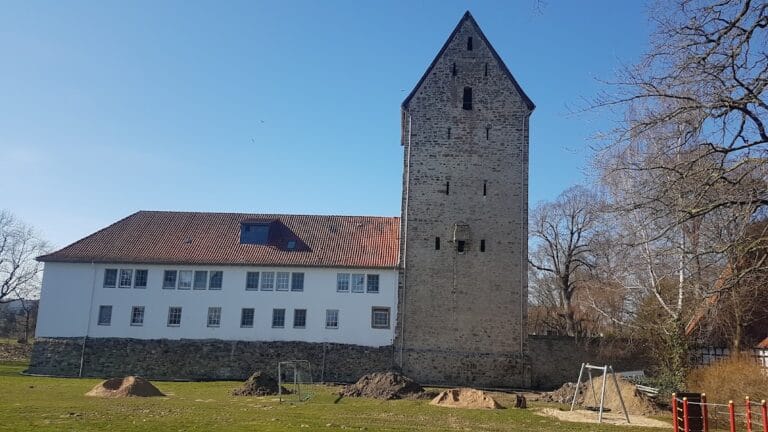
Schloss Benkhausen: A Historic Water-Castle Estate in Germany


Site at a Glance
- Rating
- 4.6
- Popularity
- Low
- Country
- Germany
- Primary era
- Early Modern
- External website
- Open
- Eras represented
- Early Modern, Modern
- Civilizations
- Brandenburg-Prussia, German, Holy Roman Empire
- Site type
- Domestic
- Remains
- Castle
On this page10 sections
History
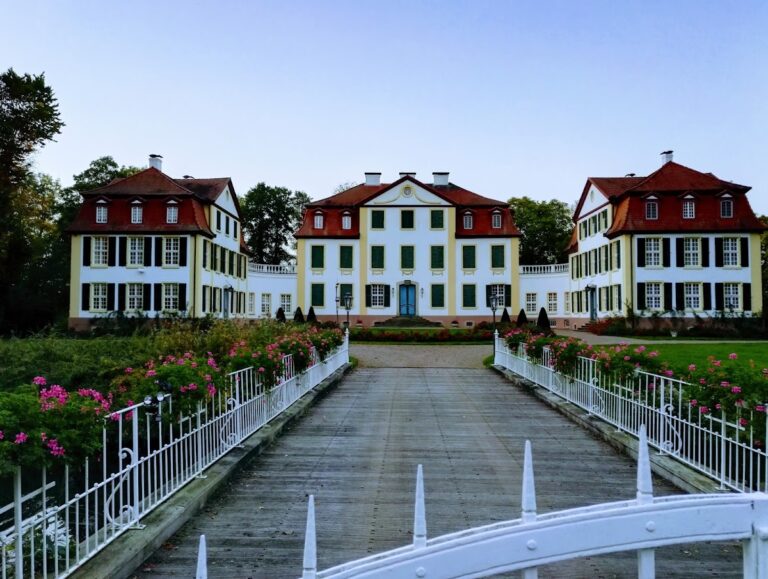
Schloss Benkhausen is a water-castle complex in Germany, built between 1657 and 1683 and retaining much of the form established during that period. The estate lies west of Gestringen, now a district of Espelkamp, and developed from the division of Ellerburg Estate among heirs of the von Münch family in 1510.
From estate division to noble succession
The Benkhausen estate was created when the Ellerburg property was divided among the von Münch heirs. The family name also appears as Monick. In 1773, Philip Münch left Benkhausen to Philipp Clamor von dem Bussche, who adopted the combined name von dem Bussche-Münch. Ownership then passed to his son Georg and later to Georg’s son and heir, Clamor Philipp von dem Bussche-Münch.
Clamor Philipp died in 1875. His three children also died soon afterward, and this branch of the family ended in 1878. The estate consequently passed by inheritance to the barons von dem Bussche-Ippenburg. Karl Freiherr von dem Bussche, who owned the property from this family and lived from 1861 to 1900, added the name Münch. His only son, Alhard, was born in 1897, remained childless, and sold Benkhausen in 1962.
Twentieth-century changes
The estate’s agricultural operation became bankrupt at the end of the 1920s, although the manor house stayed with the family. In 1945, after the Second World War, British occupying authorities requisitioned the house for the headquarters of the British Army of the Rhine, the British force stationed in Germany during the postwar occupation. From 1952, the property also served as a command post of the British Navy. The owners recovered it in 1955.
After its sale in 1962 to the Diakonische Stiftung Wittekindshof, a German charitable institution supporting people with disabilities, Schloss Benkhausen became a residence and workplace for people with disabilities. That use continued until 2009, when the buildings no longer satisfied building-safety requirements. The property then stood vacant until the Gauselmann entrepreneurial family acquired the castle, its ancillary buildings, and park at the end of 2010.
Restoration and present use
Between 2011 and 2013, the complex was converted into a training center for Gauselmann AG, a German company associated with gaming and amusement machines. Accommodation facilities were added as part of the conversion. The site now hosts professional training, conferences, workshops, and events for companies of the Gauselmann Group and other businesses. A Christmas market, art week, cultural events, and civil weddings also continue there.
The former estate district of Benkhausen was separated from the municipality of Alswede in the 1840s within the Lübbecke administrative district. It was dissolved on 1 October 1928, after which most of its territory became part of Alswede and a smaller section was transferred to Fabbenstedt.
Remains
Schloss Benkhausen occupies approximately five hectares west of Gestringen and north of the Mittelland Canal. The water-castle grounds contain the manor house, ancillary buildings, and a historic park. The complex combines surviving historic fabric with structures and landscaped areas reshaped during the 2011–2013 conversion.
Manor house and connecting buildings
The manor house was stripped from cellar to attic during the conversion and then repaired and redesigned. This work exposed historic fireplaces, stucco decoration, and sections of original timber framing estimated at about 500 years old. Eighteenth-century records and plans of the estate guided the restoration of the earlier room arrangement.
A glass building now joins the manor house to the former Maidenheim, a residence for unmarried young women. The connecting structure contains an elevator, reception area, training rooms, and a breakfast room. The former Maidenheim was also architecturally redesigned and refurnished as part of the separate redevelopment of the hotel complex.
Outer bailey and museum
The former barn in the outer bailey, the section of a castle complex used for service and agricultural buildings, was extensively repaired and converted into the German Automatenmuseum. Its permanent exhibition is arranged by theme and presents more than 1,800 coin-operated machines from the private collection of the Gauselmann family. The machines include mechanical and electrically operated examples connected with amusement, gaming, and related activities.
Park and surrounding landscape
Historic park and family burial place
The castle park was originally laid out geometrically with avenues. The northern part was redesigned from historic plans around a very large pavilion, while the courtyard and other park areas were also reshaped during the conversion. Older trees survive in the northeastern section, including a copper beech, a Holland linden, and an American walnut. The design incorporates the von Münch family burial place, a burial site reserved for members of that family. The pavilion area, park, and burial place were arranged for free public access.
Woodland path and wetland
A circular walking path of about two kilometers, opened in June 2018, passes through woodland in front of the complex and naturally landscaped meadows. It crosses wet ground with alder swamp forest, a waterlogged woodland dominated by alder trees, and crosses the renaturalized Flöthe stream twice. The route continues to the Mittelland Canal, where a landing stage was constructed.
Nearby sites