St. Stephani: Helmstedt’s Historic Lutheran Church and University Church


Site at a Glance
- Rating
- 4.6
- Popularity
- Very Low
- Country
- Germany
- Primary era
- Medieval
- External website
- Open
- Eras represented
- Medieval, Early Modern, Modern
- Civilizations
- German, Holy Roman Empire
- Site type
- Religious
- Remains
- Church
On this page18 sections
History
St. Stephani is a Lutheran church in Helmstedt, Germany, whose present Gothic building was begun around 1230 on the town’s highest hill. Dedicated to Saint Stephen, an early Christian martyr traditionally regarded as the first Christian martyr, it developed from a Romanesque predecessor and became Helmstedt’s first parish church. Older church records call it ecclesia in monte, meaning “the church on the mountain.”
Romanesque beginnings and Gothic rebuilding
A Romanesque church stood on the hill between 1125 and 1141, at a former trading place. Troops commanded by Magdeburg Archbishop Ludolf and King Philip of Swabia burned it during the destruction of Helmstedt at the turn of 1199 and 1200. The present church was begun on the site of that damaged predecessor around 1230. Its construction continued for several decades, and it was consecrated to Saint Stephen in 1300.
The church’s position on the highest hill above Helmstedt’s Old Town gave the parish building a prominent place in the medieval settlement. A west building with two suggested towers was added in the fifteenth century. These tower-like projections contain the bell installation beneath the roof, but do not rise above the church roofline. Successive alterations brought Romanesque and Gothic elements together with Renaissance and Baroque furnishings.
The Reformation and the University of Helmstedt
Heinrich Wende, a pastor at St. Stephani, preached the first Lutheran sermon in the church in 1530. He was expelled from Helmstedt soon afterward by the ducal ruler. The Reformation, the sixteenth-century movement that divided Western Christianity and established Lutheran and other Protestant churches, was officially introduced in the Duchy of Brunswick-Lüneburg in 1568 by Duke Julius.
That change removed the neighboring Catholic monastery of St. Ludgeri from control of the St. Stephani congregation. The monastery’s abbots also lost their former right to appoint the church’s pastor. The church therefore became part of the Lutheran order established under the rule of Brunswick-Lüneburg and is now associated with the Evangelical-Lutheran State Church in Braunschweig.
On 15 October 1576, a solemn service attended by Duke Julius and his heir, Henry Julius, marked the foundation of the University of Helmstedt. St. Stephani served as the university church from 1576 until 1703, when that function moved to the remodeled Augustinian church at the market square. Theology professors at the university continued to act as St. Stephani’s chief pastors and general superintendents until the university closed in 1810. The church’s Renaissance baptismal font and pulpit belong to this period of close connection with the university and the town council.
Changes in worship and later history
Eighteen altars dedicated to various saints once stood in the church, where intercessory Masses were celebrated. They were removed in 1542 during the rise of the Reformation. The Baroque high-altarpiece that now stands in the high choir was donated in 1644 by Christoph Royer, a treasurer who later became mayor.
The church also became a place of burial and commemoration for members of Helmstedt’s civic and academic communities. Johannes Borcholt, a professor at the University of Helmstedt, was buried there, as was the theologian Georg Calixt, whose tomb monument stands on the south wall of the high choir. An iron grave slab commemorates Alexander Koch, who died at the university from injuries received in a duel on 26 February 1584. His father, Jürgen, also known as Georg Koch, commissioned the slab.
The cemetery immediately north and south of the church was levelled during the nineteenth century. Around 50 of its more than 200 epitaphs and gravestones, many belonging to prominent townspeople and university members, were moved to the church’s exterior walls and interior. The congregation’s cemetery has stood outside the town near Magdeburger Tor since 1872.
St. Stephani survived the bombing raid on Helmstedt on 20 February 1944 without damage, leaving its historic building fabric unchanged by that attack. Earlier additions, alterations, and repairs had nevertheless transformed the church over the centuries. Its altar base dates from a comprehensive restoration around 1900, while the twelve principal stained-glass windows were installed between 1904 and 1906 in place of plain glazing introduced during the 1818 renovation.
The history of the bells also reflects the losses of the modern period. The oldest and largest bell, cast around 1250 and weighing about 3,000 kilograms, was melted down in 1927. A smaller council bell from 1710 was melted down in 1917, and three bronze bells cast in 1927 were surrendered during the Second World War. Only a bell cast in 1733 was rung between 1942 and 1948. The present steel bells were consecrated on Reformation Day in 1948.
Remains
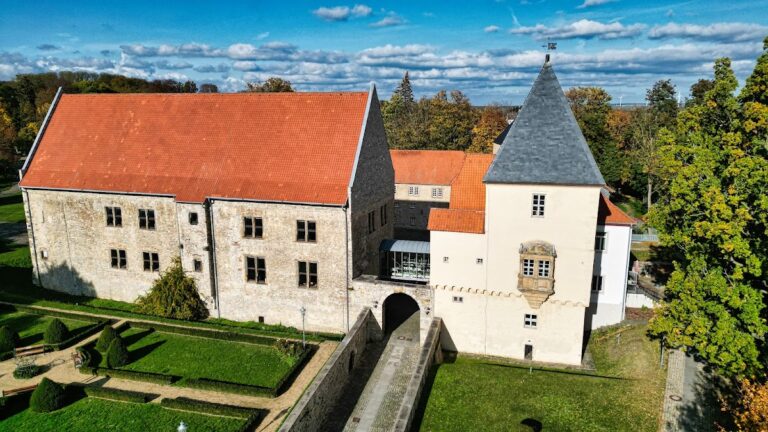
St. Stephani is a three-aisled Gothic hall church without a conventional tower. Its nave and aisles are approximately equal in height, creating a unified interior space. The church stands on the highest hill in Helmstedt and is visible from all directions. Romanesque and Gothic sections survive within the building, while Renaissance and Baroque furnishings enrich an interior whose architectural appearance is less uniformly Gothic than its exterior.
West building and bells
Roof-level bell installation
The substantial west building forms the church’s western structural block and entrance area. Its two tower-like projections stop below the roofline, giving the building its characteristic appearance without a conventional tower. The bells hang beneath the roof of this west building.
Present and historical bells
Three cast-steel bells form the present installation. They weigh 2,250, 1,350, and 1,050 kilograms and sound the pitches C-sharp, E, and F-sharp. Made by the Bochumer Verein, they have plate crowns and bear the inscriptions “Glory to God in the highest,” “Peace on earth,” and “Goodwill toward men.”
The surviving historical bell was cast in 1733. It is 44 centimetres in diameter and weighs 55 kilograms. Rather than hanging in the church, it is displayed in the District and University Museum in Helmstedt.
High choir and preaching furnishings
Baroque high altar
The Baroque high altar stands in the high choir. Its 1644 retable, the decorated structure behind an altar, has a lower section containing a painting of the Last Supper, a central scene of Mary with the infant Jesus and the Three Magi, and an upper painting of Christ in the Garden of Gethsemane.
Above the retable, a carved group shows the crucified Jesus with Mary and the apostle John. The four Evangelists flank the paintings. Matthew wears green, Mark gold-yellow, Luke red, and John blue. The altar front rests on a stone block dating from around 1900. The rear wall of the retable lists all the church’s pastors since the Reformation in Helmstedt in 1568.
Renaissance pulpit
The Renaissance pulpit was donated in 1596 by Sigismund Julius Mynsinger and Heinrich Albert Mynsinger, the sons of the ducal chancellor Joachim Mynsinger von Frundeck. The Quedlinburg craftsman Georg Steyger made it. Moses, holding the Tablets of the Law, supports the pulpit basket.
Reliefs from the Old and New Testaments decorate the staircase, while the balustrade carries 14 coats of arms of the Mynsinger family. A wooden model of Jerusalem occupies the sounding board, the canopy above the preacher, which helps project sound. Numerous angel figures surround it.
Baptismal font and paintings
Brass baptismal font
A brass baptismal font stands in the western entrance area facing the altar. Mante Pelking of Hildesheim cast it in 1590 for the then university church, paid for by the Helmstedt town council. Engraved coats of arms and the names of the donating council members decorate its foot.
Twelve apostle figures occupy two rows on the font, with six figures in each row. Six scenes on the basin and six on its cover present baptism and conversion narratives from the Old and New Testaments. They include the baptism of Jesus, Christ’s Ascension, Pentecost, the conversion of Saul, the baptism of children by Jesus, Paul in a Roman prison, Moses crossing the Red Sea, Philip baptizing the Ethiopian official, the temple spring described by Ezekiel, Jesus and Nicodemus, the Flood with Noah’s Ark, and the conversion of the centurion Cornelius.
The top of the cover represents the Trinity, the Christian doctrine of one God in three persons: Father, Son, and Holy Spirit. God the Father holds the Son, while a dove representing the Holy Spirit rests on the Son’s head. A chain suspends the cover from the vault, and a counterweight allows it to be lifted easily.
Seventeenth- and eighteenth-century panels
The interior contains 55 oil paintings on panels from the seventeenth and eighteenth centuries. Most depict episodes from the Old and New Testaments and copy works associated with Jacopo Tintoretto, Peter Paul Rubens, and Matthäus Merian. Brass plaques beneath the frames identify the subjects and the artists whose works were copied.
Eleven panels hang on the western organ gallery, while the others are arranged beneath the galleries of the north and south aisles. Two larger paintings donated by Mayor Heinrich Duve and his wife, Anna Modeler, hang on the sacristy wall in the choir. One represents the Confessio Augustana, or Augsburg Confession, the principal Lutheran confession of faith presented at the Imperial Diet of Augsburg in 1530. It follows an engraving by Johann Dürr. The other painting depicts the trial of Jesus.
Organ and stained glass
Organ case and instrument
The organ occupies the western gallery. It has a main section and a smaller rear section at the gallery rail. Its historic façade bears the date 1584, when an organ by David Beck of Halberstadt was installed.
Johann Christoph Hüsemann added two pedal towers beside the main case between 1747 and 1750. Wilhelm Sauer replaced the instrument in 1882 but retained the historic case. Friedrich Weißenborn installed a new instrument behind the old façade in 1954 and removed the side pedal towers. Karl Schuke of Berlin replaced that instrument in 1975 while preserving the façade.
The present organ has 36 stops on three manuals and pedal, with mechanical action and electro-pneumatic stop control. In 2000, Christoph Grefe of Ilsede installed a processor-controlled registration system capable of storing up to 4,000 registrations. Its listed couplers are I/II, III/II, I/P, II/P, and III/P. It also has a cymbelstern, tutti, and stop-off controls.
Principal stained-glass windows
Twelve principal stained-glass windows were made between 1904 and 1906 by Ferdinand Müller’s Quedlinburg glassworks. Eight of the larger windows were donated by Helmstedt citizens and businesses. Their subjects connect the church’s Christian dedication with the religious and academic history of the town.
The window at the south main entrance shows Saint Stephen’s stoning. The central south window depicts the Crucifixion and includes the Helmstedt coat of arms. On the central north side, Chancellor Mynsinger presents the imperial foundation charter of the University of Helmstedt to Henry Julius during the service of 15 October 1576. The scene includes the university’s coat of arms.
The eastern north window shows Martin Luther being examined at Worms in 1521. The eastern south window depicts the Reformer Johannes Bugenhagen’s visit to Helmstedt and carries an inscription referring to the introduction of the Reformation there on 14 October 1542.
The central apse window shows Christ wearing the Crown of Thorns after a work by Albrecht Dürer. The left apse window combines the Archangel Gabriel’s announcement to Mary, the birth of Christ, and the Adoration of the Magi. The right apse window shows Jonah and the whale below the risen Christ in glory. Two further small colored windows are in the apse, and two small windows in the southeast sacristy depict chalices and crosses. Other windows in the church are simply glazed.
Burial remains and commemorative stones
The hill beneath St. Stephani served as a burial place from around 1100. Epitaphs and gravestones transferred from the former cemetery remain attached to the exterior wall and displayed inside the church. These commemorative remains preserve the connection between the parish, Helmstedt’s civic community, and the university that used St. Stephani for religious services and institutional ceremonies.