Palazzo Doria Tursi: A Mannerist Palace and Municipal Museum in Genoa


Site at a Glance
- Rating
- 4.6
- Popularity
- Low
- Country
- Italy
- Primary era
- Early Modern
- External website
- Open
- Eras represented
- Early Modern, Modern
- Civilizations
- Genoese, Italian, Kingdom of Sardinia
- Site type
- Domestic
- Remains
- Palace
On this page10 sections
History
Palazzo Doria Tursi is a sixteenth-century Mannerist palace in Genoa, Italy, built from 1565 for the Genoese banker and nobleman Niccolo Grimaldi. Mannerism was a sixteenth-century style known for elaborate forms, sophisticated proportions, and complex spatial effects. Grimaldi was nicknamed “il Monarca” because of his many noble titles and extensive claims against Philip II of Spain. The palace became one of Genoa’s grand aristocratic residences and later developed into a municipal and museum complex.
Construction for Niccolo Grimaldi
The palace was built on a parcel adjoining the present Palazzo Bianco to the west, with the San Francesco monastery and Castelletto bastion to the north. Its designers were the brothers Domenico and Giovanni Ponzello, Mannerist architects who had been pupils of Galeazzo Alessi, whose work strongly influenced sixteenth-century architecture in Genoa.
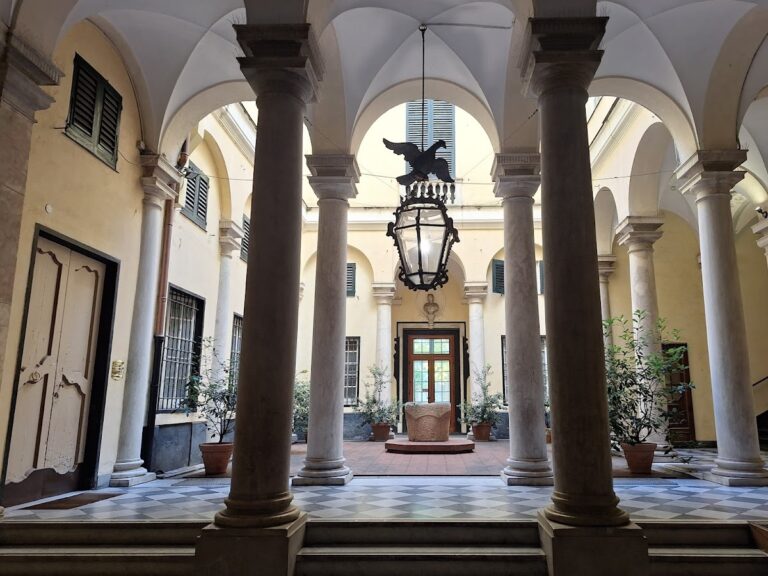
The site’s steep terrain shaped the building’s design. The architects arranged a staged sequence of spaces including an atrium, courtyard, staircase, and monumental double-flight stairway. These elements created controlled views and changing effects of light, making movement through the palace part of its architectural composition.
The Doria period and the Palazzi dei Rolli
In 1597, Giovanni Andrea Doria, Prince of Melfi, acquired the palace for his younger son Carlo, Duke of Tursi. The building’s present name derives from Carlo’s title. The two broad loggias facing the street were added during this period, further extending the palace’s presence along Strada Nuova, the street now called Via Garibaldi.
Palazzo Doria Tursi belonged to the Palazzi dei Rolli, an official system of Genoese aristocratic residences selected to house distinguished visitors during state visits. It is one of the 42 palaces included in the UNESCO World Heritage designation “Genoa: Le Strade Nuove and the system of the Palazzi dei Rolli,” inscribed in 2006. The building also held Italian national heritage status from 1941.
Royal ownership and civic use
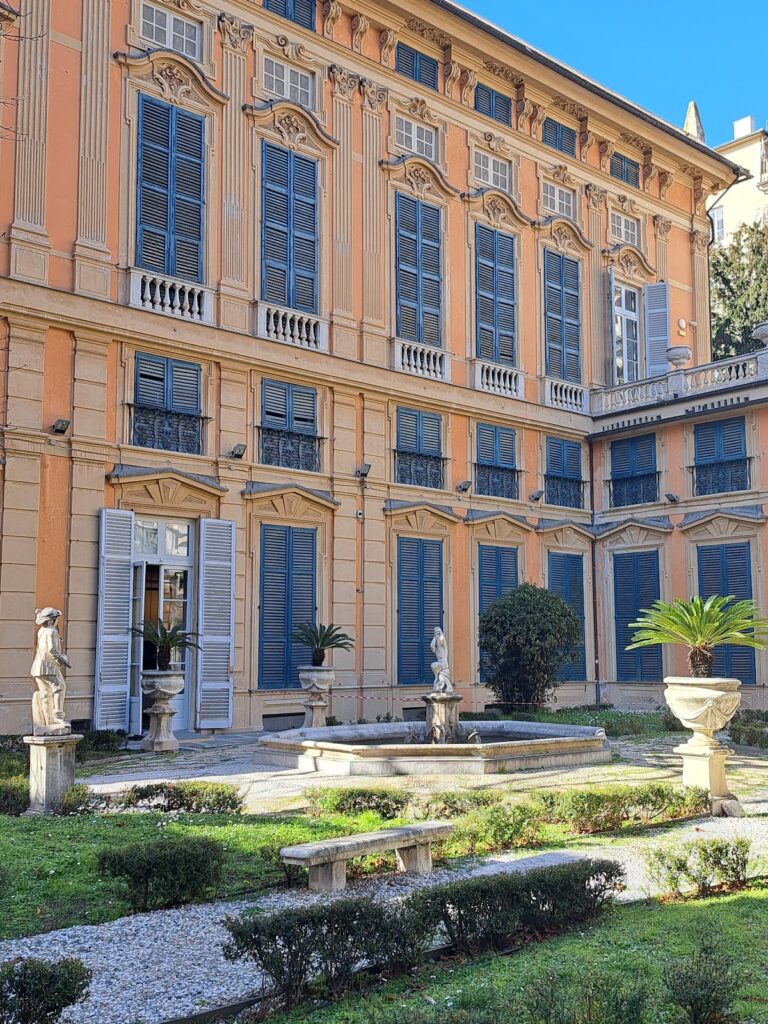
After the Republic of Genoa was annexed to the Kingdom of Sardinia, Victor Emmanuel I of Savoy purchased the palace on 13 January 1820. Carlo Randoni, the court architect, renovated the building and added a clock tower behind the rear wall. The demolition of the San Francesco monastery allowed the rear section to be expanded, and a Romantic-style garden was laid out there with sculptural and decorative elements recalling the former church.
The palace became a college in 1838 and was later lent to the Jesuits. In 1848 it became the seat of Genoa’s municipal government, while municipal ownership and use as the city-government headquarters are also dated to 15 June 1850. The name Palazzo Tursi is consequently used not only for the building but also, by extension, for Genoa’s municipal government or city council.
Modern additions and museum functions
Between 1960 and 1965, Palazzo degli Uffici was added on the Castelletto hillside side of the complex. The building was designed by Franco Albini and Franca Helg. Palazzo Doria Tursi is physically connected to the adjacent Palazzo Bianco through terraced gardens, and since 2004 part of its interior has extended the Palazzo Bianco gallery. Together, the buildings form part of the Musei di Strada Nuova.
The palace now combines municipal offices with museum functions. Its collections include Genoese painting of the seventeenth and eighteenth centuries, sculpture, coins and medals, ceramics, official weights and measures of the former Republic of Genoa, and objects associated with the Genoese violinist and composer Niccolo Paganini. The Paganini rooms were rearranged in 2021 with multimedia installations concerning his life, his relationship with Genoa, his career as a guitarist, and his violins.
Remains
Facade, loggias, and gardens
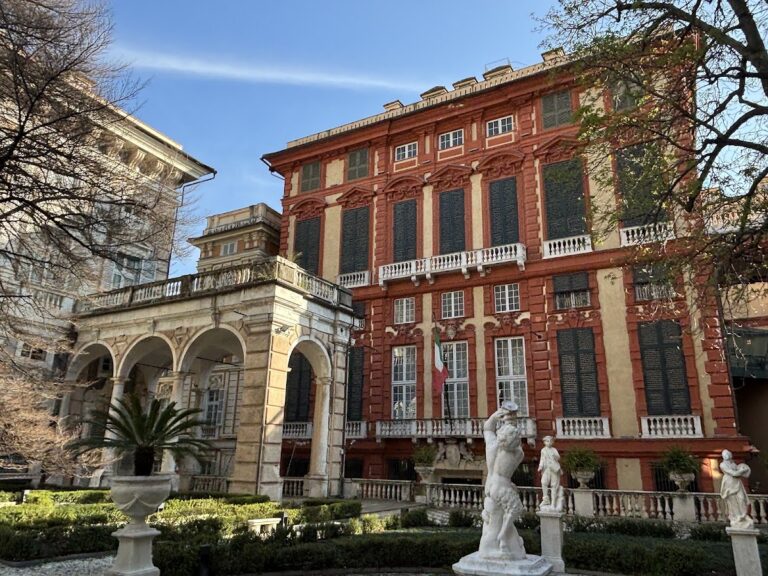
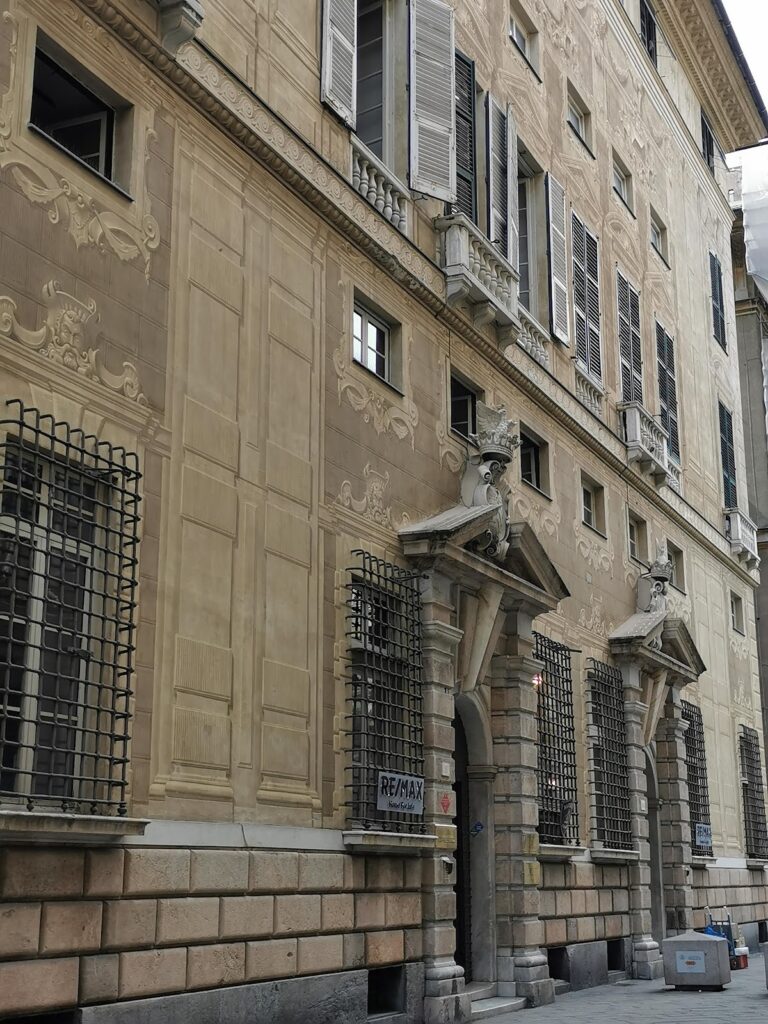
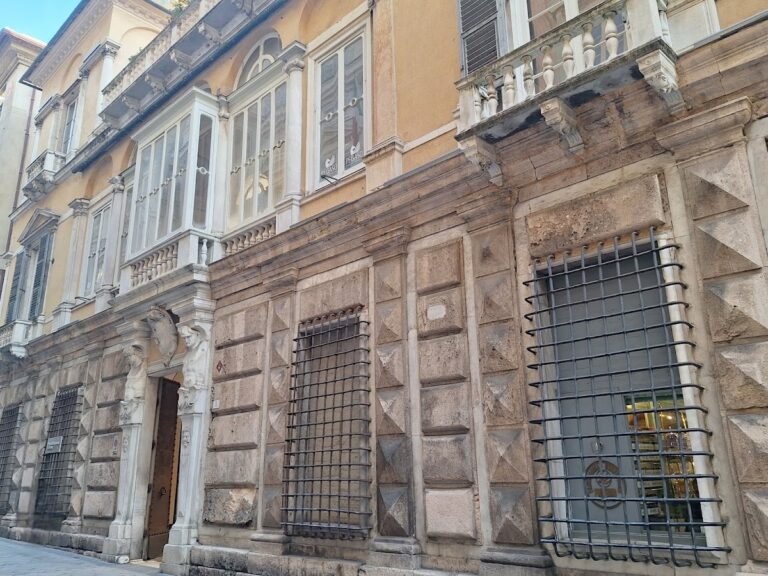
Palazzo Doria Tursi occupies three parcels on Via Garibaldi, an unusual arrangement that makes it the longest and largest building on the street. Two large gardens frame the central building. The principal facade rises above a substantial lower base and uses two superimposed architectural orders, or organized levels of columns and pilasters. The raised ground floor has specially designed windows and projecting rusticated pilasters, while the upper floor uses Doric pilasters.
Animal-faced mascarons crown the windows on both principal levels and intensify the facade’s sculptural character. Its materials alternate between pink stone from Finale Ligure, grey-black slate from Val Fontanabuona, and white Carrara marble. The white-marble portal, made by Taddeo Carlone, carries figures of armed men. These figures originally surrounded the Doria eagle, which was later replaced by Genoa’s cross-bearing shield.
The two broad lateral loggias facing the street were added in 1597. One borders the lower garden of Palazzo Bianco. The palace and its neighboring building are connected through terraced gardens, while the rear garden incorporates sculptural and decorative elements recalling the demolished San Francesco church. The clock tower behind the rear wall belongs to the 1820 renovation, and Palazzo degli Uffici occupies the hillside side of the later complex.
Interior sequence and decoration
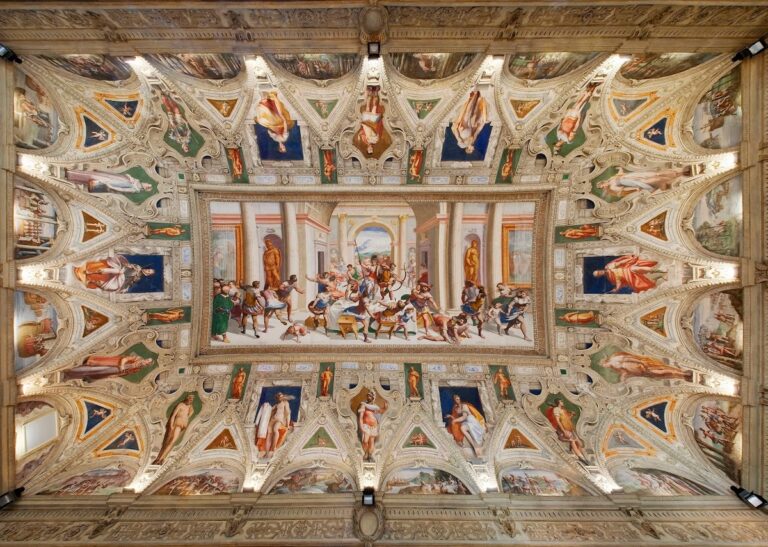
The interior is organized around an atrium, a rectangular courtyard raised above the portico and extending over two levels, and a monumental double-flight staircase. A reception hall contains frescoes and paintings. The arrangement continues the building’s use of carefully framed perspectives and changing light, while the decoration reflects its original function as an exceptionally sumptuous aristocratic residence.
Two exhibition rooms retain ceiling frescoes by Nicolò Barabino and Pietro Fea. Barabino’s fresco depicts “Munificence,” while Fea’s represents the “Chariot of the Sun.” Another statue is situated in the atrium. The sculpture collection includes Antonio Canova’s Penitent Magdalene, a statue of Giuseppe Mazzini, a bust of Camillo Cavour, and Giuseppe Benetti’s statue of Maria Brignole Sale De Ferrari, Duchess of Galliera.
Paintings and decorative arts
The paintings include works by Alessandro Magnasco such as A Picnic in the Gardens of Albaro, Saint Augustine and the Child, Prayer before a Rural Chapel, and A Scene with Soldiers. The collection also contains Gregorio De Ferrari’s Christ and the Samaritan Woman, Noli me tangere, and The Samaritan Woman at the Well, alongside works by Bartolomeo Guidobono, Domenico Parodi, Giovanni Maria delle Piane, Lorenzo De Ferrari, and Nicolas Lancret.
The decorative arts include seventeenth- and eighteenth-century objects, among them tapestries woven with gold and silver. Ceramics come from Genoa, Savona, and Albisola. They include plates from the workshops of Conrad Bacile and Grosso, a Savona plate, a seventeenth-century Savona amphora, and a Ligurian pharmaceutical vase. Pharmaceutical vessels from the former Genoese hospitals of Pammatone and Incurabili form part of the same group.
Coins, measures, and Paganini’s instruments
The numismatic collection includes a Genoese genovino, two silver scudi dated 1610, a medal of Andrea Doria, Genoese medals including one dated 1698, and Matteo de’ Pasti’s 1446 medal of Sigismondo Pandolfo Malatesta. The palace also preserves official weights, measures, and units for measuring liquids used in the former Republic of Genoa.
The Paganini displays include Il Cannone, the celebrated violin associated with Paganini. It was made in Cremona by Bartolomeo Giuseppe Guarneri del Gesù. The collection also contains a copy produced in Paris in 1833 by Jean-Baptiste Vuillaume, a French maker of stringed instruments. Seven years later, Paganini gave the copy to his pupil Camillo Sivori, who later bequeathed it, like his teacher, to the Municipality of Genoa.
Among the associated objects is a mid-sixteenth-century coat of arms of the Republic of Genoa, which originated at the San Francesco monastery of Castelletto. Together with the palace’s paintings, sculpture, ceramics, instruments, and civic measuring equipment, these objects preserve successive aspects of Genoese aristocratic, municipal, artistic, and institutional history.
Nearby sites