Palazzo Brera: Milan’s Historic Palace of Arts and Sciences


Site at a Glance
- Rating
- 4.7
- Popularity
- Low
- Country
- Italy
- Primary era
- Early Modern
- Eras represented
- Medieval, Early Modern, Modern
- Civilizations
- Duchy of Milan, Habsburg, Holy Roman Empire, Spanish
- Site type
- Civic
- Remains
- Palace
On this page11 sections
History
Palazzo Brera is a historic complex in Milan, Italy, whose present palace follows a late sixteenth- and seventeenth-century design in the Mannerist style. It developed from a monastery in Milan’s Brera district and became an important center for education, the arts, science, and scholarship. The name Brera derives from the Lombard term braida, used in medieval Latin for a field or enclosed tract of land near a city.
The Humiliati monastery
The site began as land owned by Guercio da Baggio, a Milanese consul active between 1150 and 1188. Religious brothers acquired part of the property around 1178 and purchased adjoining land in 1198. They belonged to the Humiliati, a medieval religious order active in northern Italy that combined religious life with wool processing and became an important economic and religious association in Milan.
The Brera monastery became the principal house of the Humiliati. Its adjoining church, Santa Maria in Brera, was built between 1180 and 1229. The order was suppressed by Pope Pius V in 1571. At the request of Cardinal Carlo Borromeo, a leading Catholic reformer and archbishop of Milan, and with the approval of Pope Gregory XIII, the monastery was then transferred to the Jesuits, a Catholic order founded in the sixteenth century and known for its educational institutions.
The Jesuit college and palace
The Jesuit college expanded as its enrollment reached about 3,000 students. In the late sixteenth century, the architect Martino Bassi prepared plans for a larger building. His proposals considered a square courtyard, a rectangular courtyard, or three separate courtyards, and were partly based on the Collegio Borromeo in Pavia.
Francesco Maria Richini took charge of the project in 1615 and revised the design. Construction began in 1627, but the plague outbreak of 1630 interrupted the work. Building resumed in 1651. After Richini’s death in 1658, his son Giandomenico continued the project, followed later by Gerolamo Quadrio and Pietro Giorgio Rossone, who retained Richini’s design.
Habsburg reorganization
The Jesuit order was suppressed by Pope Clement XIV in 1773, and the college passed to the Habsburg rulers of northern Italy. The building was still unfinished and had no façade. The Austrian government commissioned Giuseppe Piermarini to complete it, and the work extended from 1778 to 1795. Piermarini completed the principal courtyard and arranged the entrance from Via Brera in 1780.
Under Maria Theresa, the Habsburg empress and queen, Brera was reorganized as a palace of arts and sciences. The complex housed the Palatine Schools, where philosophy and law were taught, as well as a boarding school, physics and chemistry laboratories, and an agricultural society.
Several major institutions were established or developed during this period. An observatory operating inside the college by 1760 became the Brera Astronomical Observatory around 1764–1765. It was founded by the Jesuit Roger Joseph Boscovich, whose work included astronomy, mathematics, physics, and natural philosophy, and was later directed by prominent astronomers.
Maria Theresa founded the Brera Library in 1773 by combining the former Brera and San Fedele libraries with donations from private collections, including those of Carlo Pertusati and Albrecht von Haller. In 1774, she ordered the expansion of the Jesuit garden to create the Brera Botanical Garden and founded the Royal Academy of Fine Arts in 1776. The former medicinal-herb garden was directed by the Vallombrosan priest Fulgenzio Witman. It was transferred to the Collegio Sant’Alessandro in 1817 and placed under Milan’s Higher Technical Institute in 1863, when Théodore Caruel was director.
Napoleonic and later institutional changes
During Napoleon’s secularization of religious institutions, Santa Maria in Brera was closed in 1806 and its façade was demolished. The former church space was absorbed into the palace’s cultural functions. Its upper level became rooms for the Academy’s art gallery, while its lower level housed a collection of ancient sculpture.
An art gallery was established during the Napoleonic period, initially as part of the Brera Academy. Its paintings included works removed from churches during the Napoleonic confiscations of Italian artworks. The gallery became an autonomous institution, the Pinacoteca di Brera, in 1882, with Giuseppe Bertini as its first director.
Napoleon’s National Institute, founded in Bologna in 1797, moved to Brera in 1810 as the Institute of Sciences, Letters and Arts. In 1838, it was divided into the Imperial Royal Lombard Institute of Sciences, Letters and Arts and the Venetian Institute. The Lombard institution is now represented by the Lombard Institute of Science and Literature.
War damage and continuing use
During the First World War, the palace rooms were closed and the Pinacoteca’s paintings were temporarily transferred to Rome after the Italian defeat at Caporetto. At the beginning of the Second World War, the paintings were evacuated immediately. Bombing on 7–8 August 1943 damaged the palace, which was rapidly reconstructed after the war. Its rooms reopened in 1950.
Palazzo Brera currently accommodates the Brera Academy and its Pinacoteca, the Brera Library, the Brera Botanical Garden, the Brera Astronomical Observatory, and the Lombard Institute of Science and Literature. The Lombard Historical Society has been based in the Brera Library since 2013. The palace forms part of the historic Collegio di Brera complex and holds Italian national heritage status.
Remains
Palace exterior and courtyard
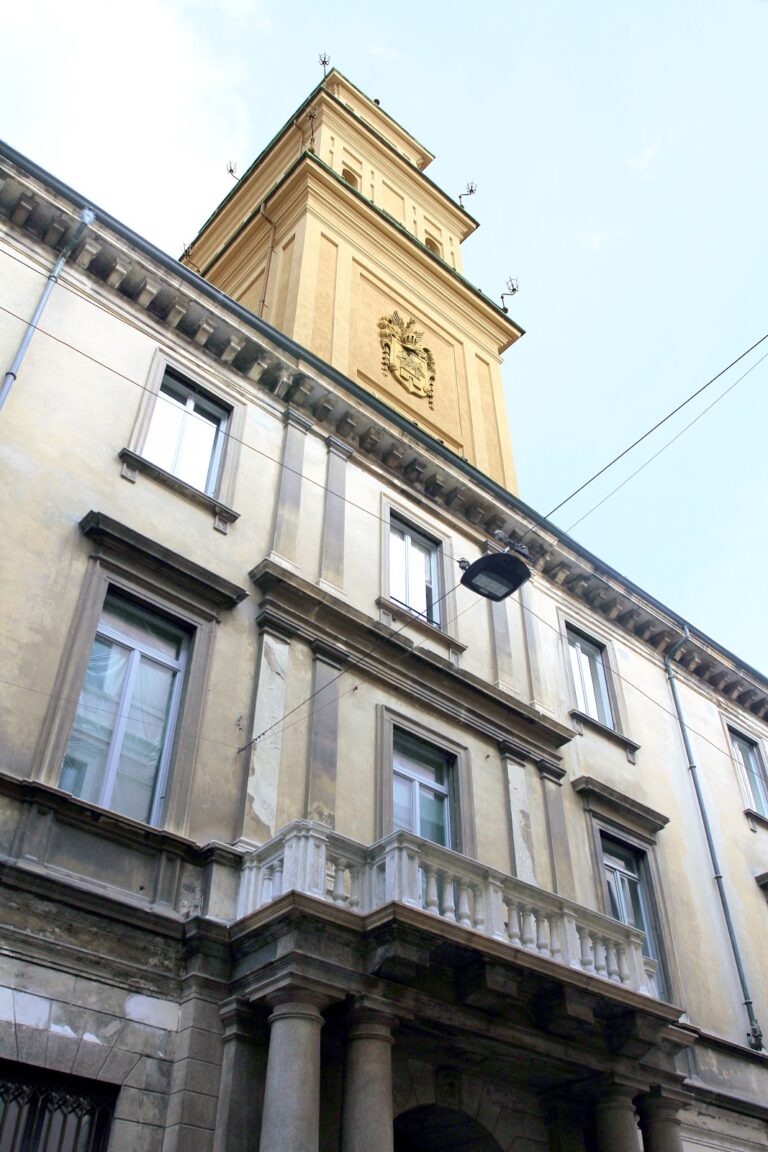
The present palace follows Richini’s design and is faced in dark red brick, with reinforced corners. Its façade is organized by regularly spaced rusticated pilasters and horizontal string courses. Stone pediments crown the windows, giving the exterior a disciplined architectural rhythm within its Mannerist composition.
The principal courtyard is surrounded by a two-storey portico. On the ground floor, the arches form Serlian arrangements, each combining a central arch with lower openings or bays at the sides, and are supported by Doric-order columns. The first floor repeats the arrangement with Ionic-order columns. The courtyard and entrance works are attributed to Giuseppe Piermarini and date from 1780.
Napoleon as Mars the Peacemaker
At the center of the courtyard stands a bronze copy of Antonio Canova’s Napoleon as Mars the Peacemaker. Francesco Righetti and his son Luigi made the copy in Rome in 1811, and it was placed in the palace courtyard in 1859. Canova was a leading Neoclassical sculptor.
Santa Maria in Brera
The former Santa Maria in Brera church is incorporated into the palace. Its façade was removed after the church closed in 1806, and its nave was divided horizontally into two floors. This alteration produced the gallery rooms and sculpture-collection spaces now contained within the complex.
The church’s earlier decoration included a Gothic marble portal added between 1346 and 1348 by the Pisan sculptor Giovanni di Balduccio. Frescoes were added by Giovanni da Milano, Vincenzo Foppa, and Bernardino Luini, linking the surviving palace spaces to the medieval and Renaissance history of the former religious building.
Cultural, scientific, and landscaped features
The complex brings together the Brera Academy, the Pinacoteca di Brera, the Brera Library, the Brera Botanical Garden, and the Brera Astronomical Observatory. It also includes the premises of the Lombard Institute of Science and Literature. These institutions occupy and define the former college and palace as a connected cultural, scientific, educational, and landscaped complex.
Nearby sites