Schloss Mosigkau: A Rococo Summer Palace in Germany


Site at a Glance
- Rating
- 4.4
- Popularity
- Medium
- Country
- Germany
- Primary era
- Early Modern
- External website
- Open
- Eras represented
- Early Modern
- Civilizations
- Holy Roman Empire
- Site type
- Domestic
- Remains
- Palace
On this page10 sections
History
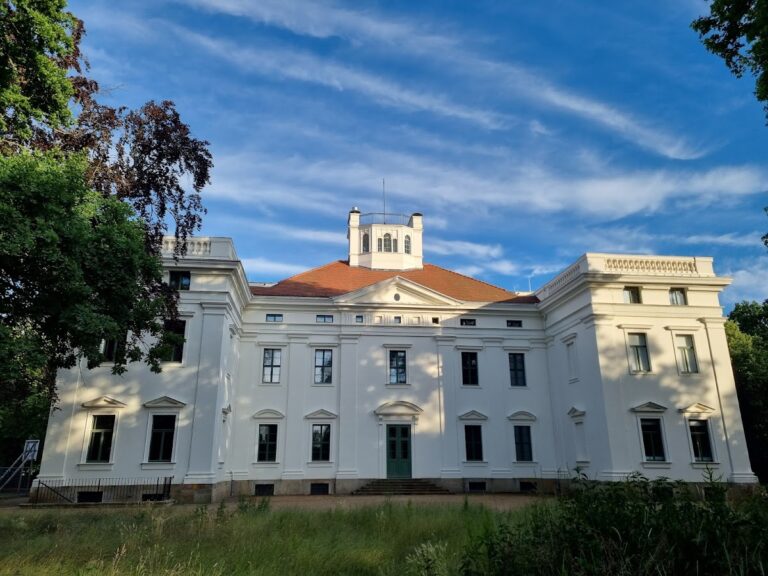
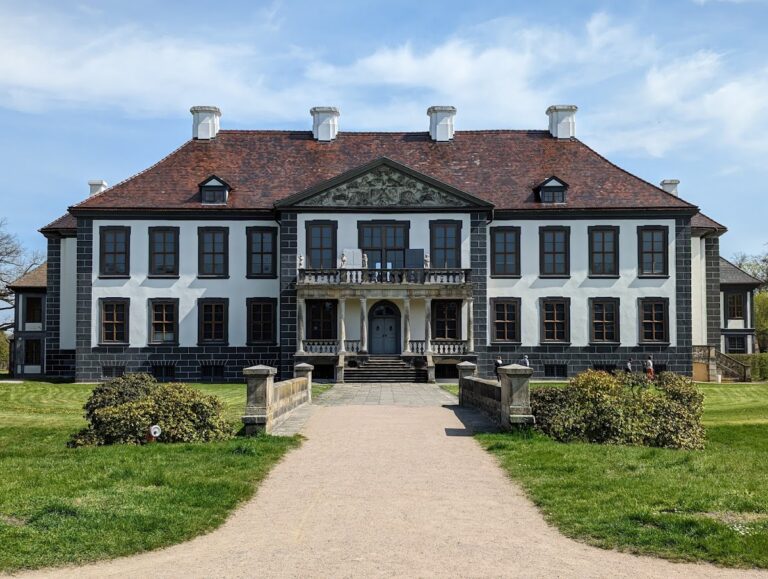
Schloss Mosigkau is a Rococo palace in Germany, located in Mosigkau, a district of Dessau-Roßlau. Built between 1752 and 1757, it served as the summer residence of the unmarried Princess Anna Wilhelmine of Anhalt-Dessau, who spent the winter months in Dessau. The palace was created as a maison de plaisance, a pleasure residence intended for seasonal retreat and courtly leisure rather than as a principal seat of government.
Foundation and construction
In 1742 and 1743, Prince Leopold I of Anhalt-Dessau gave Anna Wilhelmine two estates at Mosigkau and provided her with a substantial apanage, a financial provision or landed endowment for a member of a ruling family. These resources enabled her to plan a palace and garden complex. She began preparing the residence in 1751 and commissioned the Dessau court architect Christian Friedrich Damm to build it in 1752.
The first designs are probably connected with Georg Wenzeslaus von Knobelsdorff, the architect associated with Sanssouci, although the authorship has not been definitively established. The completed complex expressed the light, decorative character of Rococo, an eighteenth-century style associated with delicate ornament, pale colors, elaborate interiors, and playful natural motifs.
The collegiate foundation
Anna Wilhelmine died in 1780. Her will established a collegiate foundation, an endowed institution providing a permanent residence and community for unmarried noblewomen, within the palace. The foundation remained at Mosigkau until 1945. Its residents continuously occupied the residential rooms, and no later changes were made to the building, furnishings, or rooms used as living quarters. This continuity helped preserve the ensemble in its original condition.
The residents also repeatedly refused to sell the Mosigkau paintings to the Dessau government. As a result, the collection remained in the setting for which the palace had been created.
From repository to museum
After 1945, Schloss Mosigkau became a repository for the Dessau gallery. Walther Pflug began rescuing and restoring the palace in the summer of that year. The president of Saxony-Anhalt appointed him curator in 1947, and he served as the palace’s first director from 1951 to 1954. From 1951, the building operated as a museum of Rococo domestic culture.
Schloss Mosigkau is regarded as one of the last fully preserved Rococo ensembles in central Germany. Its park forms part of the Dessau-Wörlitz Garden Realm, a historic landscape of gardens and parks created largely in the second half of the eighteenth century under Prince Leopold III Friedrich Franz of Anhalt-Dessau. The garden realm entered the UNESCO World Heritage List in 2000. The palace and park are also included in Saxony-Anhalt’s Garden Dreams heritage program.
Remains
Palace complex and interiors
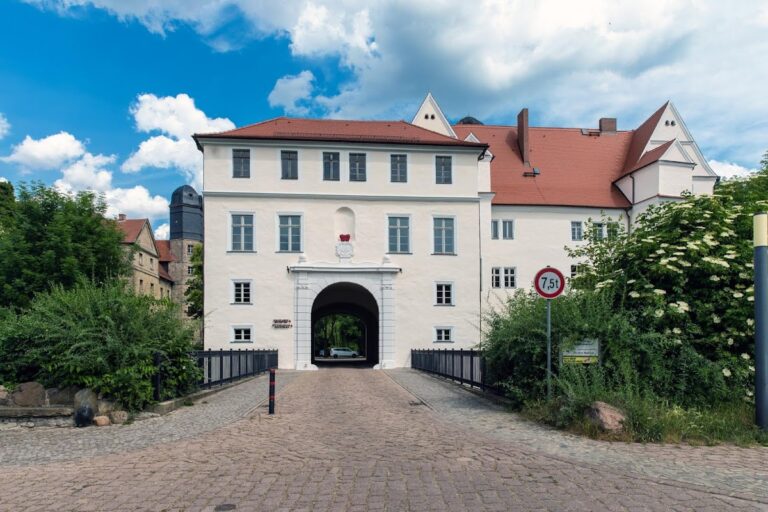
The complex is arranged around an Ehrenhof, or ceremonial forecourt. Its principal residential building, the Corps de Logis, faces two opposing pavilions known as the Cavalier House and Servants’ House, while two service buildings complete the arrangement. At the courtyard entrance, two pairs of Ionic half-columns support an entablature topped by a cartouche showing autumn. The corresponding cartouche at the garden entrance represents summer.
Residential rooms and staircase
Seventeen rooms retain at least part of their historic interior decoration. The vestibule of the Corps de Logis contains a two-arm staircase. The surviving rooms, furnishings, and decorative elements preserve the domestic character of the residence and reflect the continuity of occupation after Anna Wilhelmine’s death.
Picture gallery
The central feature on the garden side of the Corps de Logis is the picture gallery. Five large glass doors connect the room with the garden. Its decoration includes stucco, Venetian crystal chandeliers, and recessed wall panels framed by pilasters covered in green stucco marble. The paintings remain arranged according to the original Baroque hanging scheme of the period, with some works trimmed or enlarged to fit the recessed panels.
The gallery contains paintings by seventeenth-century Flemish and Dutch masters, including Peter Paul Rubens, a Flemish Baroque painter and diplomat, Anthony van Dyck, a Flemish Baroque portrait painter, and Jan Brueghel the Elder, Jacob Jordaens, Hendrick Goltzius, and Gerard van Honthorst. Works include Rubens’s Zephyr and Flora, van Dyck’s The Princes of Orange, The Judgment of Paris, Ceres and Amphitrite, and The Contest between Apollo and Pan. A portrait of Prince Leopold I of Anhalt-Dessau by Georg Lisiewski is also displayed.
The gallery paintings came from the collection of Amalia of Solms-Braunfels, the wife of Friedrich Heinrich, Stadholder of the Netherlands, and mother of Henriette Catharina of Nassau-Orange. A stadholder was a senior governor or representative of a ruler in the Dutch Republic and related territories. Henriette Catharina brought the inheritance to Dessau and left it to her son Leopold I. Other parts of the collection went to Dessau Residence Palace, Oranienbaum Palace, and the Gothic House at Wörlitz. Schloss Mosigkau also contains an extensive collection of portraits of Anhalt princes, including many works by Georg Lisiewski and Antoine Pesne.
Cabinets
Two cabinets flank each side of the gallery. Their decoration follows the Frederician Rococo style, the refined Rococo associated with the court of Frederick II of Prussia. Silver foliage appears on blue and yellow grounds, alongside marble fireplaces, inset and overdoor paintings, Chinese wallpaper, and inlaid furniture. In places, objects from the Georgium Gallery supplement the original Rococo interior after elements of the historic furnishings were lost.
Garden and orangery
The garden lies directly south of the gallery. Its formal layout includes clipped hedge compartments, a bowling-green pavilion, a fishpond, and a maze. At the rear entrance of the Rococo garden stands an orangery, a garden building used to shelter citrus trees and other frost-sensitive plants during the cold season. Two buildings flank it, and rare, partly centuries-old potted plants line the main path to the palace during the summer months.
Four statues, representing Mars, Diana, Flora, and a nymph, were transferred to the park of Schloss Mosigkau in 1951 from the park of Wust Manor. Together with the garden compartments, water feature, maze, pavilion, and orangery, they form part of the landscaped setting of the palace.