Schloss Lamberg: A Baroque Palace and Former Medieval Castle in Austria


Site at a Glance
- Rating
- 4.6
- Popularity
- Medium
- Country
- Austria
- Primary era
- Early Modern
- External website
- Open
- Eras represented
- Medieval, Early Modern, Modern
- Civilizations
- German, Habsburg, Holy Roman Empire
- Site type
- Domestic
- Remains
- Castle
On this page13 sections
History
Schloss Lamberg in Steyr, Austria, developed from the medieval Styraburg, a castle probably built at the beginning of the tenth century. First mentioned in 985, it stood above the confluence of the Steyr and Enns and gave its name to both the city of Steyr and the later state of Styria. Its present form is that of a Baroque palace, rebuilt after a major fire in 1727.
The Styraburg and the Otakars
The Styraburg belonged to the counts of Traungau, also known as the Otakars, who controlled the medieval territory centered on Steyr. Otakar II was first mentioned in 1078, and the castle became his residence in 1079. Its position at a crossroads gave it a frontier role. Around 976, it stood on the northern boundary of the March of Styria, facing the March of Austria, with the Steyr River forming the dividing line. The March of Styria became a duchy in 1180.
Through the Georgenberg agreement, a succession pact made after the extinction of the Otakar line, Styria passed to the Babenbergs in 1192. The Babenbergs ruled the March of Austria and later the Duchy of Austria. The castle subsequently came under Habsburg control. Its frontier function ended after the treaty of 3 April 1254 between Ottokar II of Bohemia and Bela IV of Hungary moved Styria’s northern boundary to the southern boundary of present-day Upper Austria.
From Lamberg lordship to Baroque residence
In 1666, the castle and its lordship passed to the Counts of Lamberg, whose name became attached to the complex. Around 1750, the lordship was the largest landed estate in Upper Austria. A fire destroyed the castle in 1727, and Johann Michael Prunner’s plans guided its reconstruction as a Baroque residence. The complex was then severely damaged during the Coalition Wars, the series of conflicts fought against revolutionary and Napoleonic France, in 1800, 1805, and 1809.
After the town fire of 1824, the Römerturm acquired its distinctive crenellated platform. The castle’s gardens also changed over time. A garden had first been laid out from 1476 under Johannes Beckenschlager, the fugitive Archbishop of Gran and later Archbishop of Salzburg. In 1618, it was enclosed by a wall under the supervision of the imperial master builder Marco Martino Spazzio. The former French ornamental garden received its present English landscape-park design in 1844.
Twentieth-century changes and present administration
Following the February fighting of 1934, the castle stables were temporarily used as a prison for about 800 detainees, most of them members of the Schutzbund, the paramilitary defense organization associated with Austria’s Social Democratic movement. Trials of the insurgents began on 17 February 1934 in the district court building on the town square.
Count Vollrath Lamberg sold Schloss Lamberg and its extensive forests in the Enns and Steyr valleys to the German Reich forestry administration in 1938. In 1943, forced laborers from the Steyr-Münichholz concentration-camp subcamp built an air-raid shelter at the castle. Since 2015, the shelter has housed the permanent exhibition Stollen der Erinnerung. After the Second World War, the castle became property of the Republic of Austria, and the Austrian Federal Forests have administered it and its associated woodland since 1961.
Restoration began in 1977 in preparation for Steyr’s 1,000th anniversary in 1980. The castle hosted the Upper Austrian state exhibition on Hallstatt culture that year and was one of three venues for the 2021 Upper Austrian state exhibition, together with the Innerberger Stadel and the Museum of the City of Steyr. The premises now accommodate the police commissariat and the Steyr city police command, as well as cultural events.
Legends of the foundation
Tradition connects the castle’s origins with the story of Biterolf and Dietleib. In this legend, Etzel, the legendary Hun king, rewarded Biterolf with the land of Styria. Biterolf and his son then built the Steyrburg on the rocky promontory. The tale continues with the abduction of Künhilde by the dwarf king Laurin.
A second foundation legend tells of two knight brothers who disagreed about whether the castle should stand on Tabor hill or on the rocky promontory at the meeting of the Enns and Steyr. They fought, and the victorious brother’s choice prevailed. This story is regarded as a migration legend derived from the foundation story of Rome. The frontier position of the site and the political tensions associated with it may also have encouraged the tale.
Remains
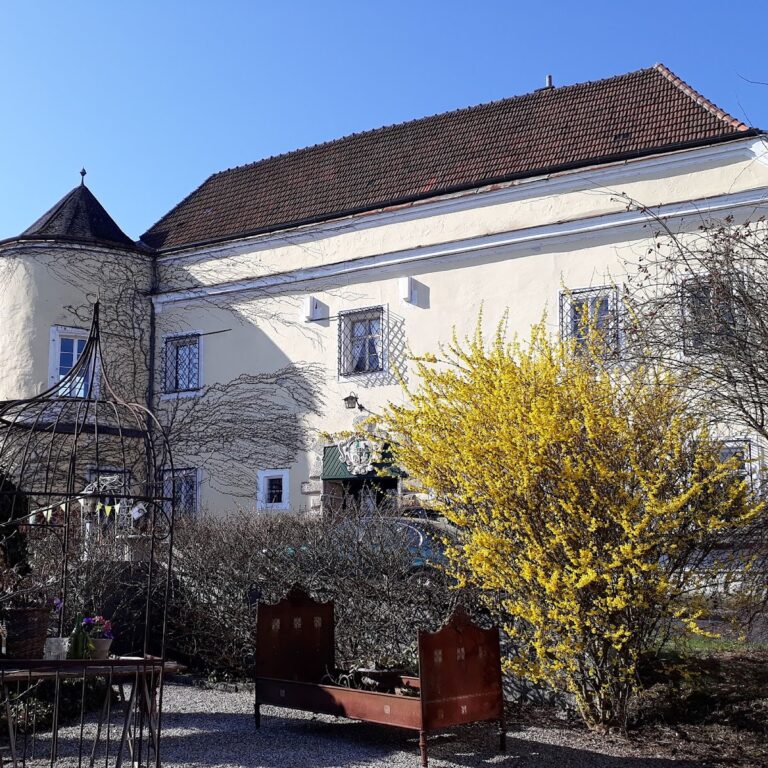
Schloss Lamberg occupies a high terrace above the confluence of the Steyr and Enns. Its three principal wings enclose a courtyard with a triangular plan, shaped by the restricted rocky promontory. The surviving complex combines elements of the medieval Styraburg with the rebuilt Baroque palace, an English landscape park, historic gardens, and later installations.
Medieval fortifications and palace core
Römerturm and medieval defenses
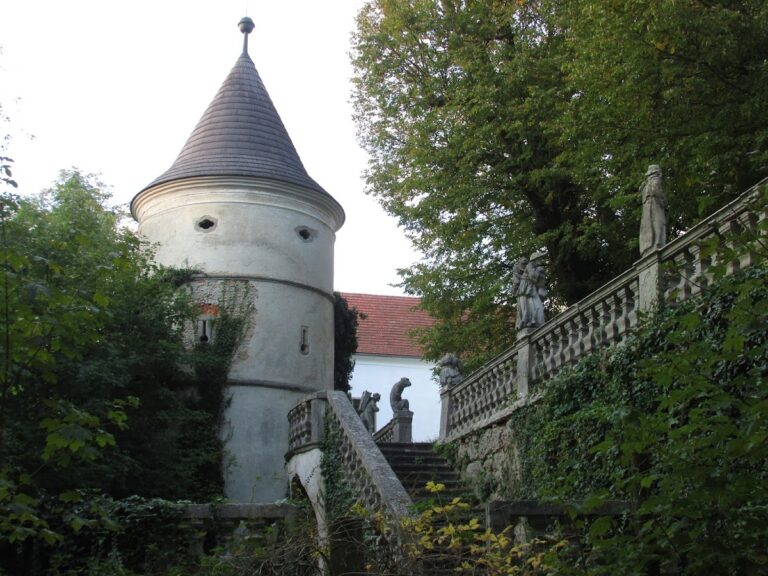
The Römerturm is the oldest part of the complex and served as the medieval castle’s keep. Its base incorporates blocks of nonlocal granite, possibly taken from the former Roman legionary camp at Lauriacum, a military settlement in the area of present-day Lorch. Other medieval elements include a Gothic gateway at the foot of the castle hill, sections of the wall on the town side, and a moat 35 metres wide.
Baroque courtyard and gate buildings
A fountain installed in the courtyard in 1666 stands at the center of the present ensemble. Its water-spouting dog represents the Lamberg heraldic animal, and the inscription “F. I. G. V. LAMBERG 1666” appears on the animal’s collar. Baroque sandstone dwarf figures surround the fountain. Johann Baptist Wuntscher of Linz created them in 1720 for the former monastery garden at Gleink, where they satirized social estates, peoples, officeholders, and fashions. They were brought to the courtyard for the 1980 state exhibition.
Six lime trees planted in the 1950s once surrounded the courtyard. Their roots severely damaged the fountain, so the trees were removed on 25 August 2014. The fountain was excavated, restored, and returned with the dwarf figures as part of a courtyard redesign. The former castle chapel occupies the southeast wing and has a two-storey Baroque facade. It now serves as the civil registry office’s ceremonial hall. The hall of the Baroque gate building leads to the staircase serving the police offices, while the clock tower, dating from 1731, originally carried a dome-like roof. The main portal, reached through Berggasse, bears the coats of arms of the Lamberg and Harrach families.
Lower Castle Gate and bridge
A Gothic gateway through the medieval fortifications leads from Berggasse toward the castle. It carries a sculptural representation of the Lamberg coat of arms and a fresco showing two full-length knights against a medieval view of Steyr. The figures represent Emperor Frederick III and his son Maximilian I. In connection with the foundation legend, they are also understood as the two knights whose duel determined the castle’s location.
Otto Götzinger painted the fresco in 1949, making it his first work in Steyr. It replaced an earlier image of two knights that had been displayed at the Enns Gate and later recreated at the tollhouse in Haratzmüllerstraße after the gate was demolished in 1864. The moat is crossed by an arcade bridge dating from around 1728 to 1731. It has also been used for operetta performances during the Steyr Music Festival and for open-air cinema. Alpine ibex were kept in the moat from 1989 until early 2024.
Library and historic park
Baroque library
The Baroque castle library contains approximately 10,300 volumes and is among Austria’s largest private libraries. Its holdings include 200 books from the sixteenth century, 2,150 from the seventeenth century, 3,000 from the eighteenth century, and 4,950 from the nineteenth century. Most are in German. About 30 percent are in Latin, 10 percent in French, and 5 percent each in Italian, Spanish, and other languages. Four incunabula, books printed in Europe before 1501 during the earliest period of movable-type printing, include the oldest volume, Ludolf of Saxony’s De vita Jesu Christi, printed in Nuremberg in 1478.
Landscape park and garden structures
The English landscape park has been publicly accessible since 23 July 1919, when the municipality of Steyr leased it from 1 August of that year. In 1938, the Reich forestry administration took over the park with Count Lamberg’s allodial property, meaning property held outright by the family. In 1942, the property passed to the Reichsgau Oberdonau. The city later acquired the park together with its glasshouses, water tower, and garden pavilion.
Sandstone figures representing the four seasons stand at the southwestern edge of the lawn. Like the courtyard dwarfs, they were installed in 1980 and came from the garden of Gleink Monastery. The garden pavilion at Blumauergasse 1 was formerly an orangery. After a long period of disuse, it was revitalized between 1969 and 1972 and renovated again in 2002. A pond forms part of the park grounds. At the Blumauergasse entrance, the Trinity Column dates from 1714. It stood previously on Leopold-Werndl-Straße and was moved to its present location in 1974.