Kasteel Woerden: A Medieval Fortified Castle in the Netherlands


Site at a Glance
- Rating
- 4.3
- Popularity
- Medium
- Country
- Netherlands
- Primary era
- Medieval
- External website
- Open
- Eras represented
- Medieval
- Civilizations
- Holy Roman Empire
- Site type
- Military
- Remains
- Castle
On this page9 sections
History
Kasteel Woerden is a medieval fortified castle in the Netherlands, built between 1407 and 1415 under Jan van Beieren, the Bavarian duke who held the lordship of Woerden. Its construction formed part of the defense of the county of Holland against the bishop of Utrecht, and the castle was placed on the eastern side of the town for that purpose.
Foundation and medieval defense
An earlier castle probably stood at Woerden. The building commission refers to another stone house, probably west of the town, which may have helped defend Utrecht against Holland. The present castle was already well advanced by 1415, when the steward Hendrik Hermansz bought building materials and many fruit trees for the site.
Religious conflict and the Siege of Woerden
During the sixteenth century, the castle was used to imprison people accused of heresy, including Jan de Bakker and Wendelmoet Claesdochter. In the Siege of Woerden from 1575 to 1576, its garrison defended the town against Spanish forces.
War and the Old Dutch Waterline
French forces occupied and heavily damaged the castle in 1672, during the Dutch Disaster Year, a period of military crisis for the Dutch Republic. The major Battle of Kruipin took place some distance away. In 1740, the castle became part of the Old Dutch Waterline, a Dutch defense system that used controlled flooding and fortified positions to hinder advancing armies.
Prisons and institutional uses
During the French period, the castle held several political prisoners, including former grand pensionary Laurens Pieter van de Spiegel, the feminist Etta Palm, Willem Bentinck, and Stefanus Jacobus van Langen. It later served as a hospital and then as a prison again. Jewish prisoners were held there, and kosher cooking could be carried out on the premises.
From 1861 to 1872, Kasteel Woerden functioned as a women’s prison, while it also served as a military prison until 1872. Later uses included a hospital, a reception camp for Ambonese people, and, for an extended period, the central clothing warehouse of the Ministry of Defence. Before the moat was excavated again, the castle also provided the setting for the Netherlands’ oldest civilian tattoo, performed by the local Harmonie de Vriendschap.
Restoration and later use
The castle was restored in the late 1980s and subsequently used as office space by Logica. In 2006, the municipality of Woerden announced plans to convert part of the complex into residential accommodation, with local residents consulted about its appearance. Since 2007, part of the castle has had a hospitality function and has provided facilities for wedding ceremonies. Kasteel Woerden is a Rijksmonument, a site protected under the Netherlands’ national heritage system for its cultural or historical value, under monument number 39307.
Remains
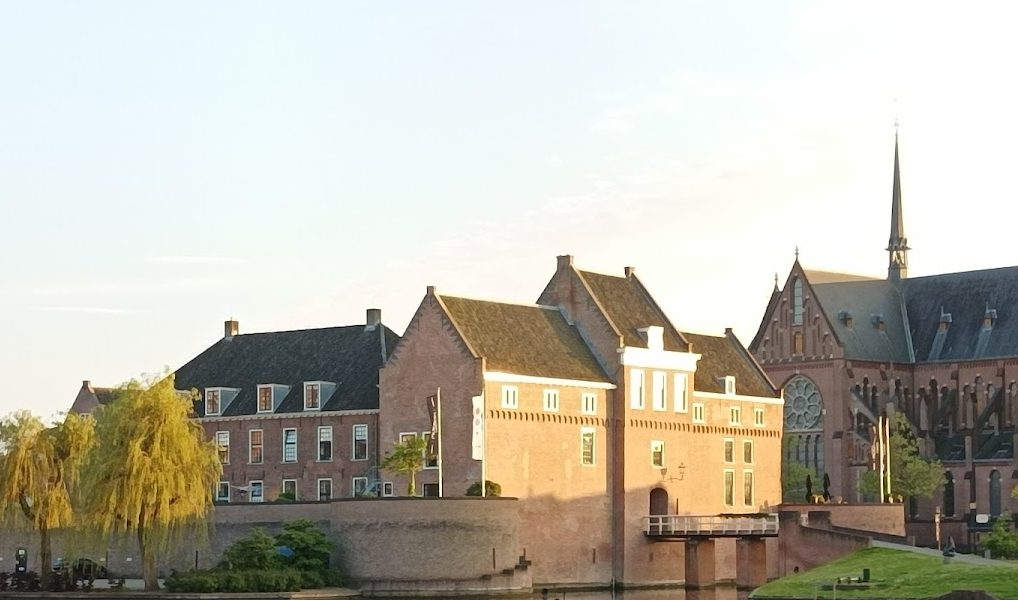
Kasteel Woerden has a square plan and retains the basic form of a fortified castle, with a drawbridge, three round towers, and one rectangular tower. Its position and defensive arrangement reflect the castle’s original military purpose. The complex stands beside the much later Sint-Bonaventurakerk.
Fortified castle layout
The square castle is organized around its enclosed fortified structure. Three round towers and a rectangular tower form the principal surviving tower elements, while the drawbridge marks the defended entrance. Together, these features define the castle’s medieval architectural character.
Moat and peninsula
The moat was filled in for a long period, changing the castle’s setting. It has since been excavated again and now largely surrounds the building with water. Kasteel Woerden occupies a small peninsula within the surrounding canal.
Nearby sites