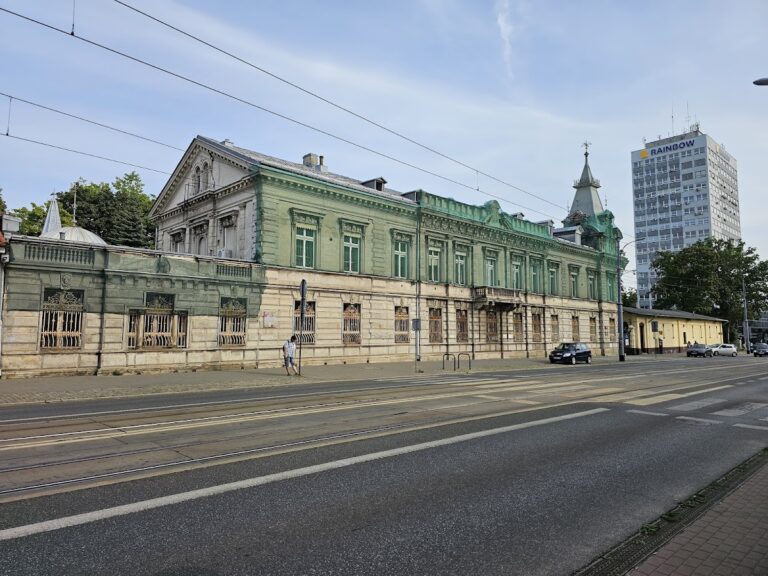
Karl Wilhelm Scheibler’s Palace: Industrialist’s Residence and Museum of Cinematography in Łódź


Site at a Glance
- Rating
- 4.8
- Popularity
- Medium
- Country
- Poland
- Primary era
- Modern
- Eras represented
- Modern
- Civilizations
- Russian
- Site type
- Domestic
- Remains
- Elite Residence
On this page9 sections
History
Karl Wilhelm Scheibler’s palace is a nineteenth-century industrialist’s residence in Łódź, Poland, built in 1856 beside Scheibler’s large textile factory and the associated workers’ settlement of Księży Młyn. Scheibler, a major textile industrialist linked to the city’s industrial development, commissioned the original building from Jan Karol Mertsching.
Construction and reconstruction
The palace was first rebuilt in 1865. Its present two-storey Neo-Renaissance form was created during a major reconstruction carried out between 1884 and 1887 by the Warsaw architect Edward August Lilpop. The work was commissioned by Scheibler’s widow, Anna Scheibler. Although the exterior acquired its current Renaissance-revival character during this period, the interiors remained eclectic, combining elements drawn from several historical styles.
Furnishings were brought to the residence from Berlin, Dresden, and Paris. The palace formed part of the same industrial estate as Scheibler’s factory and workers’ settlement, linking the family’s domestic life with the textile enterprise that helped shape Łódź’s nineteenth-century growth.
From family residence to institutional use
The Scheibler family lived in the palace until 1932. During restructuring proceedings involving the company, which was then close to bankruptcy, the property passed to Bank Gospodarstwa Krajowego, a Polish state bank and the company’s largest creditor. From January 1933 to September 1939, Feliks Maciszewski, president and managing director of the United Industrial Works of Karol Scheibler and Ludwik Grohman in Łódź, lived there on the bank’s behalf.
The Second World War brought further changes to the building’s occupants. Jerzy Scheibler, a member of the company’s supervisory board, lived there temporarily. Łódź police officials occupied some first-floor rooms from 1939 to 1941, while senior officials of AEG may have used the palace between 1941 and 1945. The Wehrmacht, Nazi Germany’s unified armed forces, was the principal occupant during this period.
After the war, the palace became the seat of the rectorate of the Łódź University of Technology, probably from about 24 May 1945 until 1950. Other institutions followed. The State First-Degree Music School used the building from 1957 to 1990, occupying only rooms in the former stables during its final years.
Heritage and cinematic history
The palace entered the historic-monument register in 1957, with further registrations in 1964 and 1971. It received the Polish designation Monument of History in 2015, a high-level heritage status reserved for nationally significant historic sites.
Since 1986, the building has housed the Museum of Cinematography, described as the only museum of its kind in Poland. The school and the Museum were co-owners from 1986, and the Museum is now the owner. The palace has also served repeatedly as a film location. Its interiors were extensively presented in Leszek Skrzydło’s 1967 black-and-white film Palaces of the Promised Land, whose commentary used passages from Władysław Reymont’s novel The Promised Land, read by Kazimierz Rudzki. Andrzej Wajda showed a long interior sequence in his film The Promised Land.
Other productions filmed in the palace include Mansarda (1963), Pavoncello (1967), episodes of Stawka większa niż życie (1968), Różaniec z granatów (1970), Jak daleko stąd, jak blisko (1971), Lalka (1977), Biały mazur (1978), Vabank (1981), Czerwone węże (1981), Między ustami a brzegiem pucharu (1987), Ludożerca (1987), Łabędzi śpiew (1988), Pożegnanie jesieni (1990), Powrót wilczycy (1990), Podróż na wschód (1994), Inland Empire (2006), which used only the north elevation, Shirley (2009), Nie ten człowiek (2009), and Złodzieje serc (2010).
The palace also hosted Iwona Łękawa’s film programme Zbliżenia, czyli to i owo o filmie from 1979 to 1992, with an interruption during the period of martial law. The programmes Klapsik and FILMówka were also held there.
Remains
The surviving complex consists of the two-storey Neo-Renaissance palace, its richly finished interior rooms, the former stables, and the former carriage house. The palace rooms now serve as temporary-exhibition galleries for the Museum of Cinematography, while the former stables contain the Museum’s administration. The reconstructed carriage house contains Kinematograf, a museum cinema that opened on 6 October 2006 and operates as a studio cinema.
Palace interiors
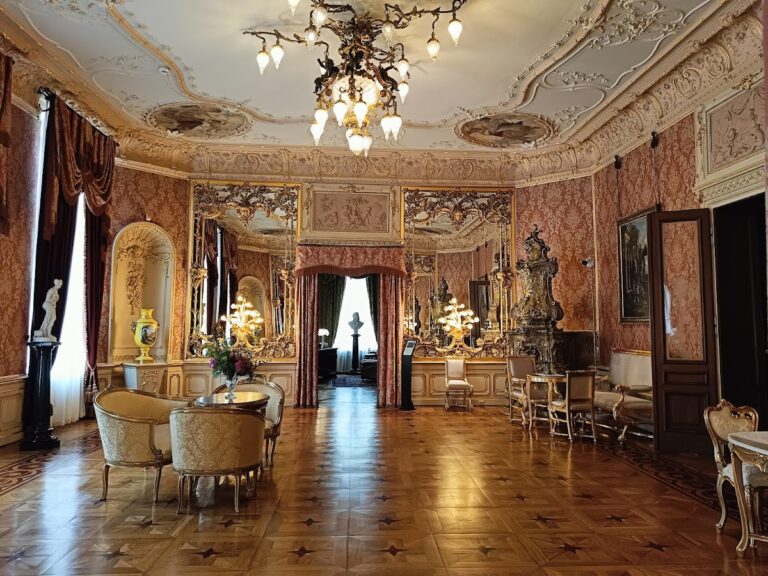
The principal ground-floor rooms are arranged as an enfilade, a sequence of rooms linked by aligned doorways that creates a continuous view through them. The suite includes a study, a mirrored room, a Neo-Mannerist dining room, a Moorish room, and a Neo-Rococo bedroom. Wood panelling, imitation embossed-leather coverings, patterned wallpapers, paintings, valuable stoves, and sideboards contribute to the eclectic interior scheme. Neo-Mannerist and Neo-Rococo details revive the forms of earlier European styles, while the Moorish room uses motifs associated with Islamic architecture of the western Mediterranean.
The former owner’s study
The former owner’s study contains an 1886 Venetian mosaic made by the stucco artist Antonio Salviati. It is identified as Salviati’s only work in Łódź, and remains in the room as part of the palace’s interior decoration.
The former palace bath
The former bath on the first floor contains a nineteenth-century photoplasticon made by August Fuhrmann. A photoplasticon is a viewing device that presents stereoscopic photographic images through a series of individually viewed pictures. The example in the palace is described as one of only four surviving examples in the world.
Former stables and carriage house
The former stables belong to the palace complex and now function as the Museum of Cinematography’s administration building. In the final years of the State First-Degree Music School’s occupation, the school used rooms in this part of the complex. The former carriage house has been thoroughly reconstructed and now accommodates Kinematograf, the Museum’s studio cinema.
Nearby sites