Château de Valmy: An Art Nouveau Wine Estate in France


Site at a Glance
- Rating
- 4.5
- Popularity
- Medium
- Country
- France
- Primary era
- Modern
- External website
- Open
- Eras represented
- Modern
- Civilizations
- French
- Site type
- Domestic
- Remains
- Castle
On this page6 sections
History
Château de Valmy is an Art Nouveau residence in Argelès-sur-Mer, France, commissioned for Jeanne Bardou by her father, Pierre Bardou, and built between 1888 and 1900. Designed during the Belle Époque, a period of cultural and economic prosperity in France before the First World War, the château formed part of Pierre Bardou’s plans to create a residence for each of his three children.
Pierre Bardou was a wealthy industrialist from Perpignan who developed the JOB cigarette-paper brand founded by his father, Jean Bardou. Jeanne married Jules Pams in 1888, the year construction began. Pams was a lawyer and an important political figure of the French Third Republic, the republican regime that governed France from 1870 to 1940. He served as president of the General Council of Pyrénées-Orientales, an elected departmental institution, as well as deputy, senator, Minister of Agriculture, and Minister of the Interior in Georges Clemenceau’s government from 1917 to 1920. He also unsuccessfully opposed Raymond Poincaré in the 1913 presidential election.
The château complex was completed in 1900 and inaugurated in 1904. After Jules Pams died in 1930, his second wife, Madame Holtzer, inherited the Pams fortune together with part of the Bardou fortune. She later sold Château de Valmy to Victor Peix, a winegrower and distiller from Millas.
Victor Peix enlarged the vineyards around the residence and established the Valmy and Valmya wine brands, which quickly gained a strong reputation. His descendants remain the owners. Viticulture was later revived by the Pams family, and the estate covered 24 hectares in the 1990s. It subsequently developed a wine-tourism business with guest accommodation and a restaurant, while remaining privately owned.
Remains
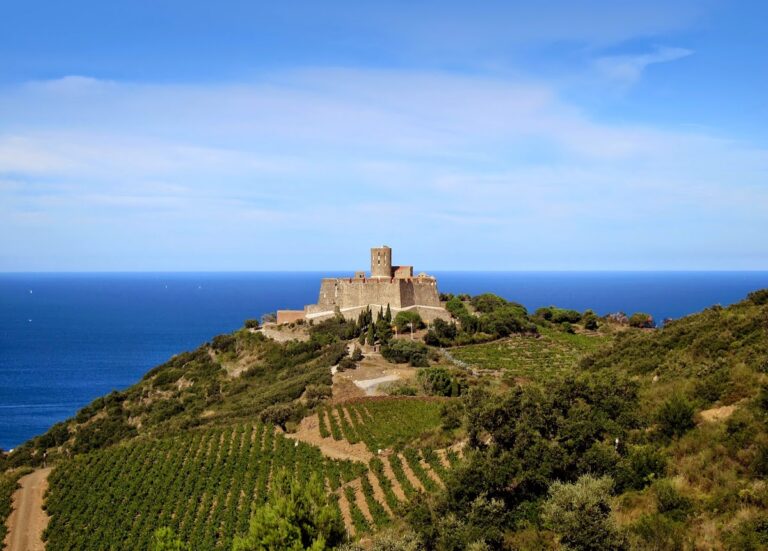
Château de Valmy stands on elevated ground in Argelès-sur-Mer, within the Pyrénées-Orientales. The estate combines a large Art Nouveau residence with surrounding vineyards. Its surviving design belongs to the Belle Époque and reflects an architectural movement known for asymmetrical forms, organic decoration, and the close integration of architecture with the applied arts.
Architecture and estate features
Art Nouveau residence
Designed by the Danish architect Viggo Dorph-Petersen, the château is a large bourgeois residence with ornate pinnacles, slender turrets, long asymmetrical windows, bow windows, and floral ceramic medallions. These elements give the building its distinctive decorative character while preserving the scale of a private family residence.
Reinforced-concrete structure
Château de Valmy was among the first private buildings in the region to use a reinforced-concrete structural frame. This load-bearing skeleton, made from concrete strengthened with steel, allowed greater freedom in the treatment of the walls and façades. Stone and brick were also used in the construction.
Vineyards and modern estate use
Vineyards surround the château and remain central to the estate’s identity. The present wine-tourism use includes five guest rooms within the château and a restaurant. A terrace offers a panoramic view extending from the Albères to the Mediterranean.
Nearby sites