Schloss Elmau: Cultural Retreat, Luxury Hotel, and Summit Venue
Site at a Glance
- Rating
- 4.8
- Popularity
- Medium
- Country
- Germany
- Primary era
- Modern
- External website
- Open
- Eras represented
- Modern
- Civilizations
- German
- Site type
- Domestic
- Remains
- Elite Residence
On this page15 sections
History
Schloss Elmau is a cultural retreat and hotel in Germany, built between 1914 and 1916 in the Reform architecture style for the writer, philosopher, and theologian Johannes Müller. Its history extends from a rural mountain estate to a centre of music and intellectual life, a wartime and postwar convalescent institution, and a venue for international diplomacy.
From rural estate to royal connection
The name Elmau first appears in 1395 and derives from a term for an alluvial meadow covered with elm trees. From 1542, the area developed through isolated farms, a sawmill, and an inn. After the local economy declined, the property was sold to two women who admired King Ludwig II of Bavaria, the nineteenth-century monarch known for commissioning romantic and historicist residences.
Ludwig regularly stayed at the estate while travelling to his mountain residence at Schachen, built around 1870. Following his death in 1886, Elmau lost much of its earlier importance.
Johannes Müller and the cultural retreat
Johannes Müller acquired the isolated estate in 1912. With substantial financial assistance from Elsa von Michael, he commissioned Carl Sattler to build Schloss Elmau between 1914 and 1916. The institution opened at Pentecost 1916 as a “free space for personal and communal life,” joining retreat in nature with concerts and dances shaped by Müller’s religious ideals.
Elmau was intended as a community and cultural institution for like-minded visitors and artists. Adolf von Harnack, Ernst Troeltsch, and Prince Max of Baden were among Müller’s early guests and friends. Prince Max regarded Müller as an intellectual mentor and hoped that he could help him overcome anxiety and psychological isolation.
Chamber music and dance evenings stood at the centre of cultural life from the opening. About 150 concerts were held annually as early as 1916, with chamber music deliberately focused on Mozart, Beethoven, and Schubert. The pianist Elly Ney played a prominent role. Music weeks, readings, concerts, and regular dances continued through the interwar period.
National Socialism and the Second World War
During the period of National Socialism, Müller combined admiration for Adolf Hitler with public criticism of Nazi biological ideology and antisemitism. The Propaganda Ministry targeted him as a supposed “friend of the Jews,” restricting his publications and lectures. In 1942 it sought his arrest, but the arrest did not take place. The Hitler salute was prohibited at Elmau, and the estate did not become a preferred hotel of the Nazi elite.
From 1942, part of the property was leased to the Wehrmacht, the armed forces of Nazi Germany from 1935 to 1945, as a convalescent home for soldiers. In 1943, Alexander Schmorell of the White Rose, a German resistance group opposed to National Socialism, attempted to use Elmau as part of an escape route to Switzerland. After the attempt failed, he returned to Munich, where he was denounced, arrested, and executed. In 1944, Schloss Elmau was converted into a military hospital.
Postwar convalescence and cultural renewal
In 1947, Bavarian state commissioner Philipp Auerbach took over the property without legal title. After brief use by the US Army as a hospital and winter military school, Elmau became a convalescent home for tuberculosis patients, displaced persons, and Holocaust survivors. Henri Heitan of the Joint Distribution Committee identified the property for this purpose, and Jakob Rosenberg served as director. Survivors could stay there for fourteen days at a time.
After Auerbach’s arrest in 1951, his suicide in prison in 1952, and his rehabilitation in 1954, the Müller heirs leased the property from the Bavarian state. Bernhard Müller-Elmau and Sieglinde Mesirca were recognized as heirs in 1960. With Sieglinde’s husband, hotel director Odoardo Mesirca, and support from regular guests and artists, they restored Elmau’s role as a cultural and convalescent institution over the following four decades.
The British-German Music Days began at Elmau in January 1957 through the initiative of conductor Hans Oppenheim and the Amadeus Quartet. Yehudi Menuhin, Gidon Kremer, Wilhelm Kempff, Emil Gilels, Alfred Brendel, Friedrich Gulda, Hermann Prey, Thomas Quasthoff, and Benjamin Britten were among the performers. Group 47, an influential German-language writers’ association, also met at Elmau in 1957. The International Society for Depth Psychology and the Anthroposophical Society held meetings there as well.
Transformation, fire, and reconstruction
Dietmar Mueller-Elmau leased Schloss Elmau in 1997 and became its majority shareholder. He redirected the institution toward luxury wellness tourism, ended the communal table arrangements and morning dance sessions, reduced the remaining dance programme, and removed compulsory participation in communal social life. From 1998, the property also became a regular meeting place for Jewish scholars from around the world.
A major fire in August 2005 destroyed the upper floors, two wings, and about two-thirds of the rooms. Water used to extinguish the fire caused further extensive damage. Reconstruction of the Schloss and bathhouse began in April 2006 under plans by Dietmar Mueller-Elmau and architect Christoph Sattler, grandson of the original architect.
Schloss Elmau reopened on 21 June 2007 as a five-star “Luxury Spa & Cultural Hideaway” and became a member of The Leading Hotels of the World. Its musical, literary, and symposium programme continued, with more than 200 musical events annually and an established place for jazz alongside classical music. The Schloss Elmau Retreat opened on 21 March 2015 after two years of construction. It was conceived as both a hotel and a cultural and conference centre concerned with German intellectual and cultural history, theology, philosophy, and the relationship between religion and politics.
International summits and protected status
Schloss Elmau hosted the G7, an international forum of Germany, France, Italy, Japan, the United Kingdom, the United States, and Canada, with European Union representatives also participating, on 7 and 8 June 2015. Preparations in 2014 included road improvements, asphalt surfacing, drainage works, and a helicopter landing site. An eight-kilometre security zone surrounded the venue, and approximately 20,000 police officers were deployed. The summit produced an agreement on decarbonizing industrial societies that was described as helping establish the basis for the Paris climate agreement.
A second G7 summit took place at Schloss Elmau from 26 to 28 June 2022. The German government stated that the property met the logistical and security requirements for the meeting. Parts of Schloss Elmau are protected monuments in the Bavarian monument register. The estate’s identity now brings together its original cultural and religious purpose, its political history, its postwar convalescent use, and its role as a luxury hotel and cultural venue.
Remains
Schloss Elmau stands above Klais in the municipality of Krün at about 1,008 metres above sea level, at the foot of the Wetterstein mountains in Upper Bavaria. The estate occupies a mountain valley between the Wamberg to the north and the Wettersteinwand to the south. Its physical setting includes the historic Schloss, the 2015 retreat building, the chapel, the Elmauer Alm, and the surrounding meadow and geological formations.
Historic Schloss and associated buildings
Main building
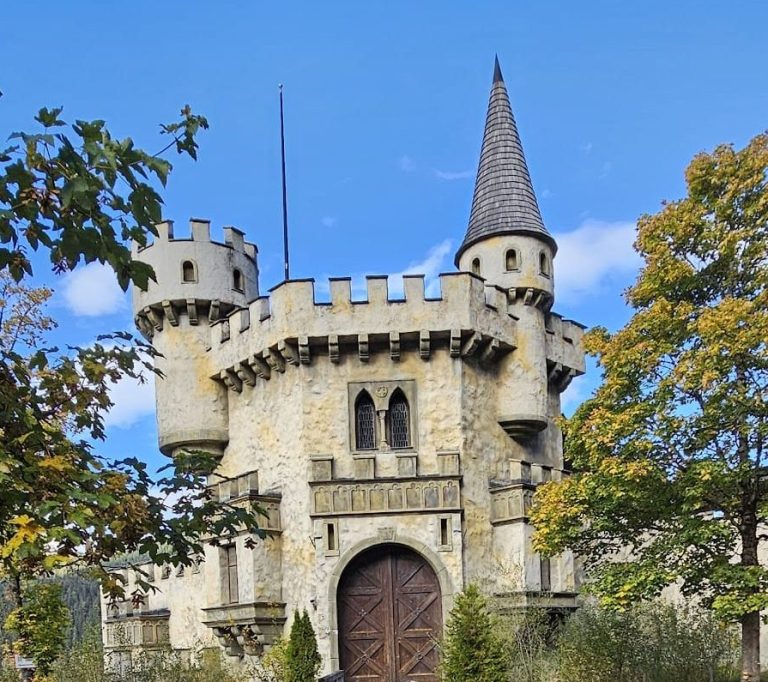
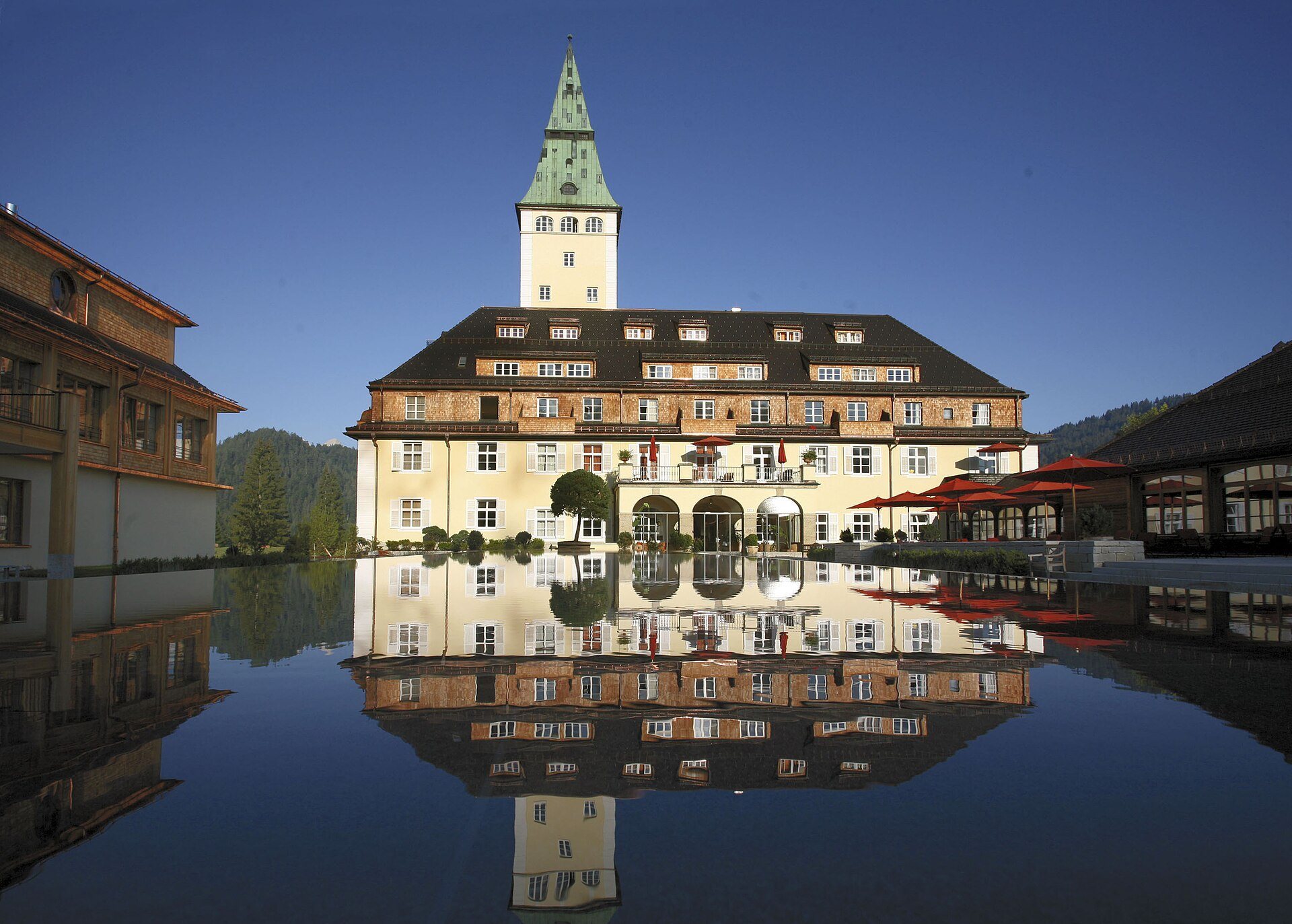
Carl Sattler’s building of 1914 to 1916 belongs to Reform architecture, an early twentieth-century movement that sought simpler, more functional forms instead of heavily historicist design. The original design included an elaborate hipped roof, a tower, and entrance halls. About 150 rooms were arranged with a large dining hall, concert hall, tea room and terrace, fireplace room, refreshment room, small garden pavilion, interior courtyard, broad corridors, and several staircases. The grounds also contained two tennis courts and bocce courts.
The south wing rises six storeys and provides guest rooms. The 2005 fire severely damaged the upper floors and destroyed two wings, while firefighting water caused additional damage. The affected sections were partly demolished, and the Schloss and bathhouse were rebuilt between 2006 and 2007 under Christoph Sattler. The rebuilt hotel contains 115 rooms and suites and spa facilities. Its concert hall seats about 300 people and hosts roughly 220 classical and jazz concerts each year.
Schloss Elmau Retreat
The Schloss Elmau Retreat stands 150 metres west of the historic building. Opened in 2015, the modern complex contains 47 rooms and suites, three restaurants, and two spas. Its planning was undertaken by Hilmer & Sattler and Albrecht together with DBLB Architects of Munich.
Elmau Chapel
The Elmau Chapel near the estate was built in 1778 and decorated in 1781 with exterior and interior frescoes by Josef Degenhart of Telfs. This Baroque monument has a roof turret and was comprehensively renovated in 1994. Its exterior paintings show the Flight into Egypt above, Saint Andrew on the left, and Saint Bartholomew on the right. The ceiling painting depicts the Coronation of Mary.
Elmauer Alm
The Elmauer Alm belongs to Schloss Elmau. Built as an alpine hut in 1927, it was expanded for guest hospitality in the early 1950s. It stands on a ridge 1,203 metres above sea level, about 1,380 metres north of the Schloss. Its position provides views toward the Zugspitze, the Wetterstein and Karwendel ranges, the Alp and Dreitorspitze, the Soiern group, and, in favourable conditions, far into Tyrol.
Geology and meadow
Schloss Elmau stands on Late Glacial gravels deposited during the Würm glaciation. The underlying rocks consist mainly of the Raibl strata, marine deposits formed during the Upper Triassic about 230 million years ago. The associated Elmau meadow, identified with the Drüsselgraben, is a protected natural area whose plant life includes spring gentians covering its rises and hollows with blue flowers.
Restaurant
The restaurant now called Ikigai was formerly Luce D’Oro. Luce D’Oro received two Michelin stars in 2019.