Vallø Castle: A Noblewomen’s Foundation and Manor House in Denmark


Site at a Glance
- Rating
- 4.5
- Popularity
- Medium
- Country
- Denmark
- Primary era
- Early Modern
- External website
- Open
- Eras represented
- Medieval, Early Modern
- Civilizations
- Danish
- Site type
- Domestic
- Remains
- Castle
On this page11 sections
History
Vallø Castle is a manor house in Denmark with medieval origins and a history connected to noble landholding, royal ownership, and a residential foundation for women of the Danish nobility. Vallø was first recorded as the possession of Eskild Krage in 1330, while remains of buildings from the thirteenth century have also been found.
Medieval and Renaissance Vallø
The estate was predominantly held by women from the fifteenth century onward. Between 1554 and 1651, it was divided into West Vallø and East Vallø. In 1525, ownership passed to Count Oluf Rosenkrantz, a Danish nobleman. After his death, his daughters Birgitte and Mette Rosenkrantz inherited the estate.
Birgitte Rosenkrantz enlarged Valløby Church, which had previously consisted of a single chapel. Mette Rosenkrantz directed a major rebuilding of Vallø between 1580 and 1586, including the south wing and the southern end of the west wing. She was described at the time as one of the wealthiest women in Denmark.
During Christen Skeel’s ownership, from 1638 to 1659, the castle was enlarged to three storeys and the west wing was extended. These changes contributed to the form of the estate that later royal and foundation-led building campaigns would further develop.
Royal Ownership and the Vallø Foundation
King Frederick IV acquired Vallø in 1708, after which it passed to Anne Sophie Reventlow. In 1731, King Christian VI transferred the property to Queen Sophia Magdalena. She founded the Noble Vallø Foundation for Unmarried Daughters in 1737.
At Sophia Magdalena’s direction, Vallø became a residential foundation for elderly unmarried women of noble birth in 1738. Its rules provided for an abbess from Denmark’s ruling dynasty, a mother superior who was a widow of high social rank, and no more than twelve resident women. Men were not permitted to remain in the castle overnight.
The Vallø Foundation continues to own the estate, which covers 4,109 hectares, including 1,860 hectares of woodland. Its income comes from agriculture, forestry, house rentals, the inn, a campground near Køge, and the leasing of hunting grounds. The castle continues to house women of the Danish nobility. Since 1976, admission has also included widows and divorced women rather than being limited to unmarried women.
Fire, Restoration, and Later History
A severe fire damaged Vallø Castle in 1893. Hans Jørgen Holm restored it largely according to its former design between 1893 and 1904. The fire and reconstruction also led to a relaxation of the residence rules.
Vallø Stift has its own churchyard. Burials there include Sophia Magdalena of Denmark, Regitze Barner, August Villads Bech, Frederik Moltke, Johanne Svanenskjold, and Elisabeth Wedell-Wedellsborg.
The castle has also served as a filming location. Carl Theodor Dreyer filmed Gertrud there in 1964, and the location was later used for The Olsen Gang Sees Red in 1978, The Girl from Egborg in 1989, and the television series Badehotellet.
Remains
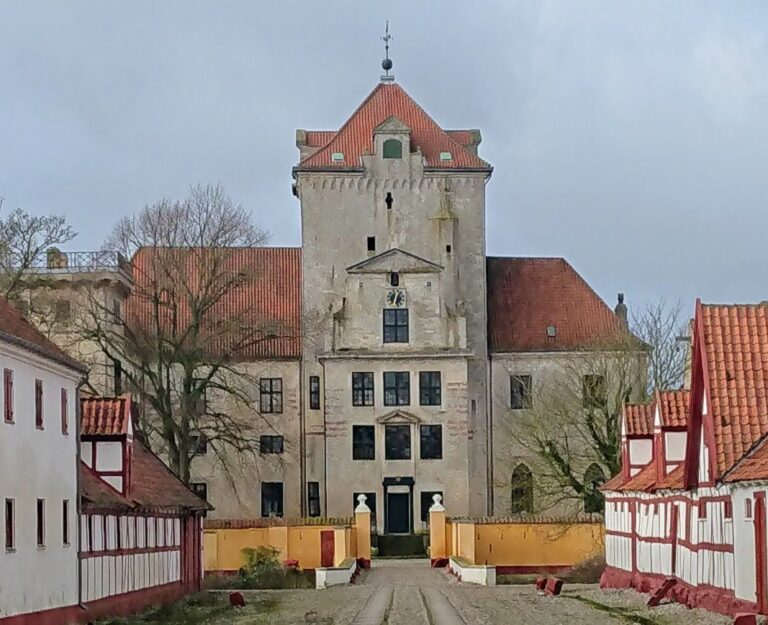
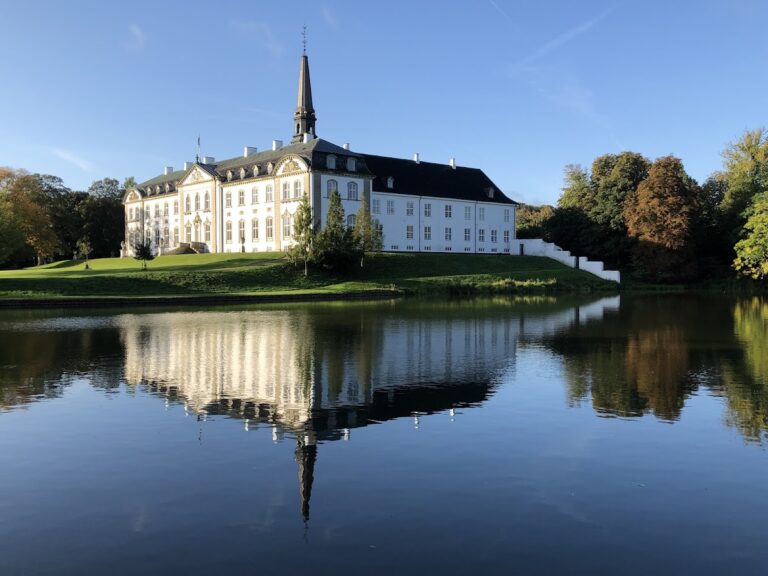
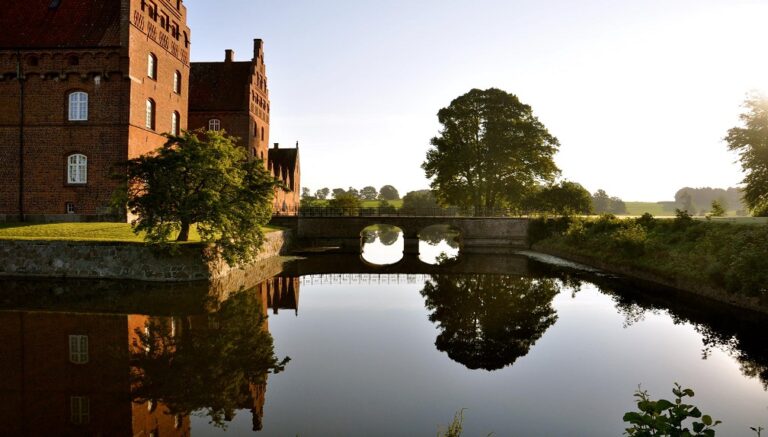
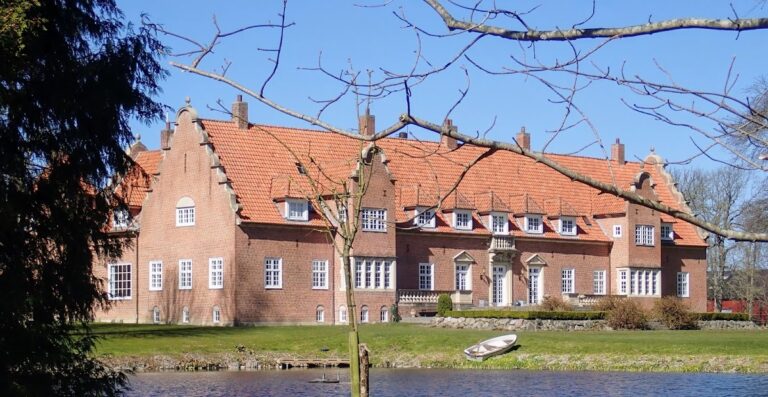
Vallø Castle stands on Zealand, approximately 7 kilometres south of Køge in Stevns Municipality. The manor house consists of four wings enclosed by a moat, a water-filled defensive ditch. Robust towers reinforce the complex, including both a round tower and a square tower.
Castle Buildings
South and West Wings
The south wing and the southern end of the west wing date from the rebuilding carried out between 1580 and 1586. The south wing is distinguished by substantial corner towers. During the seventeenth-century ownership of Christen Skeel, the castle was raised to three storeys and the west wing was extended.
North Wing and Courtyard Building
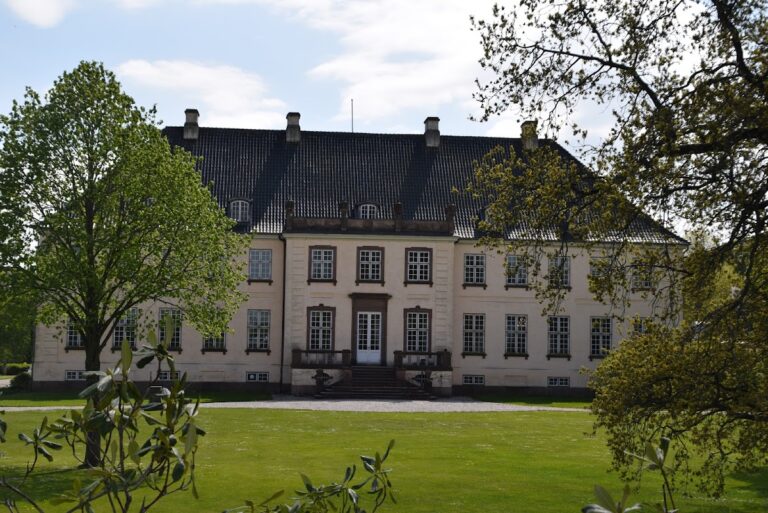
Johan Cornelius Krieger built the north wing in 1721. Between 1735 and 1738, Lauritz de Thurah designed a three-winged building for the courtyard. Its surviving central wing was enlarged with an additional storey by Georg David Anthon in 1765.
Park and Estate Buildings
Gardens and Landscape
The park contains lakes and preserves elements of the French gardens created during the 1720s. In 1830, it was converted into a Romantic landscape garden, a design intended to evoke natural scenery through irregular planting, winding paths, and varied views. A large flower park established in 1960 was later discontinued.
Vallø Castle Street
A group of historic houses stands beside the castle and park along a street known as Vallø Castle Street. Vallø Castle Inn forms part of this historic estate complex and received a royal privilege in 1784. Additional houses belonging to the estate are distributed across the surrounding countryside.