Gjorslev: A Medieval Castle in Denmark


Site at a Glance
- Rating
- 4.3
- Popularity
- Low
- Country
- Denmark
- Primary era
- Medieval
- External website
- Open
- Eras represented
- Medieval, Early Modern, Modern
- Civilizations
- Danish
- Site type
- Military
- Remains
- Castle
On this page15 sections
History
Medieval Foundation and Episcopal Ownership
Gjorslev is a medieval castle in Denmark, built around 1400 by Peder Jensen Lodehat, Bishop of Roskilde. Its Gothic secular architecture, meaning medieval non-religious construction with monumental masonry and strongly vertical forms, makes it one of Denmark’s best-preserved examples of the style. The castle remained under the ownership of the bishops of Roskilde until the Reformation, the sixteenth-century religious and political transformation that ended Roman Catholic ecclesiastical control in Denmark and brought the confiscation of church property. Gjorslev was confiscated in 1537.
Changing Ownership, 1540–1793
The castle was sold in 1540 and then passed through a long succession of owners. These included Peder Svave, Else Mouritzdatter Svave, Elsebe Pedersdatter Svave, later Juel, Peder Vincentsen Juel, Ellen Vincentsdatter Juel, later Bille, Vincents Jensen Bille, Just Høg, Stygge Høg, Joachim Irgens von Westervick, Cornelia Bicker, later Irgens, and the Schardinell trading house. Gjorslev returned to Crown ownership in 1678.
Christen Lindencrone acquired the estate in 1743. He had made his fortune as a supercargo, a commercial officer who managed a merchant ship’s cargo and trade during a voyage, for the Danish Asiatic Company. He was ennobled as Lindencrone in 1756. After his death, the estate passed to his son Johan Frederik Lindencrone, who retained it until 1793.
The Scavenius and Tesdorpf Estates
Jacob Brønnum Scavenius purchased Gjorslev in 1793. After his death, his widow retained the estate for five years. It then passed to their son Peder Brønnum Scavenius in 1825 and to his son Jacob Frederik Brønnum Scavenius in 1868. Frederik Scavenius held it from 1915 to 1923, followed by Else Haxthausen from 1923 to 1925.
Adolph Tesdorpf purchased Gjorslev in 1925, beginning the estate’s continued ownership by the Tesdorpf family. Ownership later passed through Agnete Tesdorpf, née Brun, Edward Tesdorpf, and Peter Henrik Tesdorpf. Jens Edward Tesdorpf acquired it from his father in January 2018. The estate ceased milk production in 2020–21.
Remains
Castle Layout and Construction
Cruciform Castle
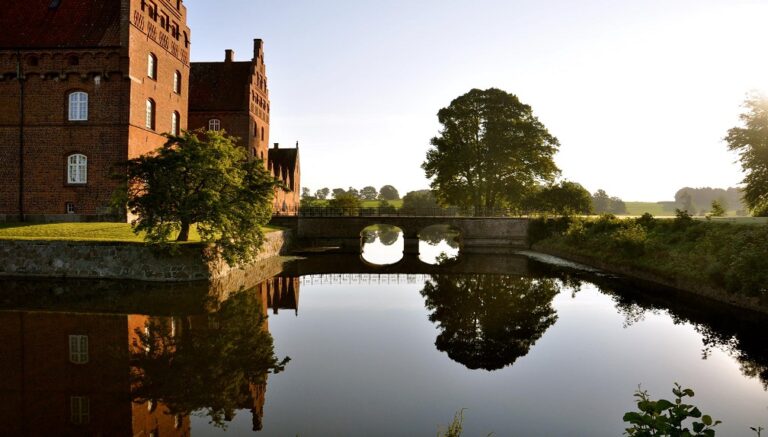
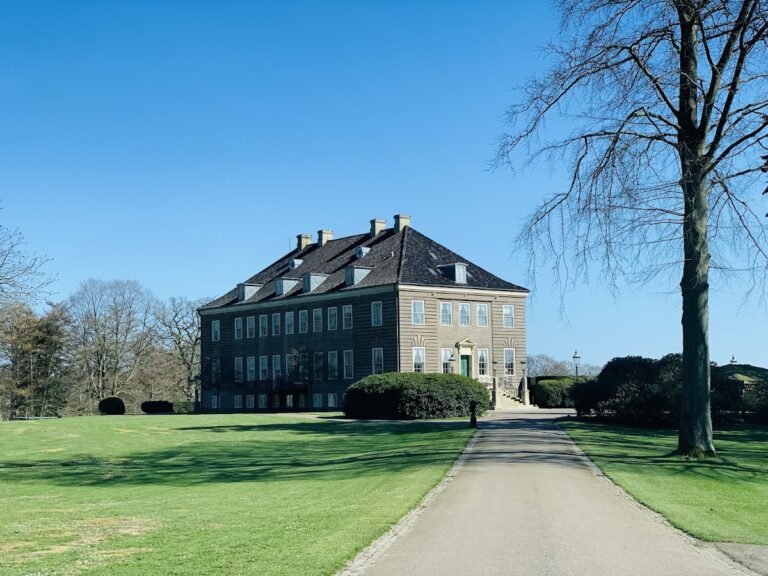
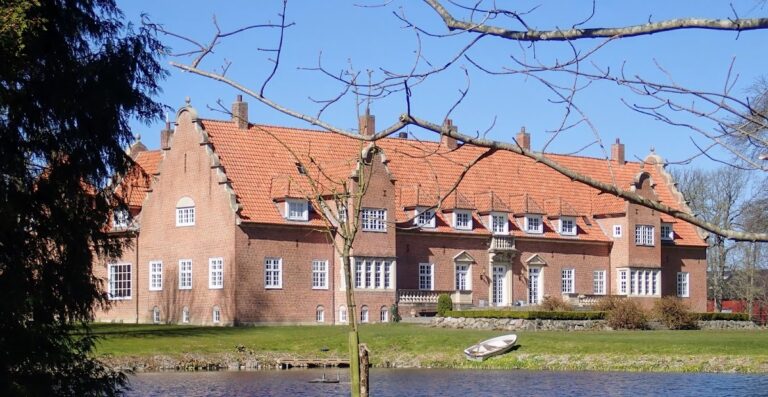
Gjorslev is a cruciform castle surrounded by moats on the Stevns Peninsula in Stevns Municipality. It combines local limestone from the Stevns cliffs with large bricks known as “monk stones.” The central tower rises just under 30 metres and contains seven storeys. The southern arm of the cross is slightly longer than the other three. A lower northern wing was added in 1638, while a long southern wing was added in 1843.
Entrance and Central Tower
The original entrance lay beneath the bishop’s chapel on the eastern side of the southern cross arm. From there, access passed through the cellar to a vaulted cellar beneath the tower. Stairs then led upward to the domed hall on the ground floor.
Alterations to the Exterior and Interior
Baroque Entrance Arrangement
Between 1665 and 1676, Ewert Janssen altered the entrance arrangement. The bishop’s chapel was demolished, the entrance was moved to the eastern cross arm, and that arm received a new facade and an internal staircase in the Baroque style. Baroque architecture is characterized here by formal facades, controlled symmetry, and more elaborate spatial treatment.
Roofs and Gables
In 1748, the original crow-stepped gable with blank arches was replaced by hipped roofs. The tower also received a pyramidal roof, changing the castle’s external profile while preserving its principal cruciform plan.
Street, Forest, and Burial Mounds
Broad Street and Farm Buildings
The castle stands at the end of a street called Broad Street. Red half-timbered farm buildings dating from 1713 line the street and form part of the estate’s surviving built setting.
Gjorslev Beech Forest
The estate includes Gjorslev Beech Forest, where the small lake Møllesøen, or “Mill Lake,” is noted for its birdlife. An observation tower also stands in the forest.
Burial Mounds
Fifty-five burial mounds are located in the forest. The longest, Fruehøj, measures 51 metres.
Nearby sites