Meggenhorn Castle: A Romantic Castle Estate in Switzerland


Site at a Glance
- Rating
- 4.8
- Popularity
- Medium
- Country
- Switzerland
- Primary era
- Modern
- External website
- Open
- Eras represented
- Early Modern, Modern
- Civilizations
- Swiss
- Site type
- Domestic
- Remains
- Castle
On this page11 sections
History
Meggenhorn Castle is a historic estate in Switzerland, situated in Meggen above Lake Lucerne. First recorded in 1240 as Mekkenhorn, the estate was associated at that time with a castle on the nearby island of Altstad. Parts of the property belonged to the collegiate foundation of St. Leodegar in Lucerne until the sixteenth century. The present castle was built in 1868–1870 as a Romantic castle influenced by the Loire châteaux, following centuries of changes in ownership and form.
From medieval estate to manorial residence
The name Meggenhorn appears in a 1240 contract between Engelberg Abbey, a Benedictine monastery in central Switzerland, and Count Rudolf III of Habsburg. Rudolf belonged to the Habsburg dynasty, a medieval ruling house whose territorial power included parts of present-day Switzerland. By the seventeenth century, the estate had become a private residence. In 1626, Ludwig Meyer, known as “the wealthy Meyer,” acquired it and developed it into a manorial estate.
After Meyer’s death, the property passed in 1663 to his daughter Dorothea as a marriage dowry. Her husband was Jakob Christoph Cloos, a councillor of Lucerne. Dorothea and Cloos had no children, so after her death in 1690 the estate went to her brother Placid, a captain of the Swiss Guard in Rome. The Swiss Guard is the military corps serving the pope. When Placid died without heirs, ownership passed in 1693 to his niece Anna Maria Catharina Meyer, who had married Jakob Balthasar around 1680. Her family later adopted the name Meyer von Schauensee.
The seventeenth- and eighteenth-century owners
Anna Maria Catharina’s son Jakob Rudolf entered public life as a court clerk in 1723 and became a member of the Grand Council in 1734. Financial difficulties led him to sell Meggenhorn in 1735 to Jakob Franz Castoreo, a notary and secretary to the papal nuncio. A papal nuncio was the pope’s diplomatic representative to a state or church jurisdiction.
Castoreo’s grandson Lorenz Castoreo later became a member of the Grand Council and a bailiff. In 1763, he married Josefa Meyer in an elaborate ceremony at the estate chapel. Archbishop Niccolò Oddi, the papal nuncio, conducted the ceremony. Joseph Rudolf Valentin Meyer purchased the manorial estate in 1767, but after being expelled from Lucerne he was forced to sell it three years later. Jost Ignaz Pfyffer, commander of the Swiss Guard, then acquired Meggenhorn. His son Karl Leodegar Pfyffer, who also commanded the Swiss Guard, inherited it after his death.
Nineteenth-century transformation
In 1803, Meggenhorn was sold to Maria Josefa Müller-Brand, formerly the owner of the Eselsmätteli estate in Altdorf. French troops had taken that property during the Napoleonic wars, a series of conflicts in which France fought changing coalitions of European powers. At Meggenhorn, remodelling followed in 1803–1804, particularly affecting the roof zone and the surrounding gardens.
Maria Josefa’s son, Lieutenant Colonel Josef Maria Müller, became owner in 1806. He acquired adjoining parcels and enlarged the estate to 37 Jucharten. A Juchart was a traditional Central European land measure whose exact size varied by locality. A barn burned in 1840 and was rebuilt. The property later passed to Müller’s daughter Sofie, who had married Josef Xaver Leonz Franz Schumacher in 1815. Colonel Josef Xaver Schumacher sold Meggenhorn to Edouard Hofer in 1857.
Edouard Hofer-Grosjean of Mulhouse commissioned the castle that stands today, constructed between 1868 and 1870. In 1886, the ensemble was acquired by Countess Amélie Celeste Marie Heine-Kohn and her husband, Armand Heine. Amélie had been Jewish and converted to Catholicism as an adult. She considered the existing house chapel insufficient and therefore commissioned a separate castle chapel.
The Heine-Kohn period and later ownership
Amélie Heine-Kohn died at Meggenhorn on 12 May 1915. In 1900, she had commissioned a Christ statue more than five metres high in gratitude for recovering from a serious illness. Leonhard Haas, Bishop of Basel, inaugurated the statue. In 1920, Paule Marguerite Laure Juliette Adélaïde Furtado-Heine sold the estate to the Zurich industrialist Jakob-Heinrich Frey-Baumann. His daughters inherited the castle in 1960.
Since 1974, the entire estate has belonged to the municipality of Meggen. The municipality restored the buildings after acquiring the property, and the estate is used as a museum and event venue. Meggenhorn is listed among the cultural properties of the Canton of Lucerne as a site of national importance and is recognized as a Swiss heritage site of national significance.
Remains
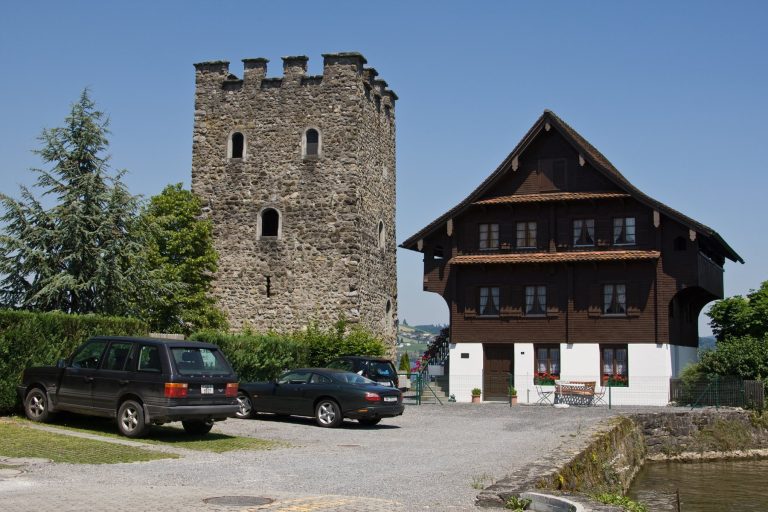
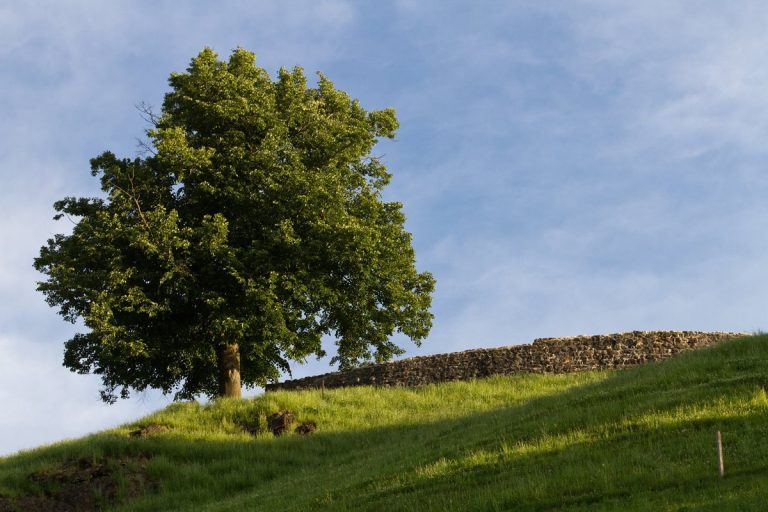
Meggenhorn occupies a hill descending toward Lake Lucerne between Lucerne and Meggen. Meadows and woodland surround the estate, which brings together the castle, a separate chapel, gardens, a vineyard, a large stable, and lakeside structures. The buildings and grounds reflect several building phases, from the country house and western garden of 1674–1675 to the Romantic castle of 1868–1870.
Early country house and estate buildings
The western country-house garden and the building with its small bell turret belong to the construction phase of 1674–1675. The gardens and roof zone were altered during the remodelling of 1803–1804. The barn rebuilt after the 1840 fire forms the northern part of the large stable, preserving a physical element of the nineteenth-century agricultural estate.
The Romantic castle and gardens
The present castle was designed as an imposing Romantic residence influenced by the Loire châteaux. It forms the central architectural element of the estate, alongside the separate chapel and the landscaped grounds. The gardens include a collection of hydrangeas associated with ProSpecieRara, a Swiss organization concerned with the preservation of cultivated plant varieties and livestock breeds.
The freestanding castle chapel
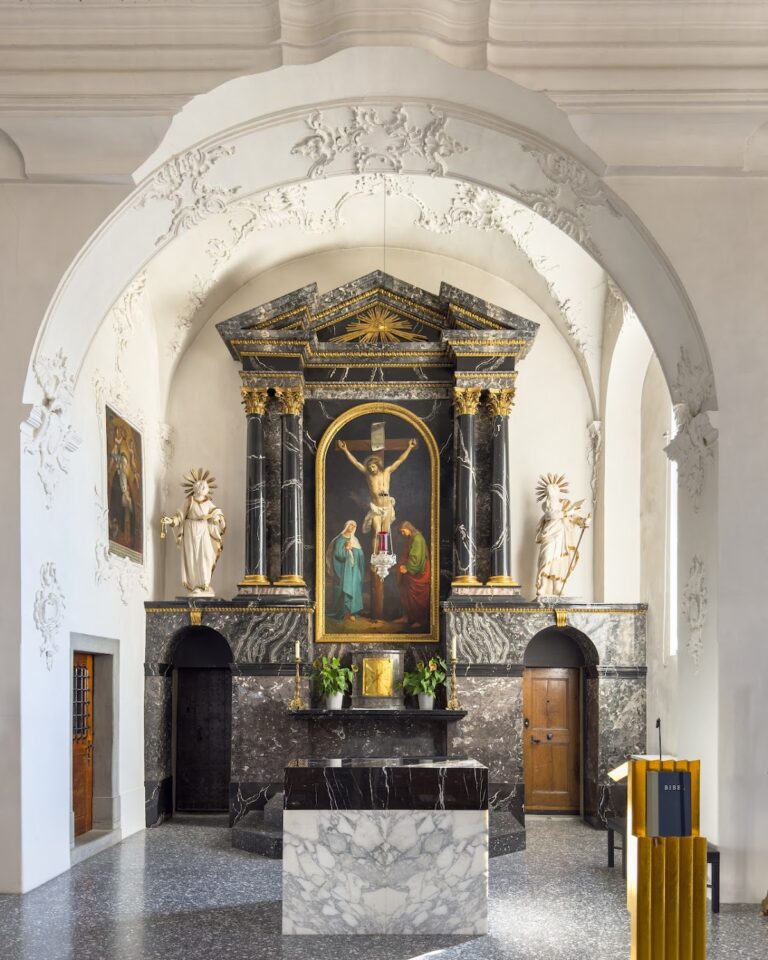
The separate castle chapel was designed by the Lucerne architect Heinrich Viktor von Segesser and built in a Neo-Gothic style. Neo-Gothic architecture uses forms inspired by medieval Gothic buildings, including pointed arches, strong vertical emphasis, and revival decoration. The chapel’s design was based on the chapel of Château d’Amboise on the Loire, and the building was inaugurated in 1888.
The Welte Philharmonic organ
The chapel contains a Welte Philharmonic organ built in 1926 by M. Welte & Sons of Freiburg im Breisgau for Jakob-Heinrich Frey-Baumann. This type of pipe organ combines manual playing with a pneumatic mechanism that reproduces performances from perforated paper rolls. The instrument has 13 stops, four transmissions, and one extension.
The console stands immediately to the left of the chapel entrance in a wooden niche resembling a confessional. The organ itself is installed in a general swell box in the basement beneath the chapel. Sound reaches the chapel through a grille in the floor and can also be directed to the adjacent exterior terrace, which lies at basement level, through a dedicated stop control and combination switch. One hundred and four paper rolls survive for the automatic mechanism, including rolls recorded by organists such as Max Reger, Eugène Gigout, and Marcel Dupré. Orgelbau Kuhn of Männedorf restored the organ in 1987 and 2020. The automatic mechanism was out of service as of 2026.
Vineyard and lakeside features
A vineyard beside and below the castle has existed since 1979. It covers about one hectare on a south-southwest-facing slope at approximately 470 metres above sea level. Its soil consists of clay, sand, and partly rocky subsoil, and it is planted mainly with Riesling-Silvaner. Wine from the estate is made in the press house on the castle grounds, with production including still wines, sparkling wines, and spirits. A signposted educational trail passes through the vineyard and explains viticulture. Since 2022, the vineyard has been managed using sustainable organic, specifically biodynamic, cultivation.
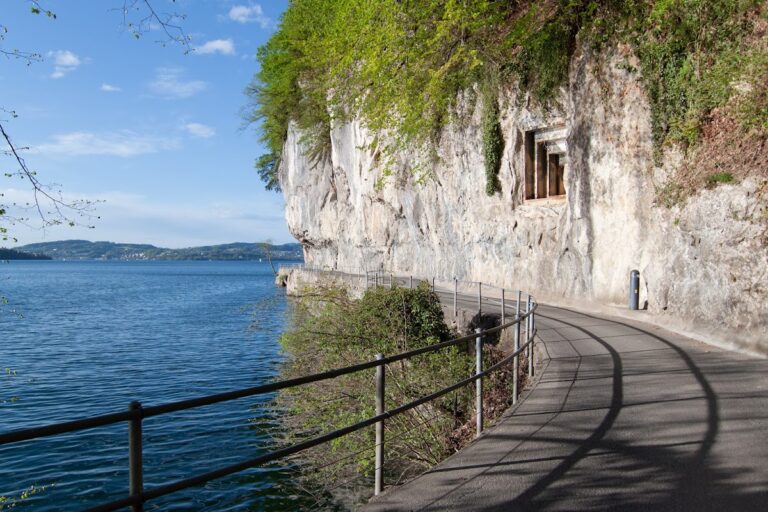
A landing stage associated with the Lake Lucerne Navigation Company stands near the Christ statue and the rock of Meggenhorn, a rock lying in the lake at the entrance to Lucerne Bay. Nineteenth-century timber-framed boathouses accompany the landing stage. Above the lakeshore, the more than five-metre-high Christ statue occupies a rocky spur, adding a commemorative feature to the estate’s lakeside landscape.