Musegg Wall: Lucerne’s Medieval City Fortification
Site at a Glance
- Country
- Switzerland
- Primary era
- Medieval
- Eras represented
- Medieval, Early Modern, Modern
- Civilizations
- Holy Roman Empire, Swiss
- Site type
- Military
- Remains
- Wall
On this page15 sections
History
Medieval construction
The Musegg Wall is a medieval city fortification in Lucerne, Switzerland, with construction underway by about 1370. It became part of the city’s historic appearance alongside the Water Tower and Chapel Bridge. Tree-ring analysis places the wall sections beside Luegisland at around or shortly after 1367. Work proceeded in stages into the fifteenth century: Schirmerturm dates to about 1420, and Zytturm to about 1442.
References to Lucerne’s fortifications in 1226 and 1238 concern an older inner defensive circuit, not the Musegg Wall. An account of building work in 1408 was once taken as a final bill showing the wall was complete, but it was an interim record. The proposed link between construction and the Battle of Sempach in 1386, a conflict between the Swiss Confederacy and Habsburg forces, is unfounded.
Explanations of the name Musegg have varied. Older proposals connected it with words for looking out or with an armoury or chain mail. Swiss place-name research instead derives it from muus, “mouse,” and egg, “corner” or “ledge.” The name may refer to terrain associated with many mice or to a small, mouse-like ledge, and the wall takes its name from Musegg hill.
Demolition and preservation
Between 1833 and 1856, Lucerne gradually demolished most of its other fortifications. The defenses obstructed growing traffic, and the municipal assembly considered the city more attractive without its medieval walls. Demolished sections included defenses on the southwestern side of the Reuss and an older northern wall with its gates and towers. The Musegg Wall largely escaped because its position on Bramberg did not impede traffic.
An association devoted to preserving the wall was founded in 2002, followed by a foundation in 2003. Their work led to a comprehensive restoration carried out between 2003 and 2015. The Musegg Wall is listed among Lucerne’s nationally significant cultural properties.
Remains
The wall and defensive walkway
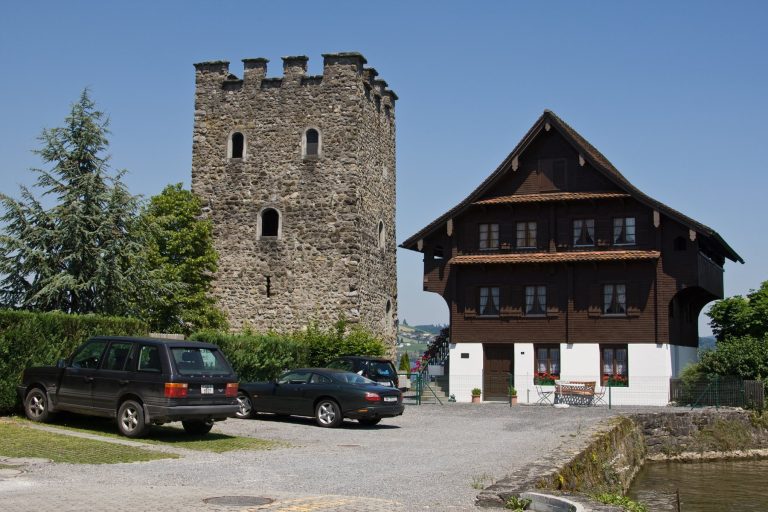
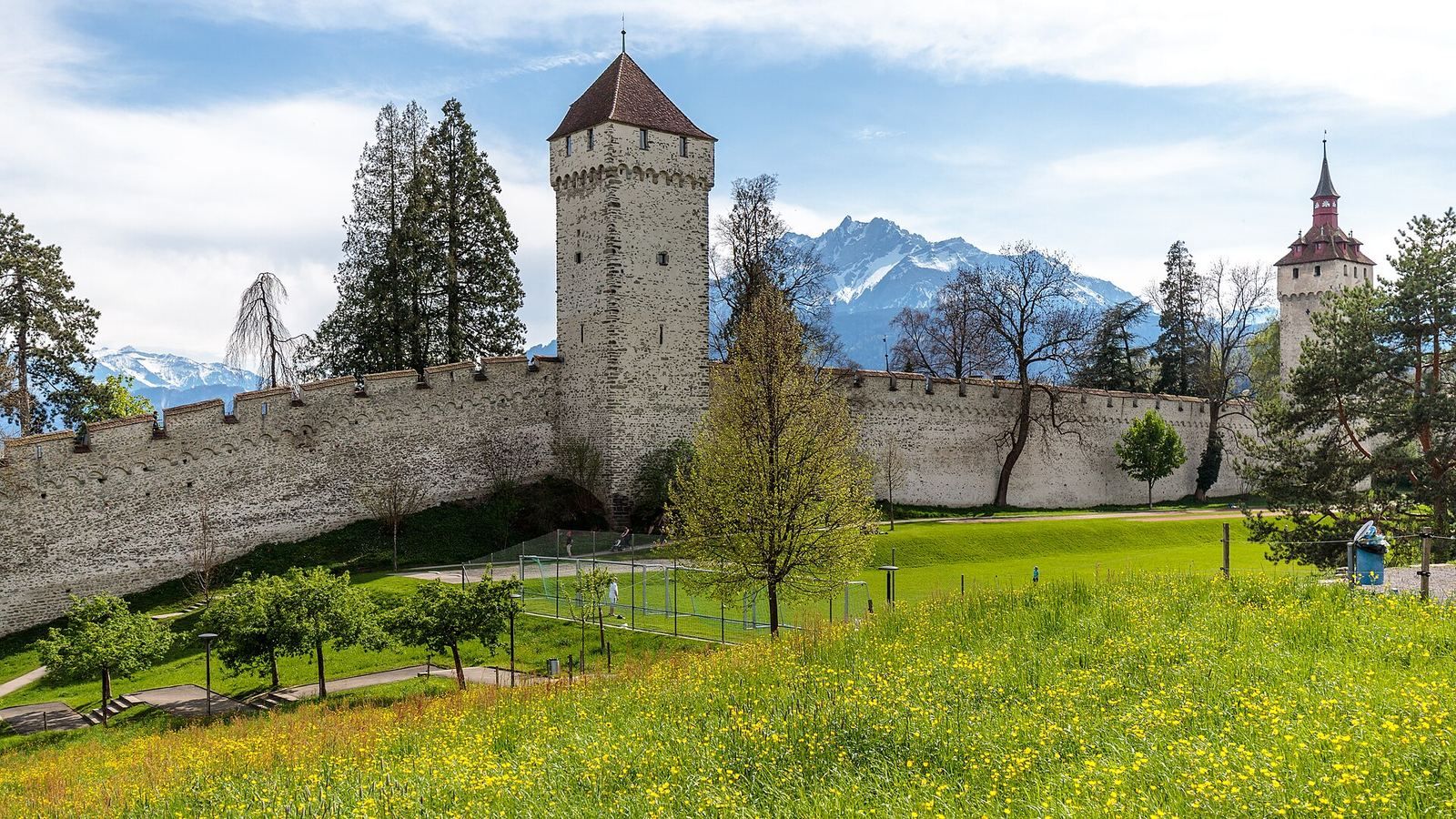
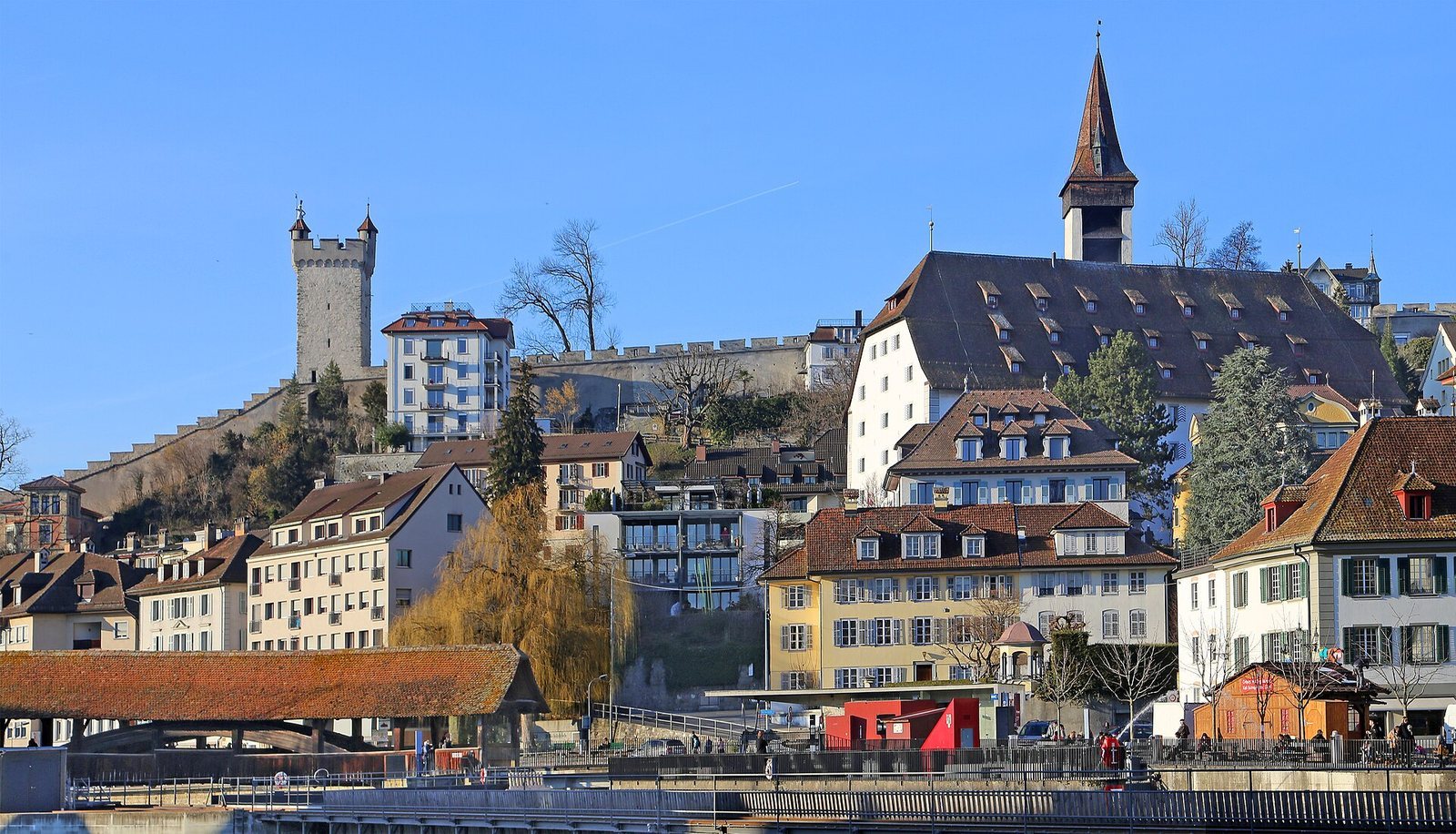
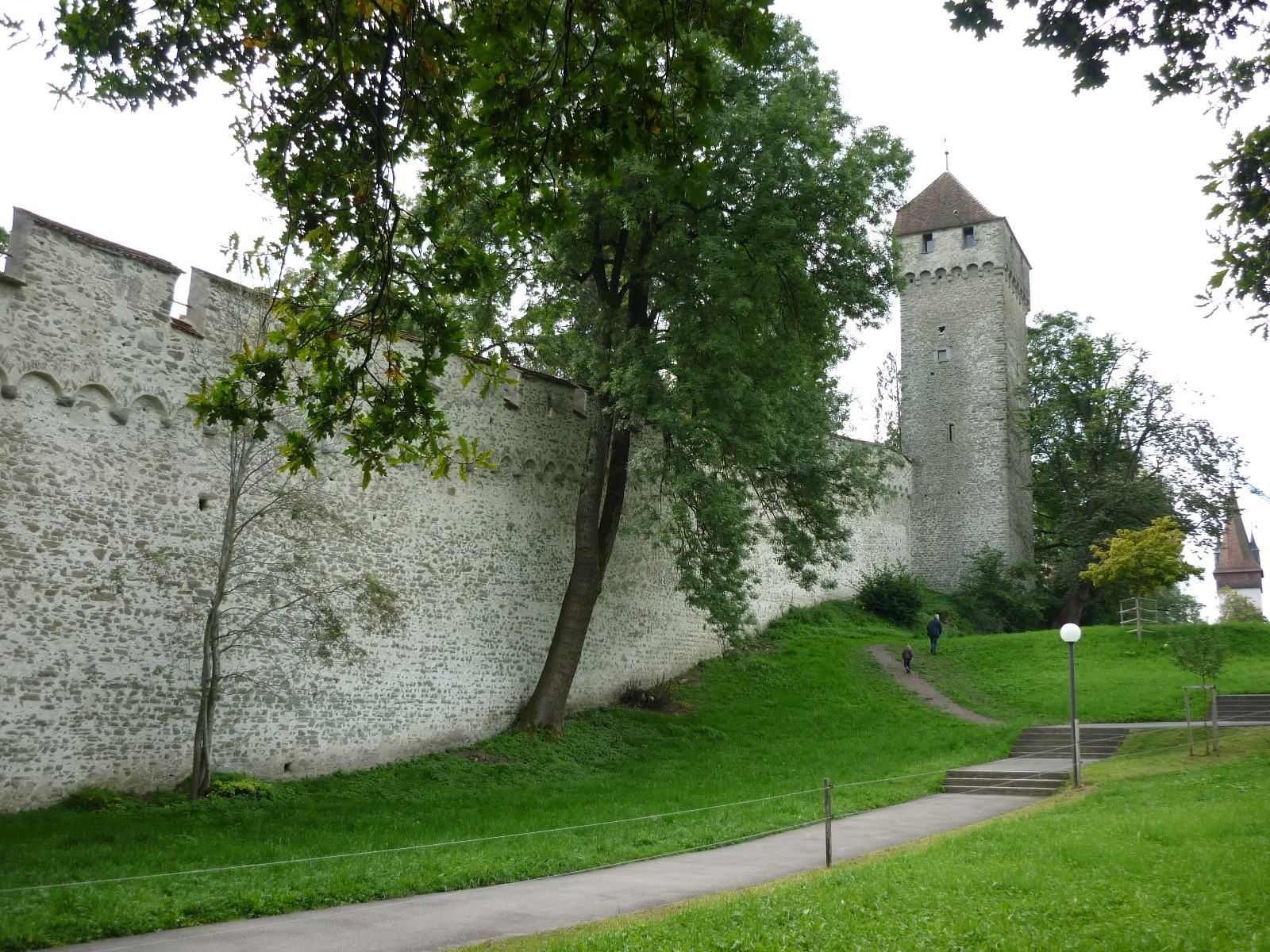
The wall runs for 870 metres from the Reuss near Geissmatt Bridge, west of the old town, over Musegg hill to the eastern side of the old town near Musegg Cantonal School. It survives almost in full, with a 40-metre section lost at the eastern end. Its thickness averages 1.5 metres, while its height varies with the ground and averages about nine metres.
An uncovered defensive walkway runs behind the battlements, the alternating raised sections and openings along the wall top. Beneath them, an irregular band of projecting round arches is carried on square and rounded corbels, or projecting supports. Several gates are associated with the wall.
The towers
Nine towers are associated with the wall. Nölliturm stands on the Reuss bank; the other eight are positioned in front of the wall. Most began as shell towers, open on the city-facing side, a form retained only by Luegisland. The towers were enclosed during the fifteenth century, except for Dächliturm, which was enclosed in the eighteenth century. Some were also raised over time. Apart from Luegisland, they originally had a single-slope roof within the battlements, falling eastward; Männliturm retains this arrangement. Several towers gained roof structures before 1513, and the others before 1597. Their interiors are wooden, and stone stairs lead from upper floors to the stone-paved wall-walk. Some retain rotating wooden beams and posts used to lift building materials.
Nölliturm
This round stone tower beside the Reuss is 28 metres high. The present structure bears the date 1513 and replaced an earlier gate tower on the site. A road passage was opened through it in 1901. Since 1922, it has housed the Safran Guild, a tradespeople’s association with social and civic functions, including its meeting room and archive.
Männliturm
The second tower along the rising rocky ridge reaches 33 metres from ground level to its battlements. An iron figure carrying a banner stands above it and can be seen from far out in the countryside.
Luegisland
At 52.6 metres, Luegisland is the highest of the nine towers and the only one still open toward the city. Its tall, pointed roof has a profile twisted by the wind from left to right. It served as an observation tower, and the wall sections adjoining it date to around or shortly after 1367.
Heuturm, or Wachturm
This 44-metre tower stored hay and gunpowder. In 1701, lightning ignited 350 Zentner of gunpowder, a traditional weight measure whose value varied by place and period. The explosion destroyed the tower, sent masonry falling into the city, and killed five people. The tower was rebuilt immediately. In 1768 its guardroom was moved from Luegisland, and dormers, a rooftop turret, and a tiled stove were added; thereafter it was called Wachturm, or Watchtower.
Zytturm
The 31-metre tower contains a clock made by the Swiss-German clockmaker Hans Luterer in 1535. It remains in operation, and its large dial could be read by fishermen on the lake. Lucerne painters Schobinger and Schmidiger renewed the tower’s frescoes in the early twenty-first century. Its bell signals the time one minute before the town-hall clock.
Schirmerturm
This tower, 27.5 metres high, stands in front of the wall beside the gate of the same name, which led from the city into the countryside. It is built of plastered quarry stone, with rough-cut corner blocks and a projecting round-arched band supported by corbels. A low pyramidal roof sits above its battlements.
Pulverturm
One of the oldest structures on Musegg, Pulverturm was built up from a stone house and reaches 27.5 metres. Lucerne’s city government divided its gunpowder between two towers so that half the supply would remain safe if an accident occurred in the other; Pulverturm held one portion. The Wey Guild repaired the tower using labor service, and it now serves as a guild room.
Allenwindenturm
Also known as Holdermeyerturm after a former treasurer, this former shell tower has walls 1.8 metres thick. Its profile stands below the surrounding houses on Musegg. Since 1972, the Lucerne City Drummers’ Association has used its lower half, while the Lucerne Mask Friends Association occupies the upper half.
Dächliturm
Also called Chutzenturm, this is the smallest tower on the Musegg line. Its pyramidal roof is probably older than most of the other towers’ roofs. Since 1936, the Lucerne section of the Swiss Master Joiners’ Association has had a club room in the tower.