Casino of Venice: A Historic Gambling Institution in Italy


Site at a Glance
- Rating
- 3.9
- Popularity
- Medium
- Country
- Italy
- Primary era
- Early Modern
- External website
- Open
- Eras represented
- Medieval, Early Modern, Modern
- Civilizations
- Italian, Venetian
- Site type
- Entertainment
On this page11 sections
History
The Casino of Venice is a regulated gambling institution in Italy, whose modern operation began in 1936 and whose history is connected to Venice’s seventeenth-century Ridotto, a publicly authorized house for gaming and entertainment. The Ridotto is described as the first public and legal casino in the Western world, while the present institution operates from historic Ca’ Vendramin Calergi and the modern Ca’ Noghera venue.
The Ridotto and public gaming
The Venetian Great Council established the Ridotto in 1638 during the annual Venice Carnival. Authorities had failed to suppress private gambling clubs and street gaming, so the new arrangement brought gambling into a legally authorized setting. It also directed gaming income toward public finances, making the Ridotto an early example of gambling being used to raise state revenue.
The establishment occupied Palazzo Dandolo at San Moise. Although it was formally open to the public, high stakes and strict expectations of dress, including tricorn hats and masks, effectively limited participation to nobles and wealthy citizens. Games included biribissi, a lottery-like game involving 70 possible outcomes, as well as bassetta and sbaraglino. Bassetta was later replaced by faro. Sbaraglino belonged to the family of board games related to trictrac and backgammon.
Closure and later legal gaming
On 27 November 1774, the Venetian reformer Giorgio Pisani proposed closing the Ridotto in the interests of piety, discipline, and moderation. The motion passed by a large majority, and the establishment closed later that year. For a long period, another gambling house operated by the barnabotti in Campo San Barnaba remained Venice’s only legal gaming house. The barnabotti were impoverished Venetian nobles associated with gambling and moneylending in eighteenth-century Venice.
The modern casino
The modern Casino of Venice was inaugurated at the Lido of Venice on 1 July 1936. It operated there as a summer venue until the end of the 1990s. The City of Venice acquired Ca’ Vendramin Calergi in 1946 and established the palace as the casino’s winter headquarters, opening the venue there in the same year.
The City of Venice remains the legal entity authorized to operate gambling at the venues under an Interior Ministry authorization issued on 16 July 1936. From 1997, management was entrusted to CMV, a company wholly owned by the municipality. On 1 October 2012, the operating assets, excluding the venues, were transferred to Casinò di Venezia Gioco S.p.A., which also assumed the management agreement.
Italian gambling houses operate under strict state regulation and are authorized as an exception to the country’s criminal laws for only four public entities, including the City of Venice. The agreement with the municipality required the casino to transfer 25 percent of gaming revenues to the city. This arrangement was identified as producing persistent structural losses and requiring municipal capital contributions. In the early 2000s, ownership of Ca’ Vendramin Calergi and associated properties passed from the city to Casinò di Venezia S.p.A., a municipality-owned company. During the same period, the company opened a casino in Malta, but that operation subsequently failed because of a loss-making balance sheet.
Expansion to Ca’ Noghera
In 1999, Ca’ Noghera opened near Marco Polo Airport as the first American-style casino in Italy. The Casino of Venice consequently developed into an institution operating through two venues, Ca’ Vendramin Calergi in the historic center and Ca’ Noghera near the airport.
Remains
The physical presence of the Casino of Venice is divided between a Renaissance palace on the Grand Canal, a modern gaming structure near Marco Polo Airport, and the former Lido summer venue. These locations represent different phases of the institution’s development, from its postwar establishment in a historic Venetian residence to its later expansion into a purpose-built casino.
Venetian palace and former summer venue
Ca’ Vendramin Calergi
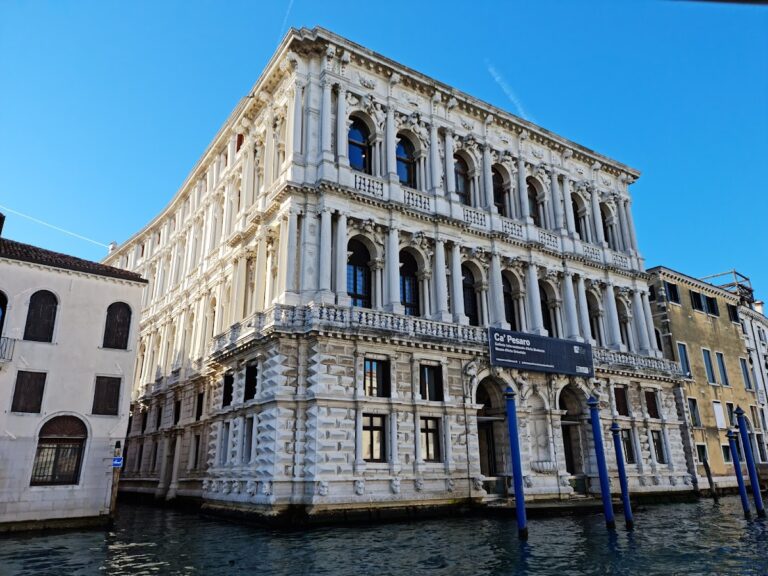
Ca’ Vendramin Calergi is a Renaissance palace facing the Grand Canal in Venice’s historic center. Its design is associated with Mauro Codussi, a Renaissance architect active in Venice, and the building formerly served as a residence for Venetian patricians. The name uses Ca’, the Venetian abbreviation of casa, meaning house, a form commonly used in the names of palaces and residences.
The palace was the final residence of Richard Wagner, the nineteenth-century German composer. It now contains the winter and historic-center venue of the Casino of Venice. Its gaming facilities include French-style tables for chemin de fer, punto banco, and French roulette, together with American-derived games such as Caribbean poker, fair roulette, and blackjack, as well as slot machines.
Lido venue
The Lido venue was a separate summer location of the modern casino. It served this seasonal function from the institution’s inauguration in 1936 until the end of the 1990s.
Ca’ Noghera
Modern gaming structure
Ca’ Noghera is a modern casino structure of more than 5,000 square meters near Marco Polo Airport. It contains more than 550 slot machines and tables for American- and French-style games. Its gaming facilities include fair roulette, blackjack, Caribbean stud poker, punto banco, chemin de fer, and French roulette.
The venue’s documented facilities also reflect changes in its use. Ca’ Noghera formerly had a Texas hold’em poker room, which is no longer present. The surviving gaming arrangement combines the large modern structure with the range of table games and slot machines that distinguishes the airport-side venue from the historic palace.