Schloss Merode: A Renaissance Moated Castle in Germany


Site at a Glance
- Rating
- 4.6
- Popularity
- Medium
- Country
- Germany
- Primary era
- Early Modern
- External website
- Open
- Eras represented
- Medieval, Early Modern
- Civilizations
- Holy Roman Empire
- Site type
- Domestic
- Remains
- Castle
On this page7 sections
History
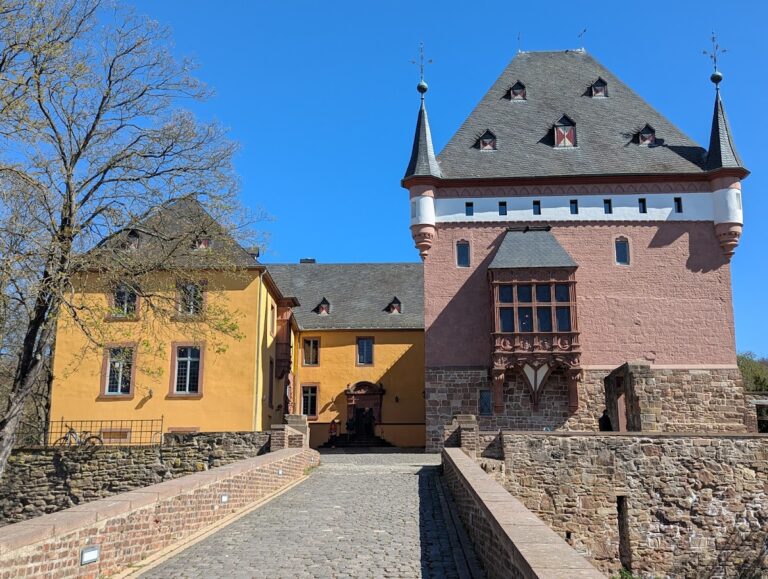
Schloss Merode is a twelfth-century moated castle in Germany, located in the Merode district of Langerwehe near Düren. Held by the Merode family since 1174, it is regarded as a notable example of Renaissance architecture in the Rhineland, a European style shaped by renewed interest in classical forms and ordered proportions.
Foundation and Medieval Development
The first secure mention of Schloss Merode dates to 1170, when Werner of Kerpen established a seat on cleared land after receiving the Echtz estate and surrounding territory as a fief. Werner was a royal ministerial of Frederick I Barbarossa, the twelfth-century Holy Roman Emperor. Members of this medieval service elite held offices and lands while serving a ruler. The name Merode derives from expressions meaning “from the clearing.”
The earliest complex was probably a small fortified manor, protected by a palisade and a defensive moat. The name Castrum de Rode first appears in 1263. Over time, the family that held the site rose from lordly status to that of counts and princes, while retaining possession of the castle.
Renaissance Transformation
Schloss Merode acquired its present overall appearance through major construction initiated at the beginning of the eighteenth century by Field Marshal Jean-Philippe-Eugène de Merode-Westerloo. A field marshal is a senior military rank. Further structural changes followed between 1834 and 1838, adding to the form of the Renaissance-style castle.
War Damage and Reconstruction
Fighting during the Second World War largely destroyed Schloss Merode. Postwar rebuilding restored much of the complex, while the northwestern tower and parts of the north wing were not rebuilt. The castle suffered another major disaster on 19 June 2000, when a fire seriously damaged about 80 percent of the restored sections. The internal structures and roofs of the large tower and a corner tower burned completely, and the private family archive was destroyed. Reconstruction and restoration continued for many years.
Schloss Merode remains privately owned by Charles-Louis, Prince of Merode, and his family. It is identified as an architectural monument of North Rhine-Westphalia. In 2019, the Merode family received the Grand Monument Preservation Prize of the German Castle Association Foundation for the reconstruction and careful treatment of the castle’s architectural heritage. A weekly religious service continues in the castle chapel, and since 2011 the Düren District Festival has been held at Schloss Merode after its transfer from Nideggen Castle.
Remains
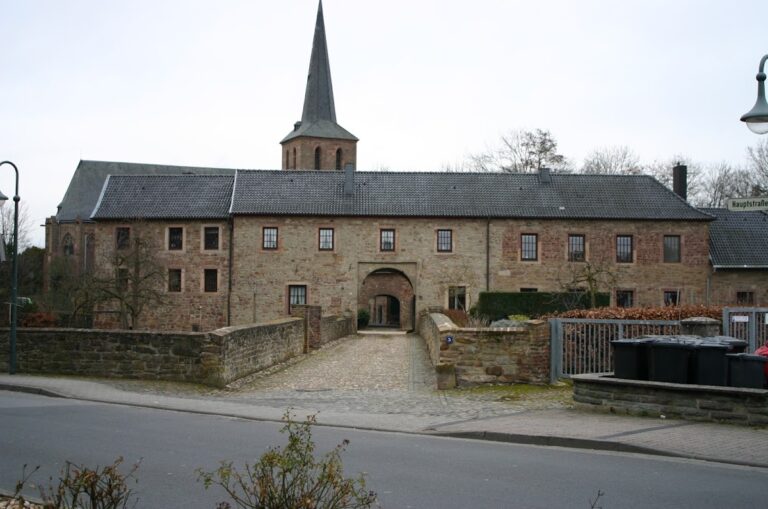
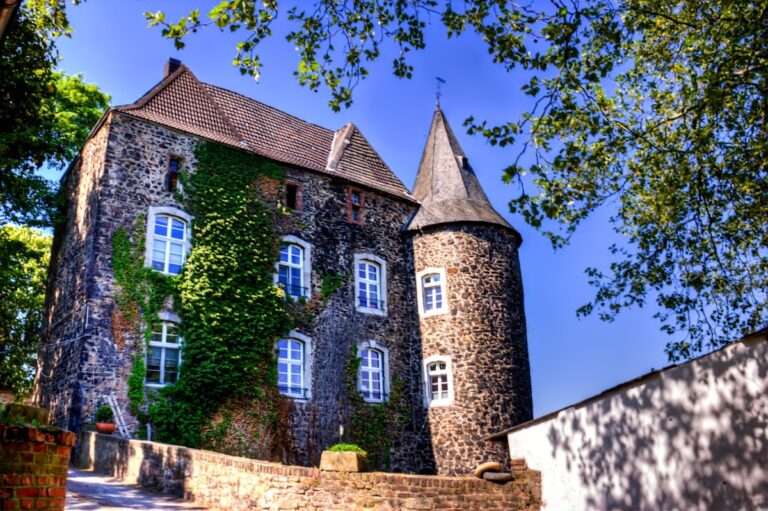
Schloss Merode survives as a Renaissance-style castle enclosed by water on every side. A stone bridge provides access across the moat and occupies the position of the earlier drawbridge, a movable bridge that could be raised to restrict entry. The complex presents the results of medieval fortification, early eighteenth-century rebuilding, nineteenth-century alteration, wartime reconstruction, and the long restoration that followed the 2000 fire.
Moat and Castle Complex
The earliest fortified manor stood within a palisade and defensive moat, although its twelfth-century appearance is otherwise unknown. The later castle is traditionally said to possess twelve towers, corresponding to the months of the year, and 365 windows, corresponding to the days of the year. The surviving structure incorporates the damage and rebuilding associated with the Second World War and the 2000 fire, including the reconstructed portions of the complex and the large tower and corner tower whose internal structures and roofs were destroyed by the blaze.
Castle Chapel
The castle chapel contains the gravestone of Jean-Philippe-Eugène de Merode-Westerloo, whose building campaign helped establish the castle’s present form. Its small organ was made by Orgelbau Schumacher of Eupen. The instrument has six divided registers on one manual, meaning one keyboard, with an attached pedal keyboard.
Nearby sites