Burg Kreuzau: A Medieval Lowland Water Castle in Germany


Site at a Glance
- Rating
- 4.2
- Popularity
- Very Low
- Country
- Germany
- Primary era
- Early Modern
- Eras represented
- Medieval, Early Modern
- Civilizations
- Holy Roman Empire
- Site type
- Domestic
- Remains
- Manor House
On this page7 sections
History
Burg Kreuzau is a lowland water castle in Germany, built around 1330 near the crossing of an old Roman road over the Rur. A Roman-period house may already have occupied the site. The castle formed part of the medieval political landscape of the Duchy of Jülich, whose dukes held feudal authority over it.
Medieval ownership
In the second half of the thirteenth century, the knight Dietrich Schinnemann, a powerful vassal of Duke Wilhelm I of Jülich, rebelled against the duke’s authoritarian government and its restrictions on knightly rights. Schinnemann initially fought successfully, but lost the feud, and his castle at Freialdenhoven was demolished. He may have belonged to the von Ouwe family, which was known as the lords of Burg Kreuzau.
In 1384, the Duke of Jülich authorized Schinnemann to sell Burg Kreuzau, together with its associated rights, for 2,000 gold guilders to the Collegiate Foundation of St John the Evangelist. A collegiate foundation was a religious institution served by a chapter of clergy. The foundation was then located in Nideggen and later moved to Jülich.
Changes of ownership and the 1668 conflict
After the Schinnemanns, the von Walrave family of Cologne owned the estate until the end of the sixteenth century. Ownership then passed by marriage to the von Raesfeld family. At the instigation of the Teutonic Order, a religious and military order that also held estates and exercised legal influence, Burg Kreuzau was assessed in 1653 at approximately 4,600 thalers. The owners moved away from Kreuzau in 1658.
On 23 February 1668, Lieutenant Colonel Dietrich Adolf von Torck presented the Kreuzau aldermen with a deed stating that his relative Anna Stephana von Raesfeld, abbess of the Bocholtz collegiate foundation, had transferred the hereditary right to the castle to him. Von Torck took possession in July and leased the castle. The feudal lords in Jülich rejected his claim and demanded its return.
Von Torck responded by ordering the destruction of the entire main castle so thoroughly that rebuilding was considered uneconomic. On the evening of 10 October 1668, he attacked the castle with three armed men. The dean and the foundation’s bursar, the official responsible for financial and material administration, were slightly wounded. The chapter in Jülich sued von Torck, who also pursued a legal claim to the castle, but he abandoned it after learning the likely court costs.
Kaspar Jadokus, von Torck’s eldest son, later brought a lawsuit before the court in Düsseldorf. The case was decided in his favour in 1701, although Herbert Müller, the tenant appointed by the Jülich foundation, was allowed to continue farming the estate.
Later estate history
The von Torck family retained ownership until 1883, when the family line ended with Maria Franziska Wilhelmina. She bequeathed the estate to her distant relative Wilhelm Jungbluth. After his death in 1889, his brother Joseph Jungbluth inherited Burg Kreuzau and sold it in 1903 to Heinrich Arthur Hoesch.
Wilhelm Schmitz acquired the castle in 1931. Schmitz and his wife died during the air raid on Düren on 16 November 1944, after which their two daughters, Dr Trude Weis-Pfennig and Christel Jacobs, inherited the estate jointly. Burg Kreuzau is now used for agriculture. Damage during the Second World War was followed by dismantling down to the first floor and reconstruction in its present form in the early 1970s.
Remains
Layout and farm buildings
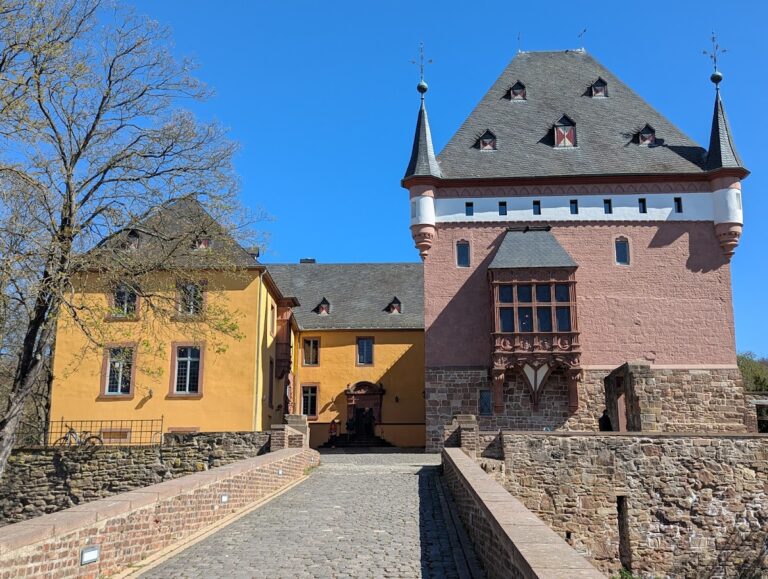
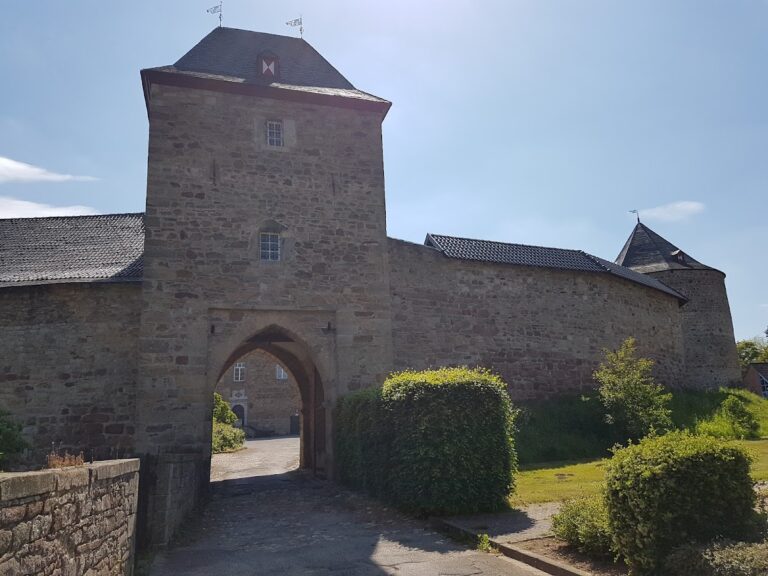
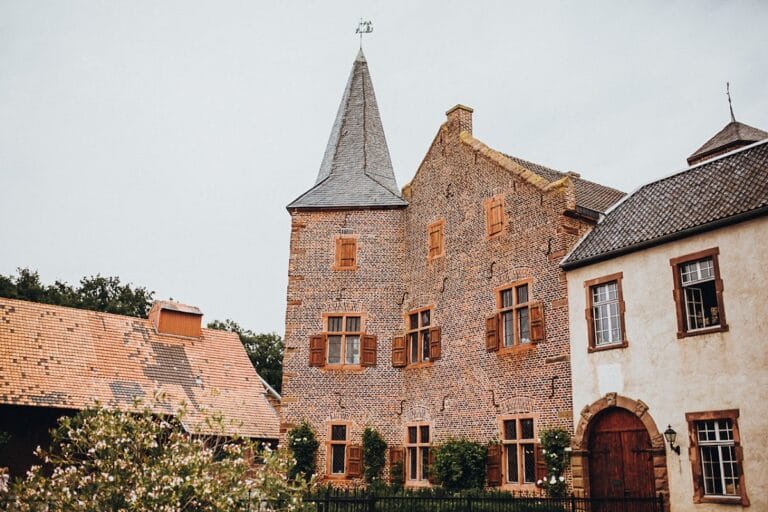
The surviving site is a rectangular farm complex built of rubble stone and partly surrounded by dry ditches. It represents the former economic or service area of Burg Kreuzau rather than the destroyed main castle. The residential building dates from the seventeenth or eighteenth century. Farm buildings have been altered several times and incorporate older castle walls, preserving elements of the earlier complex within the agricultural layout.
Destroyed main castle
The principal fortified section was the main castle, which Dietrich Adolf von Torck ordered destroyed in 1668. It was not rebuilt because reconstruction was considered uneconomic. The northern side aisle of the parish church of St Heribert was allegedly built in 1906 and 1907 on the foundation walls of this destroyed section.