Palazzo Braschi: A Historic Palace and Museum in Rome


Site at a Glance
- Rating
- 4.5
- Popularity
- Medium
- Country
- Italy
- Primary era
- Early Modern
- External website
- Open
- Eras represented
- Early Modern, Modern
- Civilizations
- Papal States
- Site type
- Domestic
- Remains
- Elite Residence
On this page11 sections
History
Palazzo Braschi is a Baroque-Neoclassical palace in Rome, Italy, constructed between 1791 and 1804 as a residence for the Braschi family. Commissioned by Duke Luigi Braschi-Onesti at the request of his uncle, Pope Pius VI, it occupies a site with a long history and now houses the Museo di Roma.
The Orsini Palace and Pasquino
The site was formerly occupied by Palazzo Orsini, built in 1435 for Francesco Orsini, then prefect of Rome. In 1501, Cardinal Carafa added a second building that incorporated part of an ancient sculptural group found nearby. This fragment gave rise to the name Pasquino, which later became associated with the statue and urban area beside the palace. A tower was added at the corner of Piazza Navona and Via della Cuccagna in 1516.
Papal Patronage and Construction
The site was acquired with papal funds in 1790, and demolition of the Orsini palace began in 1791. Pius VI supported the project as a residence for the Braschi family, making the building a late example of papal nepotism, the advancement of relatives through patronage and public resources. Cosimo Morelli designed the new palace for Luigi Braschi-Onesti, a Roman nobleman and papal nephew.
Construction drew on papal assistance and church funds, as well as a disputed testamentary bequest made in favor of Pius VI by the Roman patrician Amanzio Lepri. The dispute between the Lepri and Braschi families ended in a concordat connected with the marriage of Anna Curti Lepri to Duke Pio Braschi Onesti.
Work stopped in 1798 during Napoleon Bonaparte’s occupation of Rome and after the death of Pius VI, whose pontificate lasted from 1775 to 1799. Construction resumed in 1802 and was completed in 1804, although parts of the palace were still unfinished when Luigi Braschi died in 1816. His death left the family’s finances exhausted.
French Occupation and Loss of the Collections
In 1809, after Napoleon declared Rome an imperial city, Luigi Braschi returned to the palace and became mayor of Rome. During the French occupation, the palace’s recently acquired antiquities were confiscated, and many artworks formerly kept there were sent to France. Most were never returned.
The removed works included an equestrian portrait of the Spanish ambassador by Antoon van Dyck, paintings by Frans Viruly, Bartolomeo Manfredi, Giulio Romano, Francesco Albani, and Bernardino Fasolo, and a copy of Raphael’s Madonna of Loreto. Most entered the Musée Napoleon and are now in the Louvre. The works by Frans Viruly and Bartolomeo Manfredi were later lost during recovery operations led by the sculptor Antonio Canova. Bernardo Strozzi’s Supper at Emmaus is in the Musée de Grenoble, while Saint Sebastian by “l’Orbetto” is in the Musée des Beaux-Arts de Bordeaux.
State Ownership and Fascist Use
In 1871, the Braschi heirs sold the palace to the Italian state. It became the seat of the Ministry of the Interior, whose minister generally also served as president of the Council of Ministers. A monument to Marco Minghetti was inaugurated in front of the palace in Piazza San Pantaleo in 1895.
After the Ministry of the Interior moved to the newly built Palazzo del Viminale in 1923, Palazzo Braschi housed several institutions of the Fascist regime. These included the provincial federation of the National Fascist Party, the principal Fascist political organization of the period. The palace temporarily housed the Madonna del fascio mosaic, which was later transferred to Predappio, and was also associated with a large sculptural mask of Benito Mussolini, the Fascist dictator of Italy.
In 1943, after Marshal Pietro Badoglio and the House of Savoy fled to Brindisi, the palace became the headquarters of the Republican Fascist Party. It also housed the Palazzo Braschi Armed Guard, known as the Bardi-Pollastrini band, during the period of the Italian Social Republic.
War Damage and the Museo di Roma
From the end of the Second World War until 1949, the abandoned palace housed homeless people, families displaced by the war, and approximately 300 refugee families. Fires lit for heating seriously damaged many interior frescoes, while other possessions were stolen.
The Museo di Roma was founded in 1930 by the art historian Antonio Muñoz. It first occupied the former Pantanella pasta factory, and its collections document Rome from the Middle Ages to the nineteenth century through maps, city views, scenes of popular life, portraits, costumes, furnishings, and related material. The museum moved to Palazzo Braschi in 1952, when ownership passed from the Italian state to the Municipality of Rome.
Serious damage led to the palace’s closure in 1987. It reopened in stages during the 2000s and 2010s, chiefly for temporary exhibitions, and reopened completely in 2017. The complex also includes the Municipal Gallery of Modern Art and the Museum of Contemporary Art of Rome.
Remains
Plan and Exterior
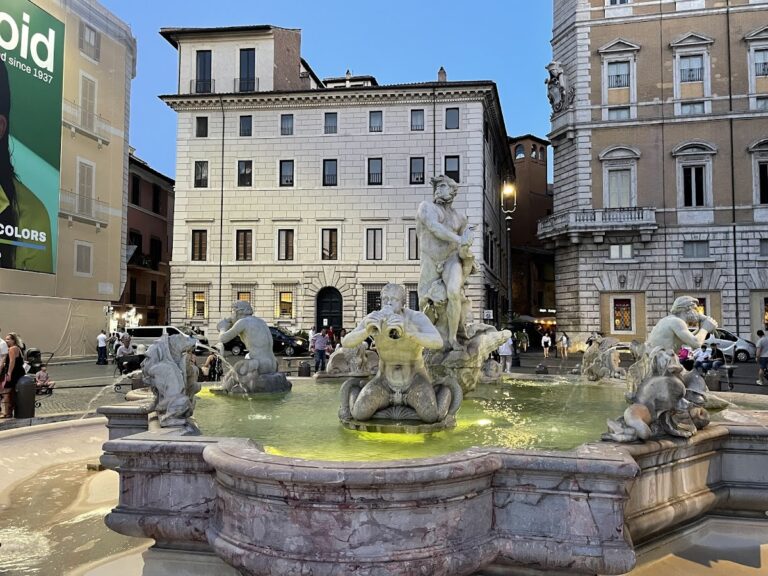
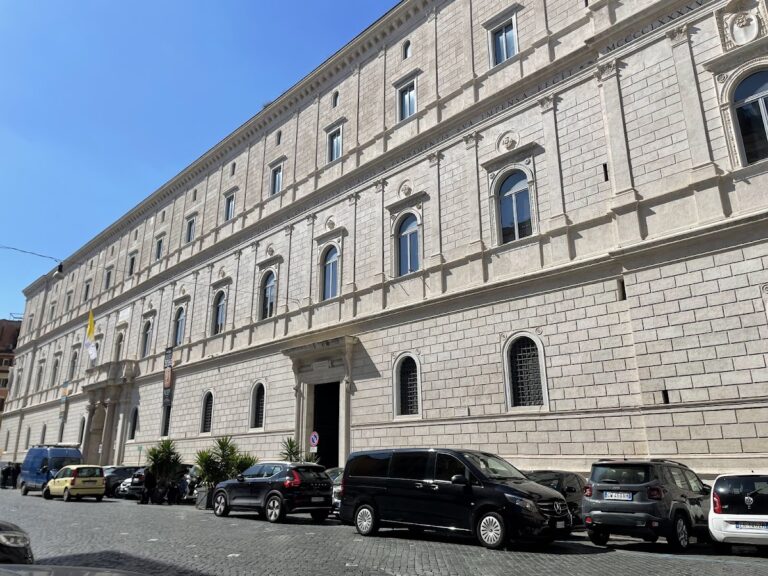
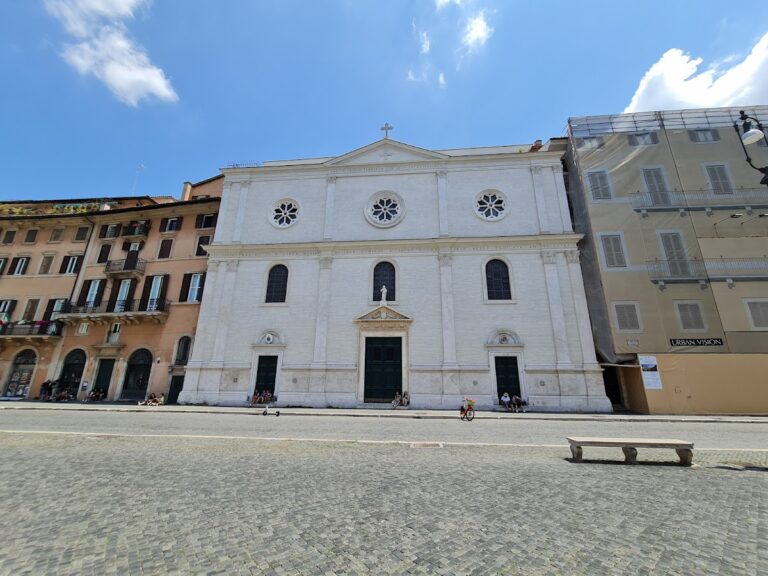
Palazzo Braschi has a trapezoidal plan and occupies the area between Piazza San Pantaleo, Via San Pantaleo, Via della Cuccagna, Via di Pasquino, and Piazza Navona. Its longer side faces Piazza Navona, while its shorter side faces Piazza San Pantaleo, where the principal entrance is located. The building also has access from Piazza Navona and stands in one of Rome’s oldest urban areas, with one facade facing the area of the ancient Stadium of Domitian, whose remains lie beneath modern Piazza Navona.
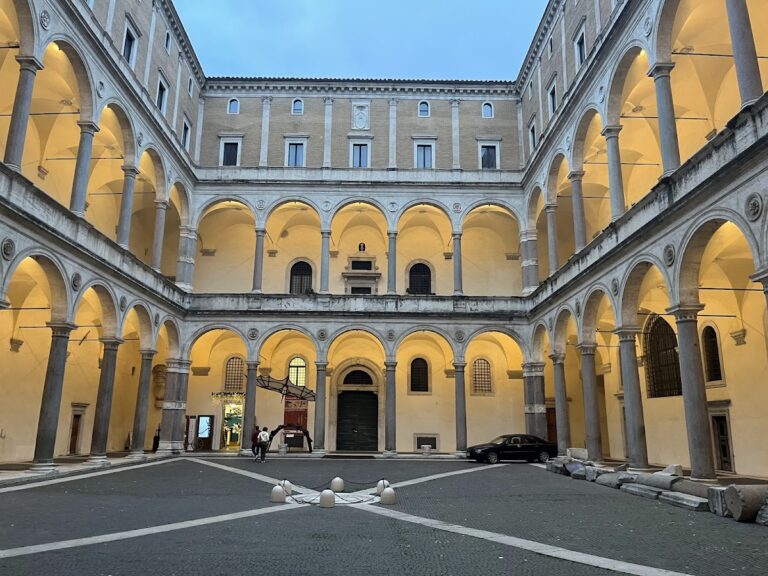
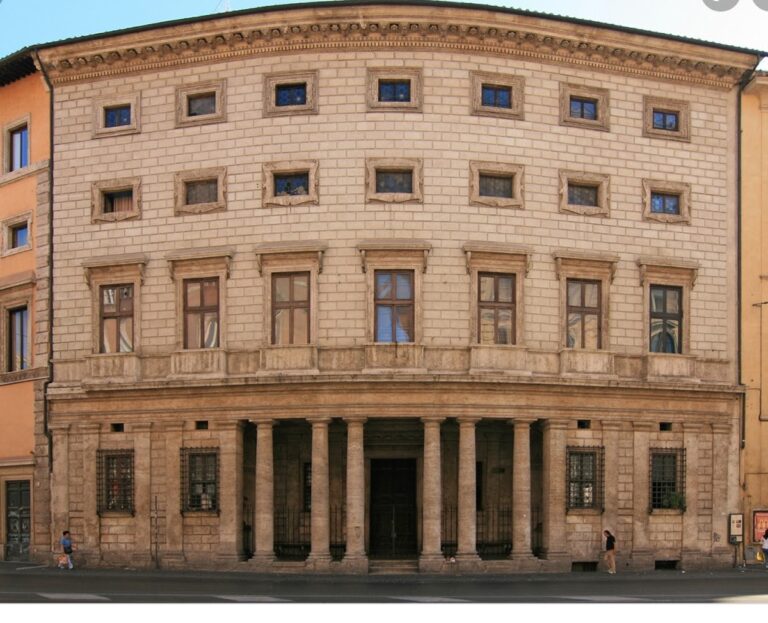
The exterior uses a Roman Neoclassical treatment with rusticated masonry and emphasized window surrounds. The building contains a ground floor, two upper floors, a mezzanine, an attic, and a semibasement level around a quadrangular courtyard. Lion heads holding pine cones crown the first-floor windows. These are heraldic symbols of the Onesti family. Lilies and stars from the Braschi coat of arms decorate the attic, while a large coat of arms of Pius VI marks the southwest corner.
Courtyard and Monumental Staircase
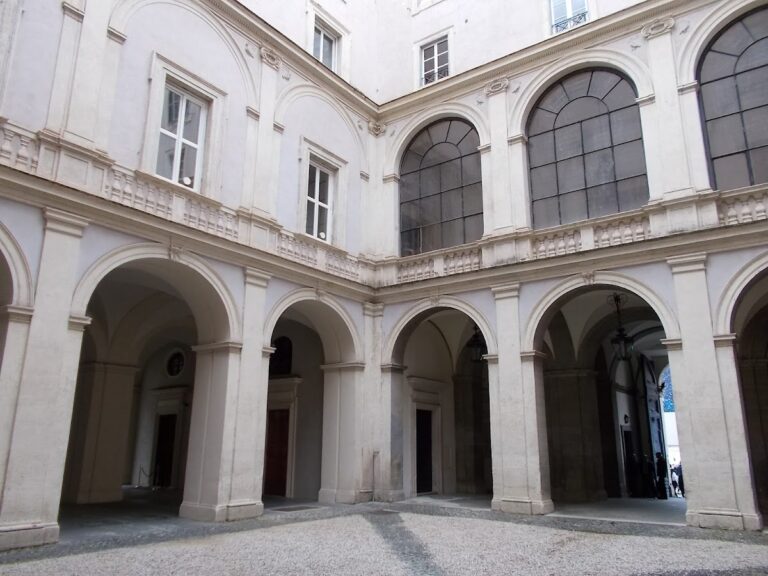
The quadrangular courtyard organizes access to the museum and its associated spaces. A Baroque staircase leads from it into the museum, while a conference room lies to the left, the collection of historic carriages to the right, and the bookshop directly opposite the main entrance.
From the principal entrance, an oval hall leads toward the monumental staircase. The staircase contains eighteen red-granite columns, traditionally said to have come from the palace of Caligula, formerly located on the banks of the Tiber. Ancient sculptures and stucco reliefs by Luigi Acquisti decorate the ascent, with the reliefs inspired by the story of Achilles in Homer’s Iliad. Giuseppe Valadier later revised the staircase and designed a chapel on the second floor.
Painted and Woven Interiors
Several rooms on the first floor retain sixteenth-century frescoes. Among them are chiaroscuro paintings by Polidoro da Caravaggio and Maturino da Firenze, a cycle showing Apollo and the nine Muses by an unidentified artist of the Umbrian school, and scenes connected with the history of the papacy in the Vatican.
Other interiors contain eighteenth-century French tapestries based partly on seventeenth-century designs by Charles Le Brun. On the second floor are three paintings by Gavin Hamilton on classical subjects, watercolors from the series Lost Rome, and fragments of twelfth- and thirteenth-century mosaics from the former Basilica of Saint Peter.
Statue and Piazza San Pantaleo Monument
A statue of Pasquino stands at the southwest corner of the palace. The nearby monument to Marco Minghetti occupies Piazza San Pantaleo in front of the building, linking the palace’s surviving urban setting with the political history of its later state ownership.
Nearby sites