San Lorenzo in Damaso: Rome’s Early Christian Basilica and Titular Church


Site at a Glance
- Rating
- 4.7
- Popularity
- Low
- Country
- Italy
- Primary era
- Medieval
- External website
- Open
- Eras represented
- Classical, Medieval, Early Modern, Modern
- Civilizations
- Papal States, Roman
- Site type
- Religious
- Remains
- Basilica
On this page22 sections
History
San Lorenzo in Damaso is a Roman Catholic parish church, minor basilica, and titular church in Rome, Italy, founded as an early Christian basilica in the 380s under Pope Damasus I. Dedicated to Saint Lawrence of Rome, a deacon martyred in AD 258 who became one of Rome’s principal saints, it was the first church established on the Campus Martius, the low-lying district of ancient Rome later filled with religious, civic, and residential buildings. The church also functions as a station church on the fourth Tuesday of Lent. Its current cardinal priest is Antonio María Rouco Varela, former Archbishop of Madrid.
Foundation under Pope Damasus I
Tradition attributes the foundation to Pope Damasus I, who governed the Roman Church from AD 366 to 384 and actively promoted devotion to the city’s martyrs. He erected the basilica in the 380s, possibly within or beside his residence on the Campus Martius. A lost inscription from the early Christian apse originally dedicated the building to Christ. Damasus’s promotion of Saint Lawrence’s cult later encouraged the dedication by which the church became known.
The basilica stood near the Theatre of Pompey and the Via Triumphalis. Earlier names included Sancti Laurentii juxta Theatrum, meaning Saint Lawrence near the Theatre, and Sancti Laurentii in prasino, a reference to the former stables of the Green racing faction that occupied the area. The church first appears in the acts of the Synod of 499 as Titulus Damasi. A titulus was an early Roman Christian church associated with a particular clerical or institutional title.
Archives, relics, and medieval rebuilding
The two side wings of the basilica’s narthex, an entrance hall before the main body of a church, housed the archives of the Roman Church until the establishment of the Holy Shrine at the Lateran in 649. The Holy Shrine was a Lateran repository for the church’s archives and sacred records. During the eighth century, the relics of Pope Damasus I were ceremonially transferred from his earlier burial place on the Via Ardeatina to San Lorenzo in Damaso.
Popes Hadrian I, Leo III, and Stephen IX restored the church at different stages. In the eleventh century, the basilica was reportedly badly damaged by fire and was extensively rebuilt. It was reconsecrated under Stephen IX. The association with Pope Damasus continued to shape the church’s religious identity and later became physically represented by his burial place beneath the high altar.
Renaissance incorporation into the Cancelleria
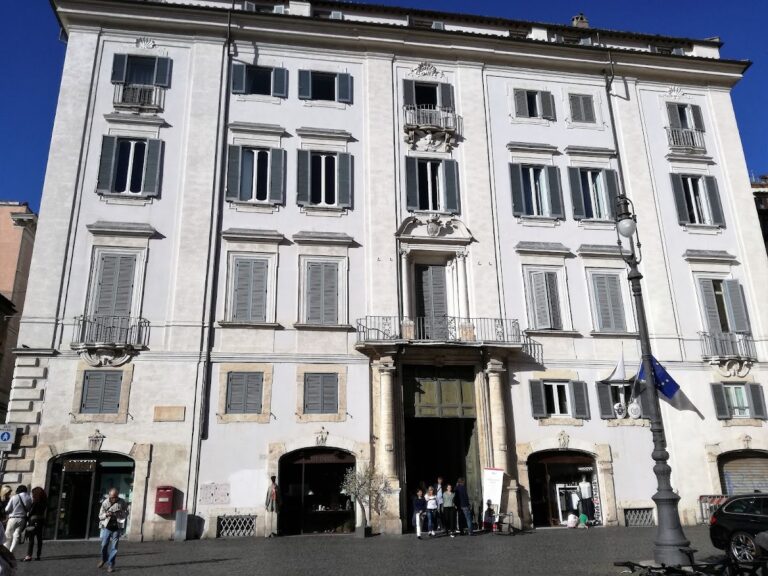
The construction of the Palazzo della Cancelleria between 1485 and 1513 transformed the church’s position and appearance. The early Christian basilica was demolished in stages between 1496 and 1503, and a new church replaced it around 1497 at a higher level, north of the earlier site. The new building was incorporated into the palace rather than given an independent exterior.
Cardinal Raffaele Riario, titular of San Lorenzo in Damaso, patronized both the palace and its church. Because he was also titular cardinal of San Giorgio in Velabro, the complex was initially called the Palazzo di San Giorgio. The architects of the wider palace are uncertain, while the church’s reconstruction has been attributed possibly to Donato Bramante, a major Italian Renaissance architect. This attribution remains uncertain. Associations with Leon Battista Alberti and other Renaissance architects concern the wider palace.
The church’s connection with the Roman Church’s administration continued after the Renaissance. The Palazzo della Cancelleria became the administrative center of the papal chancery, and the church retains a traditional association with the Roman archives. It currently accommodates part of the Vatican Library alongside institutions of the Curia within the palace.
Baroque interventions and eighteenth-century changes
At the request of Cardinal Francesco Barberini, Gian Lorenzo Bernini remodelled the presbytery between 1638 and 1640. Bernini, a leading seventeenth-century Italian sculptor and architect of the Roman Baroque, created a new apse and confessio. A confessio is a devotional space associated with a saint’s tomb or relics, usually placed beneath or near an altar.
Earthquake damage in February 1703 led to the rebuilding of the church’s courtyard under Cardinal Pietro Ottoboni. Muzio Clementi, the composer and pianist, was baptized in the basilica on 24 January 1752, one day after his birth. The church’s religious and artistic life continued alongside the administrative functions of the Cancelleria.
Occupation, restoration, and modern status
During the French occupation of 1798, the church was temporarily used for military purposes, including as a stable and weapons store. The occupation seriously damaged the interior decoration and caused the loss of the ceiling. Giuseppe Valadier began restoring the building in 1807, with Gaspare Salvi supervising later work through 1820. Valadier moved the presbytery two bays forward, reduced the nave to a rectangular form, covered it with a barrel vault, and removed Bernini’s confessio. A large room adjoining the presbytery was later eliminated.
The Cancelleria became the seat of the Constituent Assembly in 1849 during the events that preceded the proclamation of the Roman Republic. After Rome was incorporated into the Kingdom of Italy, the palace nevertheless remained in papal possession. Between 1868 and 1882, Virginio Vespignani removed many of the changes introduced by Valadier and Bernini and largely restored the church’s Renaissance appearance. A fire later damaged the basilica, and restoration was completed in 1944.
Since 1929, the palace and church have participated in the extraterritorial status of the Holy See, a legal arrangement granting the complex special status within Italy. San Lorenzo in Damaso also forms part of the UNESCO World Heritage property comprising the historic center of Rome and sites associated with the Holy See.
Remains
The surviving church occupies part of the Palazzo della Cancelleria and is physically distinct from the earlier basilica, whose excavated remains lie mainly beneath the palace courtyard. The present building is a three-aisled Renaissance basilica measuring approximately 48.60 by 34.40 meters. Its central nave rises to the level of the palace’s piano nobile, the principal upper floor of a Renaissance palace. The nave has a flat ceiling, while the side aisles are covered by groin vaults. Strong piers carry the arcades in six bays.
The early Christian basilica
The earlier basilica measured approximately 43 by 25 meters and had three aisles. Arcades carried on columns separated the central nave from unusually narrow side aisles, apparently because earlier foundations restricted the available width. The building had a western apse, an eastern facade, and a narthex between the facade and the nave. Three arcade arches opened the narthex toward the nave, while its northern and southern ends projected beyond the side aisles as apses.
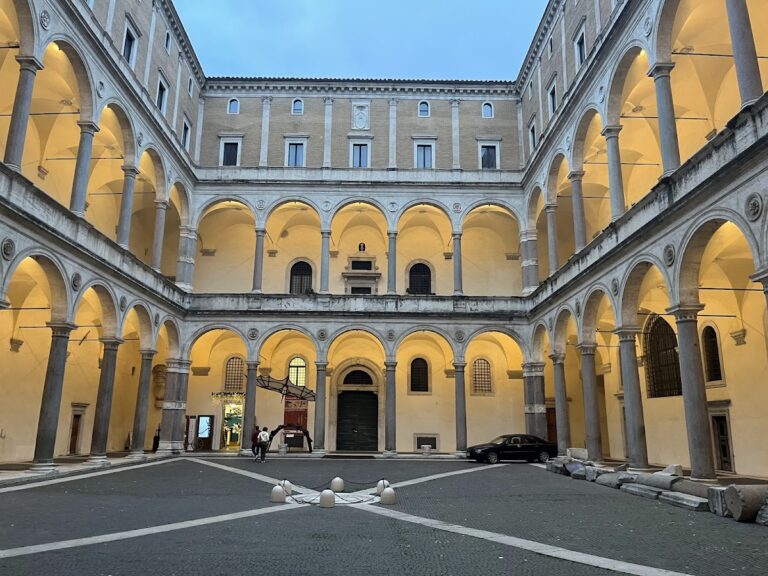
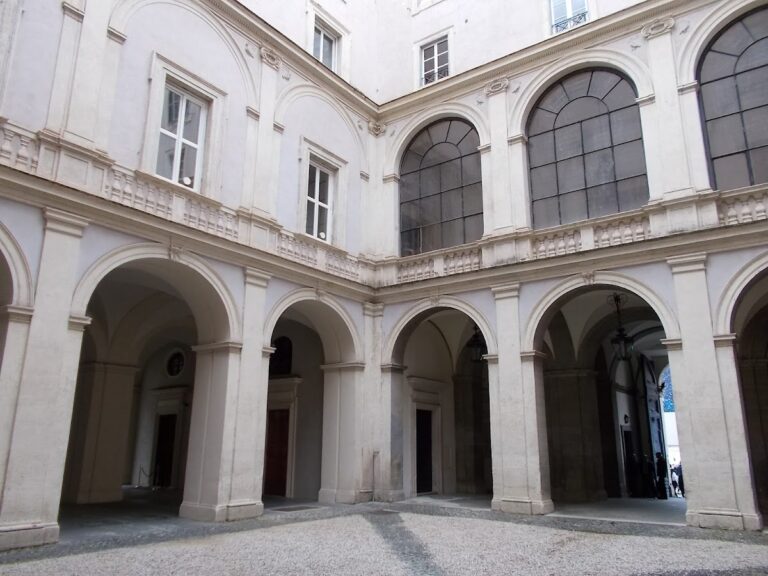
Granite columns from the early basilica were reused in the arcaded courtyard of the Palazzo della Cancelleria. Excavations beneath the courtyard also recovered column bases, choir screens, and marble inlay. These remains preserve elements of the church that was dismantled during the palace’s construction and help define the scale and organization of the earlier Christian building.
The Renaissance church and palace entrance
Entrance hall
The present church retains a transverse, two-aisled entrance hall at the east. Its arcades rest on square piers arranged in five bays, and the space is covered by ribbed vaults. The entrance hall provides the architectural transition between the palace frontage and the basilica’s nave.
Palace portals
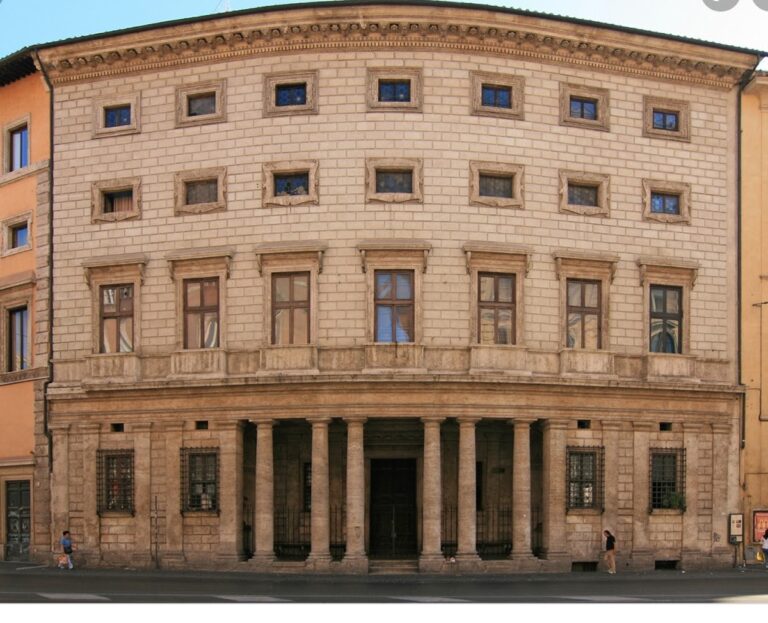
San Lorenzo in Damaso has no independent external facade. Its entrance is the smaller of two portals set into the ground floor of the Palazzo della Cancelleria’s monumental travertine facade. The church is concealed behind the unified palace frontage. A secondary exit leads toward Corso Vittorio Emanuele II, while another portal opens toward the palace courtyard.
Presbytery and principal artworks
High altar
The high altar contains the burial place of Pope Damasus I and the relics of Popes Damasus I and Eutychian. Its present baldachin, or altar canopy, is supported by four alabaster columns and was made by Virginio Vespignani. The altar therefore combines the church’s early association with Damasus with its later nineteenth-century restoration.
Apse decoration
The apse conch contains round frescoes by Francesco Grandi personifying Faith, Hope, and Charity. Luigi Fontana painted scenes from the lives of Saint Lawrence and Pope Damasus on the walls. Federico Zuccari’s altarpiece, The Coronation of Mary, was made for the church in 1568. Christ crowns Mary in the upper part of the painting, while Saints Lawrence, Damasus, Peter, and Paul appear in the foreground and Lawrence’s martyrdom is shown behind them.
Chapels and devotional features
Chapel of Saint Nicholas
The first chapel on the right side of the entrance hall is the Chapel of Saint Nicholas, also called the Ruffo Chapel. It was remodelled in 1743 for Cardinal Tommaso Ruffo. Sebastiano Conca’s altarpiece shows the Virgin and Child with Saints Philip Neri and Nicholas, while Corrado Giaquinto painted the frescoes in the vault.
Chapel of the Blessed Sacrament
The first chapel on the left side of the entrance hall is the Chapel of the Blessed Sacrament. Remodelled in the eighteenth century and restored by Valadier in the nineteenth, it contains Vincenzo Berrettini’s Last Supper as its altarpiece. Andrea Casali’s Apotheosis of the Lamb of God occupies the vault.
Crucifix Chapel
The Crucifix Chapel in the right aisle was created in 1582 by combining three smaller chapels. Its altar was designed by Giovanni Domenico Navone in 1758 and contains a wooden crucifix attributed to the Roman school of the fourteenth century. Funerary monuments associated with the Massimo family are also located in the chapel.
Chapel of the Sacred Heart of Jesus
Another chapel on the right occupies a former side entrance that was converted in 1615 into a chapel dedicated to Saint Charles Borromeo. It received its present dedication after 1820. Designed by Pietro Gagliardi, the Chapel of the Sacred Heart of Jesus contains a portrait of Pope Leo XIII proclaiming the statutes of the Pious Union of the Sacred Heart of Jesus. The foundation of that fraternity was celebrated in the basilica in 1883.
Other Marian chapels
A chapel at the end of the right aisle is dedicated to Our Lady of Pompeii and contains a copy of the image venerated at Pompeii. Near the sacristy, another chapel contains Nicolò Circignani’s, known as Il Pomarancio, altarpiece of the Madonna delle Gioie. It also contains silver statues of Saints Lawrence and Damasus by Ciro Ferri.
Chapel of the Immaculate Conception
The Chapel of the Immaculate Conception lies to the left of the presbytery. Pietro da Cortona and Giovanni Francesco Romanelli remodelled it between 1635 and 1638 with Tuscan architectural forms, and it was restored in 1859. Its altar contains a twelfth-century Marian icon transferred in 1635 from Santa Maria in Grottapinta. The image is a copy of the Maria Advocata type and has a hollow space formerly used to contain relics.
Tombs, sculpture, and music
The church contains the tomb monument of Cardinal Ludovico Trevisan, dated 1505 and attributed to the workshop or school of Andrea Bregno. The monument is also described as containing a recumbent statue by Paolo Romano. The tomb of the poet Annibale Caro dates from 1566 and is attributed to Giovanni Antonio Dosio. Other monuments commemorate Giovanni Pacini, Princess Maria Gabriella di Savoia Massimo, Pellegrino Rossi, and members of the Massimo family.
Stefano Maderno made the entrance-area statues of Saints Francis Xavier and Charles Borromeo in 1610. Bernini designed a 1639 memorial to Alessandro Valtrini, a minister of Pope Urban VIII. The church also contains a copy of a statue of Saint Hippolytus of Rome commissioned by Cardinal Pietro Ottoboni. The antique original is preserved in the Vatican Library.
The church’s organ tradition reaches back to the sixteenth century. Balbiani-Vegezzi Bossi built the present organ in 1908, and Mascioni electrified it in 1979. The instrument has 20 stops, two manuals, and a pedal division.