Palace of Charles V: A Renaissance Palace within the Alhambra


Site at a Glance
- Rating
- 4.6
- Popularity
- Medium
- Country
- Spain
- Primary era
- Early Modern
- External website
- Open
- Eras represented
- Early Modern, Modern
- Civilizations
- Spanish
- Site type
- Domestic
- Remains
- Palace
On this page9 sections
History
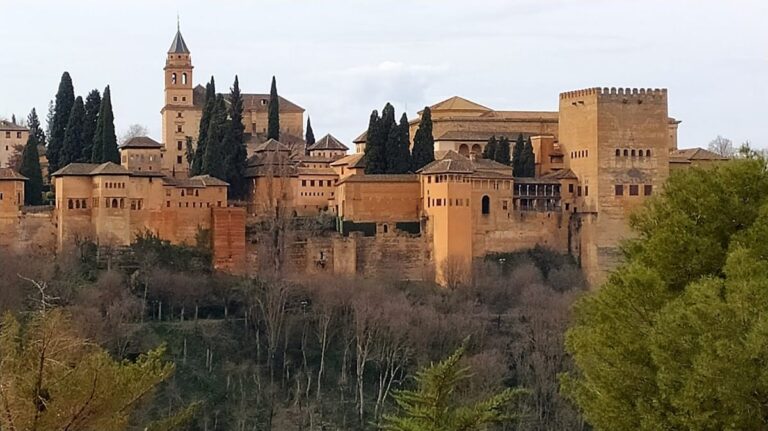
The Palace of Charles V is a Renaissance palace in Granada, Spain, commissioned by Charles V, also known in Spain as Charles I, in 1526. Construction began in 1527 inside the Alhambra, the former palace complex of the Nasrid dynasty, to provide the emperor with a permanent and suitably grand residence. Its Italian High Renaissance design expressed Charles V’s imperial status and stood in sharp contrast to both the prevailing Spanish Plateresque style and the adjacent medieval palaces.
Imperial Foundation
Pedro Machuca designed the palace after training in Rome and encountering the artistic circles associated with Raphael, Giulio Romano, and Michelangelo. The building’s classical language and unusual combination of geometries represented a deliberate departure from established local forms. Its placement at the heart of the Nasrid Alhambra also carried political meaning. It proclaimed the authority of the Christian emperor and the victory of Isabella I of Castile and Ferdinand II of Aragon, the Catholic Monarchs, whose conquest of Granada ended Nasrid rule in 1492.
Creating the palace required the relocation of a pavilion opposite the Comares Tower, a major Nasrid tower adjoining the palace area. The intervention has long been criticized for its effect on the earlier complex, although it has also been interpreted as helping preserve the remaining Alhambra rather than allowing the medieval palace complex to be destroyed altogether.
Interrupted Construction
After Pedro Machuca died in 1550, his son Luis Machuca continued the work, completing the façades and building the internal courtyard. Construction stopped for fifteen years after the Morisco Rebellion began in 1568. The palace was still unfinished when Philip IV, the Habsburg king of Spain from 1621 to 1665, visited in 1628. The project was finally abandoned in 1637, and no monarch ever occupied the building.
Abandonment and Restoration
For centuries, the unfinished palace stood without a roof. It was later used to store gunpowder and other materials. During the French occupation of the Alhambra from 1810 to 1812, French troops removed wooden furnishings from the building for firewood. Restoration began after 1923 under Leopoldo Torres Balbás, a Spanish architect and heritage conservator, and eventually brought the project to completion. The roof was finished in 1967.
The building began to house museums during the twentieth century. A small Arab museum opened there in 1928, became the Alhambra Archaeological Museum in 1942, and developed into the present Alhambra Museum in 1994 and 1995. The Fine Arts Museum of Granada was installed on the upper floor in 1958, with later adaptation of its premises recorded in 2008. The palace forms part of the Alhambra, Generalife, and Albayzin cultural heritage complex.
Remains
Plan and Exterior
The palace has a square plan measuring 63 metres on each side and rises approximately 17 metres. Its two principal storeys are supplemented by mezzanine levels. The exterior is square, while the interior is organized around a circular courtyard 30 metres in diameter. This contrast between square and circle was an innovative feature associated with Mannerism, the sixteenth-century movement that developed from Renaissance classicism and favored sophisticated compositions and unusual spatial effects. The internal rooms and staircases follow the relationship between these two geometries, while the curved courtyard governs the building’s circulation and vertical organization.
The lower exterior storey follows the Tuscan order, a classical system of architectural proportion and decoration. Its pilasters are set within heavy rustication, masonry treated with strongly emphasized joints or rough surfaces, and are decorated with bronze rings. The upper storey uses the Ionic order and has elaborately framed windows, pediments, and round windows. Two principal façades are marked by monumental portals faced with stone from the Sierra Elvira. The main entrance combines paired half-columns, pedestals, windows, sculptural reliefs, and concentrated decoration.
Circular Courtyard
The circular courtyard has two levels. Its lower level is formed by a Doric colonnade of conglomerate stone. Above the columns is an entablature, the horizontal structure carried above columns or pilasters, with triglyphs and metopes decorated with crowns and bull heads. The lighter upper colonnade is Ionic and carries a plain entablature. The courtyard’s curved form is unusual within an otherwise Renaissance composition and reflects the architect’s strong knowledge of Roman imperial architecture.
Connection to the Nasrid Palaces
The palace is directly attached to the Nasrid palaces at the end of the Court of Myrtles. A monumental staircase shares paving slabs with the walls of the Comares Palace. Conservation work has sought to separate the staircase structurally from those walls, preserving the relationship between the later palace and the earlier Alhambra fabric while addressing the physical pressure created by their connection.
Museum Collections
The Alhambra Museum occupies the ground floor and presents artifacts and works of art from the Alhambra and the Islamic history of Granada. Its holdings include tenth-century marble pieces from Madinat al-Zahra, a tenth-century caliphal palace-city near Córdoba, and other caliphal sites; fragments and panels of Nasrid palace decoration; Nasrid marble fountains and sculptures; furnishings, coins, a tenth-century sundial, illuminated Qurans from the twelfth to fourteenth centuries, Almohad amphorae, carved wood, marbles, stucco, and glazed tiles. Among its notable objects are the fourteenth-century Vase of the Gazelles and a marble lion from the Maristan, a medieval Islamic hospital.
The Fine Arts Museum of Granada occupies the upper floor. Its collection contains paintings and sculptures from Granada dating from the sixteenth to twentieth centuries, much of it originating in Catholic churches, monasteries, and convents. Notable works include The Burial of Christ by Jacopo Torni, Thistle Still-Life by Juan Sánchez Cotán, a Limoges enamel, and paintings by Manuel Ángeles Ortiz.