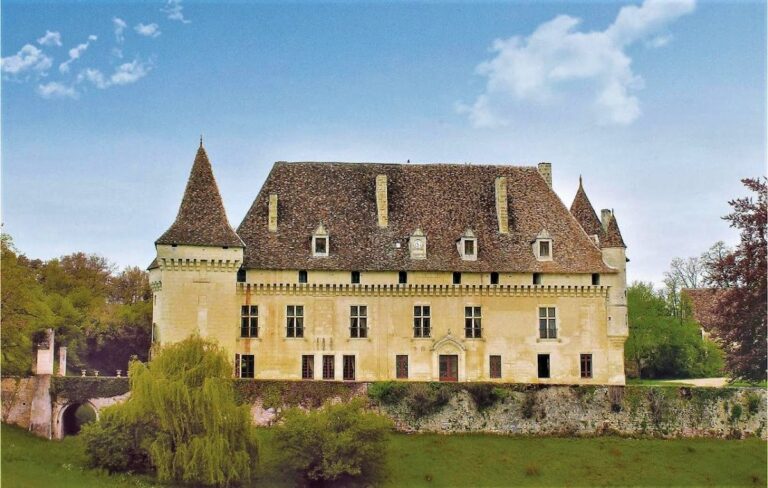
Château de Grignols: A Fortified Château in France

Site at a Glance
- Rating
- 3.7
- Popularity
- Very Low
- Country
- France
- Primary era
- Medieval
- Eras represented
- Medieval, Early Modern
- Civilizations
- French
- Site type
- Military
- Remains
- Castle
On this page14 sections
History
Château de Grignols is a fortified château in France, in the commune of Grignols in the Dordogne. Its oldest surviving parts date from the thirteenth century, and its construction history extends from the thirteenth to the seventeenth century. The site developed as a defended position above the Vern valley and later served as the centre of a châtellenie, a territorial jurisdiction administered from a castle.
Early fortresses and the new castle
An earlier wooden fortress known as Château-Vieux stood between Soutenac and Puy de Lagarde. The site had been established in the fifth or sixth century, and medieval records refer to it under several names, including Chatel-Vielh in 1203, Chastel Vieilh in 1258, and Castrum Vetus de Granholio in 1271. Three castle mottes, which are raised earthworks associated with early fortifications, and the remains of a tenth-century tower survive there.
After the Norman invasions, a new castle was built farther west, probably around the tenth century, on a promontory above the Vern valley. It was mentioned as Castrum novum de Granolhio in 1278. Its position near the Bordeaux to Périgueux road enabled the castle to supervise an important route. The fortified parts were probably rebuilt in the thirteenth century, when the later Château de Grignols took its established medieval form.
The Talleyrand lordship
The lordship of Grignols was probably acquired by the counts of Périgord through marriage. Before 1243, Archambaud II, count of Périgord, granted it to Boson de Grignols, also called Boson Talleyrand, who belonged to a collateral branch of the comital family. The Talleyrand family then held the lordship, and later the county, for several centuries.
In the fourteenth century, Grignols became the seat of a châtellenie that included the parishes of Bourrou, Bruc, Grun, Jaure, Manzac, Neuvic, Saint-Léon, Saint-Paul-de-Serre, Vallereuil, and Villamblard. The castle was under English authority in 1303. During the Hundred Years’ War, the prolonged conflict between the English and French crowns from 1337 to 1453, Marshal Louis de Sancerre besieged and captured it in 1376.
The succession of Talleyrand lords began with Hélie I, who held the title from 1225 to about 1238, followed by Boson I, about 1238 to about 1255, and Hélie II, about 1255 to 1328. Raymond followed from 1328 to about 1341, Boson II from about 1341 to after 1375, and Hélie III from after 1375 to after 1401. François I held the lordship from after 1401 to 1452, Charles I from 1452 to about 1468, Pierre from about 1468 to 1474, and Jean I from 1474 to 1535. François II followed from 1535 to 1556, Julien from 1556 to after 1574, and Daniel I from 1564 to 1618. Daniel I was recorded as the first count of Grignols and the first marquis of Excideuil. Charles II held the title from 1618 to 1636, André from 1636 to 1663, Adrien from 1663 to 1736, Gabriel I from 1736 to 1737, Daniel II from 1737 to 1745, and Gabriel II de Talleyrand-Périgord from 1745 to 1795. Hélie-Charles I de Talleyrand-Périgord followed from 1795 to 1829, Hélie-Charles II from 1829 to 1879, and Hélie-Roger de Talleyrand-Périgord from 1879 to 1883.
Renaissance expansion and religious wars
Between 1495 and 1505, Jean de Talleyrand transformed the castle by adding two rectangular pavilions with large rooms. Defensive elements were retained or added during this work, including a curtain wall, the defensive wall joining fortified points, and loopholes, which are narrow openings used by defenders to observe or operate weapons.
The Wars of Religion, the sixteenth-century civil and religious conflicts between Catholics and Protestants in France, brought further attacks. Huguenot forces besieged Grignols in 1584 but failed to take it. After the Protestant victory at the Battle of Coutras, Viscount Turenne seized the castle in November 1587. The following year, troops raised by the mayor and consuls of Périgueux defeated Huguenot forces near Grignols at the Moulin de la Peyre.
After numerous peasants had been imprisoned, the castle was besieged again in 1594 during the Croquants’ revolt, one of the rural insurgencies that affected southwestern France. In 1613, King Louis XIII raised the châtellenie of Grignols to the rank of a county, a higher-ranking territorial lordship.
Destruction and preservation
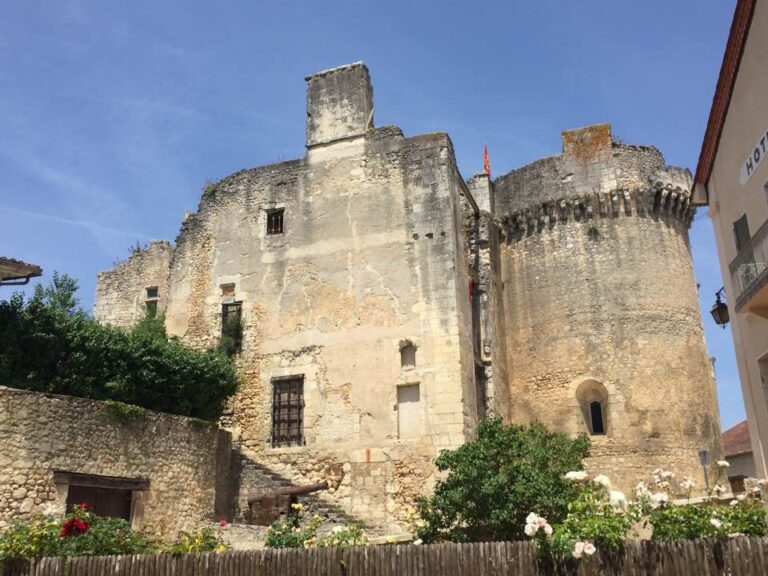
During the Fronde, a series of rebellions and civil wars directed against royal government between 1648 and 1653, troops of the Prince of Condé bombarded the castle in 1652. They then looted and burned it. By 1756, an inventory commissioned by Gabriel-Marie de Talleyrand-Périgord recorded only poor accommodation for the concierge and a prison in fairly good condition. The rest of the castle had collapsed.
During the French Revolution, accessible architectural ornament was destroyed or damaged in 1793. This included bas-reliefs showing coats of arms and fleurs-de-lis. Hélie-Roger-Louis de Talleyrand-Périgord died without descendants in 1883 and left his estates and lands at Chalais, Excideuil, Grignols, and Mareuil to the hospital of Chalais. The hospital sold the ruins to private purchasers in 1902.
On 12 October 1902, André Jouanel purchased the property to prevent its complete ruin. He was the municipal archivist of Bergerac, first deputy mayor of Sarlat, and vice-president of the Historical and Archaeological Society of Périgord. Château de Grignols was listed as a historic monument on 31 March 1928, with the designation covering all of its remains. Its later owners restored and furnished the surviving structures during the twentieth century.
Remains
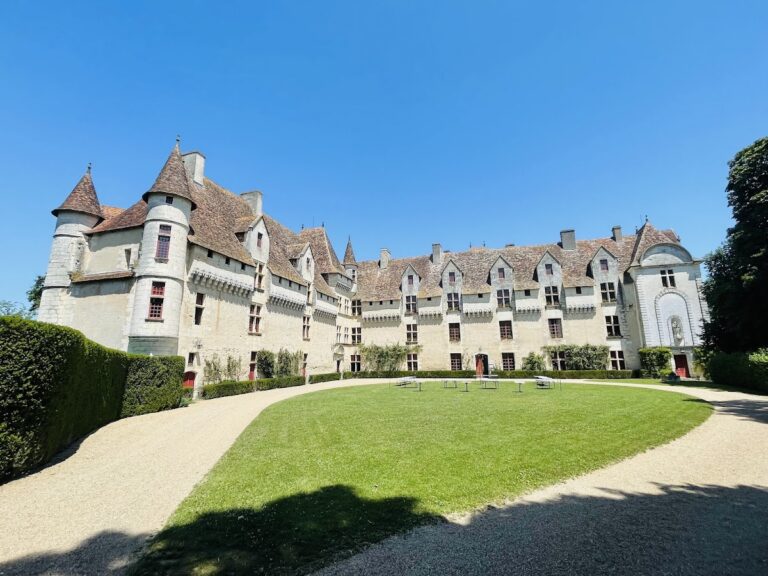
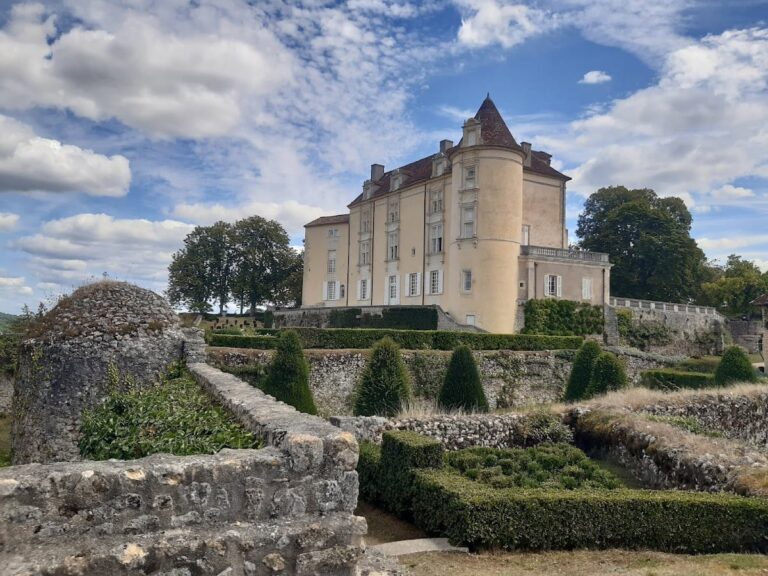
Château de Grignols occupies a promontory about fifty metres above the Vern valley, in the eastern part of the Landais. The medieval complex combined a lower enclosure to the northwest, a higher bailey to the east, and the château itself at the eastern limit of the fortifications. The remains reflect successive phases of defensive construction, Renaissance alteration, seventeenth-century destruction, and twentieth-century restoration.
Earlier Château-Vieux site
Between Soutenac and Puy de Lagarde, the earlier Château-Vieux site preserves three castle mottes and the remains of a tenth-century tower. These earthworks and masonry fragments represent the physical remains of the earlier fortified settlement associated with the wooden fortress.
Medieval fortifications
Lower enclosure
The thirteenth-century fortress included a lower enclosure on the northwest side. Its ramparts incorporated part of the village of Grignols, and three gates provided access to the remainder of the settlement. A church dedicated to Saint Mary stood within that village area.
Bailey
Farther east and at a higher level, the bailey formed an enclosed defensive area approximately 150 metres long and 60 metres wide. Its ramparts were about 2 metres thick and between 8 and 10 metres high. Five houses belonging to local lords of the châtellenie stood within it. They were associated with Frateaux, Mauriac, Milon, Taillefer, and Veyrines.
Triangular château
The château had a triangular plan and formed the eastern boundary of the fortified complex. A moat approximately 7 metres wide separated it from the bailey. The arrangement placed the principal residence within a distinct defended area while linking it to the larger enclosure.
Renaissance buildings and surviving fabric
Rectangular pavilions
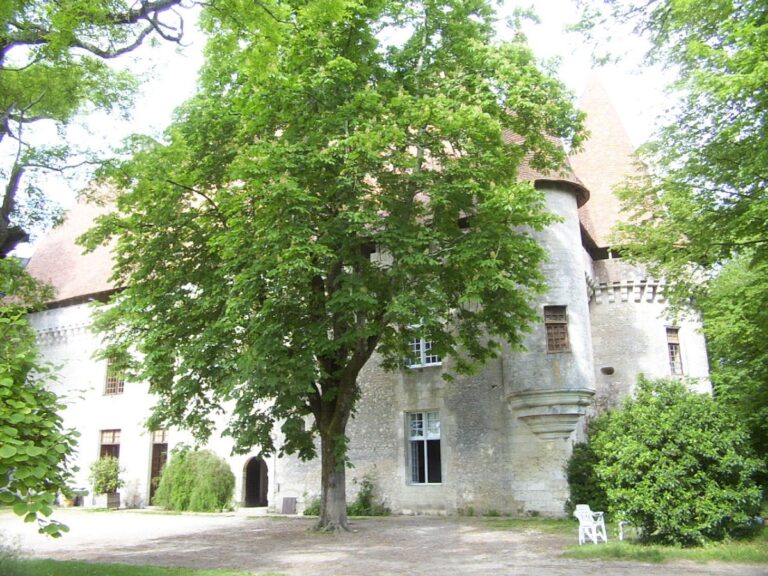
Jean de Talleyrand’s building campaign of 1495 to 1505 added two rectangular pavilions containing large rooms. The work changed the residential character of the complex while preserving its fortified setting. A curtain wall and loopholes also formed part of the castle’s defensive fabric.
Damaged and restored remains
Bombardment, looting, and fire in 1652 severely damaged the buildings, leaving the castle largely collapsed by 1756. Accessible heraldic and fleur-de-lis bas-reliefs were damaged during the revolutionary destruction of 1793. The structures that survived these events were restored and furnished by later owners during the twentieth century.
Nearby sites