Château de Poligny: A Medieval Fortress in France


Site at a Glance
- Rating
- 4.4
- Popularity
- Very Low
- Country
- France
- Primary era
- Medieval
- Eras represented
- Medieval
- Civilizations
- Duchy of Burgundy, French
- Site type
- Military
- Remains
- Castle
On this page7 sections
History
Château de Poligny, also known as Château de Grimont, is a medieval fortified castle in Poligny, France, built in the ninth century at the initiative of Girart de Roussillon. It occupied a strategically important position at the entrance to the Poligny reculée, a steep-sided limestone valley of the Jura, and beside routes leading toward Geneva. The fortress first belonged to the Duchy of Burgundy and later to the counts of Burgundy.
Origins in the ninth century
The castle was established on Mont Grimont, where an earlier religious center of the Celtic Sequani and a Gallo-Roman temple dedicated to Apollo had stood. Poligny was then part of the Kingdom of Lotharingia, one of the territories formed through the division of Charlemagne’s empire among his heirs. The fortress emerged during the political fragmentation and feudal reorganization of western Europe, a period also affected locally by Viking raids and conflict involving Muslim raiders. Between 886 and 889, Viking attacks reached the borders of the Kingdom of Burgundy and were defeated by Richard, Duke of Burgundy, and his vassals.
The castle guarded a contested zone between Burgundy, France, the Holy Roman Empire, and later Habsburg Spain. Poligny’s position at commercial crossroads, together with the wealth generated by saltworks, vineyards, agriculture, forestry, and other industries, increased the town’s strategic value. The stronghold was regarded as one of the safest in the region.
Castle offices and the Burgundian administration
The counts of Burgundy kept property charters, seals, banners, and treasures at Poligny under the care of the treasurer of the Grimont charters. In 1259, the knight Eudes de Poligny received the offices of castellan, the official responsible for a castle’s administration and defense, and captain of the castle from Count Palatine Hugh. The grant was made as a fief for Eudes, his son, and his grandson. From 1262, Eudes also served as bailiff of the County of Burgundy, a senior judicial and administrative officer, and as constable of Burgundy, a senior military official.
Other members of the Poligny family held related offices over the following generations. Odon de Poligny held a castle office from about 1270, became constable of Burgundy in 1275, and served as bailiff-general of Burgundy. Jean de Poligny was recorded as a knight around 1285, Odet II de Poligny as a squire in 1299, and Jean II de Poligny as a squire and lord of Coges in 1412. Jean III de Chalon-Auxerre, an important prisoner of the county, died in the castle prison in 1369 after about a year in captivity.
The castle’s administrative role continued into the sixteenth century. Before 1544, Jean Bonnot, lord of Cormaillon and grand marshal of lodgings to the dowager queen of Hungary, held the castle office by appointment of Emperor Charles V. He resigned in 1544, and Christophe de Villey received the position through imperial letters patent. After a fire at Poligny Castle, the treasury of charters was moved to the Château de Dole in 1561.
French conquest and military destruction
Louis XI conquered the County of Burgundy in 1479, but spared Poligny while many other fortified towns and castles were destroyed. He made the town a principal French stronghold and regional administrative center, then ordered major strengthening works on the town walls and castle in 1481. The fortress later served as the headquarters of Baudricourt’s troops in 1492 and 1493, including during the Battle of Dournon.
Henry IV attempted unsuccessfully to conquer the County of Burgundy in 1595. Poligny and its castle were captured on 13 August, then ransomed for 20,000 écus to prevent their destruction before the French army was defeated at the fortress of Salins-les-Bains.
During the Franco-Spanish War and the Franche-Comté War of Ten Years, conflicts within the wider Thirty Years’ War, Louis XIII and Cardinal Richelieu entrusted Duke Henri II of Orleans-Longueville with the conquest of the province. French forces campaigned in 1637 and returned on 29 June 1638. On that date, they captured the fortress, which was supported by Duke Charles IV of Lorraine on behalf of Habsburg Spain.
The town and fortress were dismantled on royal orders in 1643, and the resistant population was massacred. Poligny then remained uninhabited for about thirty years before families from Saint-Claude, Switzerland, Savoy, and Bugey repopulated it. The town capitulated again in 1668 to the forces of Louis XIV, Louis II de Bourbon-Condé, and Sébastien Le Prestre de Vauban. It surrendered to France on 24 March 1674 and became permanently French under the Treaty of Nijmegen, which ended the Franco-Dutch War.
Remains
Castle on Mont Grimont
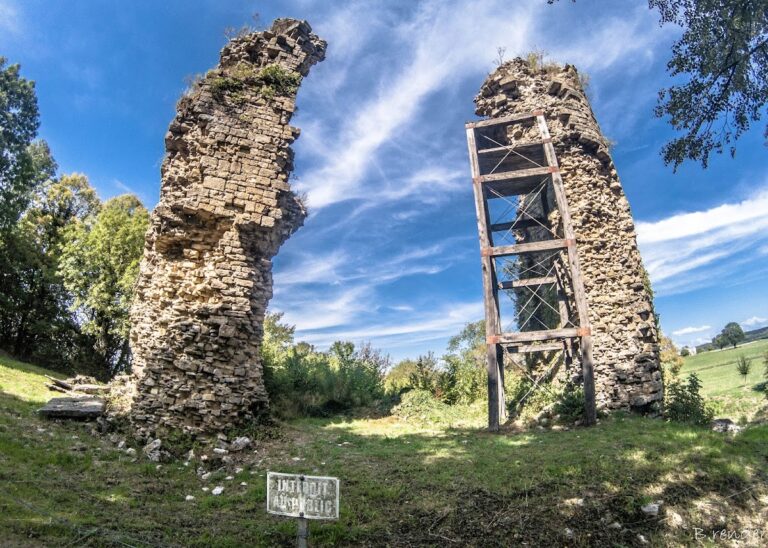
The former fortress occupied about 3 hectares on the high ground of Mont Grimont, along a cliff at the foot of the Jura massif. Its position used the natural strength of the escarpment to defend the entrance to the Poligny reculée and the road toward Geneva. The complex included a keep and six towers, while its fortified rampart extended for about 800 metres and was described as having seven towers. Surviving elements include the Saint-Laurent keep, sections of the castle walls, several towers, and fragments of the castle ramparts.
Fortified town defenses
Two walls connected the castle to the fortified town and extended approximately 1,800 metres down toward Poligny. The town defenses were protected by 25 towers. Associated remains include the towers of Sergenterie and Paradis, while loopholes survive in the walls of houses on the Grande Rue and can be seen from the gardens of Rue de Longeville.