Château Palmer: A Historic Margaux Wine Estate in France


Site at a Glance
- Rating
- 4.3
- Popularity
- Very Low
- Country
- France
- Primary era
- Modern
- External website
- Open
- Eras represented
- Modern
- Civilizations
- French
- Site type
- Economic
- Remains
- Production Complex
On this page9 sections
History
Château Palmer is a historic wine estate in Margaux-Cantenac, France, in the Médoc on Bordeaux’s left bank. Its vineyards belong to the Margaux appellation, and its principal wine was classified as a Troisième Grand Cru Classé, or third growth, in the Bordeaux Wine Official Classification of 1855. This classification places it in the third category of leading Bordeaux wines, rather than providing a simple ranking of present-day quality.
From Domaine de Gasq to Charles Palmer
The property formed part of the Château d’Issan estate until 1748, when the holdings were divided among the heirs of the Foix-Candale family. Fifty hectares of vines passed to the Gascq family. Their wine, known as Domaine de Gasq from the early eighteenth century, was served at the court of Louis XV at Versailles.
On 16 June 1814, Charles Palmer bought the estate from Marie Brunet de Ferrière, the widow of Blaise Jean Charles Alexandre de Gascq. The agreed price was 100,000 francs, including 60,000 francs paid immediately and a lifetime annuity of 500 litres of wine each year. Palmer did more than acquire an existing property. He brought scattered vineyards and parcels together and enlarged them into an estate that took his name.
A British career officer and politician, Palmer had served as an aide-de-camp to the Prince Regent and represented Bath in Parliament. Between 1816 and 1831, he acquired land in Cantenac, Issan and Margaux. By 1831, the estate covered 163 hectares, including 82 hectares of vines.
The nineteenth-century château and classification
Palmer’s expansion ended under severe financial pressure. Debt, poor financial management, family difficulties, powdery mildew, restrictive export legislation and additional penalties on wine producers forced him to sell the remaining estate to the Caisse Hypothécaire in 1843. This mortgage bank managed the property for almost a decade. Palmer died in 1851 without a fortune.
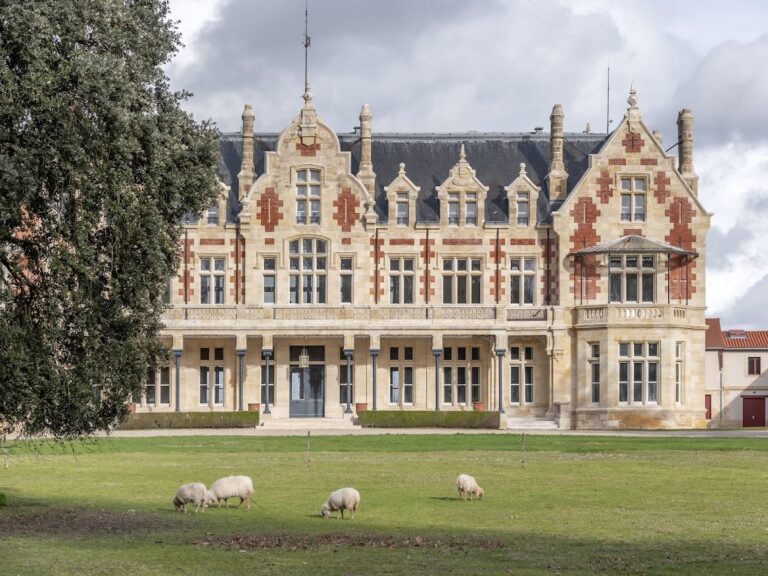
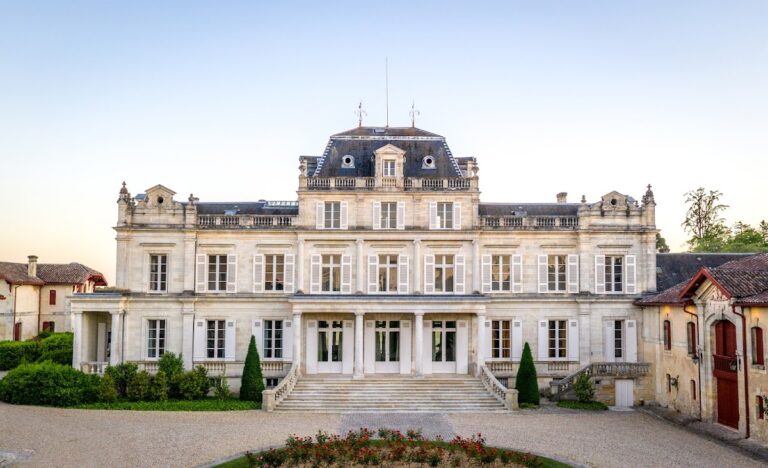
Émile and Isaac Pereire purchased Domaine de Gasq and its 83-hectare vineyard from the bank in 1853. The Bordeaux-born brothers were bankers and entrepreneurs, particularly associated with railway development and Saint-Simonian social and economic ideas. They invested heavily in the property and commissioned the Bordeaux architect Charles Burguet to build the present château in the mid-nineteenth century. The work was completed by about 1860.
Château Palmer entered the 1855 classification as a third growth. Its vines later suffered heavily from fungal disease and phylloxera, an insect pest that devastated European vineyards in the nineteenth century. Replanting replaced the earlier vines completely by 1858. By 1870, the estate covered 177 hectares, including 109 hectares of vineyards.
Family ownership and twentieth-century change
The Pereire heirs created Société Civile Péreire in 1889 to manage the estate. Their family ownership ended when the descendants decided to sell in 1937. In 1938, the property passed to the Bordeaux wine-trading families Ginestet, Miailhe, Mähler-Besse and Sichel.
Land sales during the 1930s had reduced the vineyard to about 36 hectares. In 1950, the Ginestet and Miailhe families sold their shares to the Mähler-Besse and Sichel families, who remain co-owners. The estate became profitable again in 1953. Jean Bouteiller, married to Olga Mähler-Besse, managed the winery until his death in 1962. His son Bertrand Bouteiller then directed it until 2004.
The Chardon family also maintained a multigenerational connection with Palmer. Pierre Chardon became estate manager in 1938, and his sons Claude and Yves continued working there until their retirement at the end of 1996. In 1963, the wines were released once under the Desmirail label.
Labels, farming and recent direction
Before 1998, the estate produced a second wine in some years under the name Réserve du Général. Alter Ego de Palmer was introduced with the 1998 vintage as a separately vinified second label intended for earlier drinking. It draws on the same general terroirs as the principal wine but uses a different blend and winemaking approach.
Thomas Duroux became managing director in 2004. During his direction, the estate introduced detailed mapping of its growing conditions, developed biodynamic viticulture and expanded toward an integrated mixed farm. Biodynamic viticulture treats the farm as an ecological unit and uses preparations and timing practices intended to support soil and plant vitality. Trials began in 2009 on the one-hectare Boulibranne parcel, full vineyard conversion was decided in 2014, and Demeter certification followed in 2018.
The 2018 vintage brought severe mildew damage, destroying approximately two-thirds to three-quarters of the harvest. The small surviving vintage was nevertheless regarded by critics as exceptional. The current owners are the heirs of the Mähler-Besse and Sichel families. The estate’s principal wines include Château Palmer, Alter Ego de Palmer, Historical XIXth Century Wine and a white Château Palmer wine.
Historical XIXth Century Wine was created in 2004 to revive a nineteenth-century Bordeaux practice. It is a non-vintage blend made primarily from Palmer wine and Syrah from the northern Rhône, traditionally described as an “hermitaged” Bordeaux. Because of this composition, it does not carry the Margaux appellation.
An earlier white wine was made for estate consumption in the 1920s and abandoned in the 1930s. The discovery of two bottles of the 1925 vintage in the château cellars helped prompt the revival of white-wine production. Vin Blanc de Château Palmer began with the 2007 vintage, initially for shareholders before limited commercial release. The estate now produces approximately 240,000 bottles annually, including about 100,000 bottles of Château Palmer and 80,000 of Alter Ego.
Remains
Gravel mounds and vineyard
The estate occupies about 100 hectares of vineyards, meadows, woodland and buildings. Approximately 66 hectares are planted with vines on the crests of raised Günzian gravel mounds. These Quaternary deposits were carried by the Garonne and Dordogne rivers from the Massif Central and the Pyrenees. They rest on asteria-bearing limestone, locally called Bordeaux stone. Changes in sea level shaped the gravel into elevated mounds, while fine clay accumulated on their summits during warmer periods.
Palmer’s soils contain more clay than the average gravel soils of Margaux. Surveys begun after 2004 used aerial and infrared analysis, electrical-resistivity mapping and about fifty soil pits to identify roughly twenty terroir types, each with different proportions of sand, clay and gravel. In this context, terroir means the combined influence of soil, topography, climate and local growing conditions on a vineyard.
The present planting is divided equally between Cabernet Sauvignon and Merlot at 47 percent each, with Petit Verdot making up the remaining 6 percent. The vines are planted at approximately 10,000 per hectare. The unusually large share of Merlot reflects extensive planting on clay-rich parcels from the 1940s onward. Merlot accounted for about 3 percent of the vineyard in the 1920s, later rose to 60 percent and was reduced to 47 percent in the 1950s.
Château and historic production buildings
Charles Palmer provided workers’ housing and built a cellar containing 15 oak barrels and three presses. The present château, commissioned from Charles Burguet after the Pereire acquisition, has a nineteenth-century medieval appearance, with conical turrets and slate roofs. It was constructed after the 1855 classification, when the wine had already entered the official list, and therefore represents a later phase of the estate’s development.
The fermentation hall built in 1995 replaced wooden vessels with temperature-controlled stainless-steel vats. Vinification is now carried out separately for each grape variety and parcel. The vats are divided among Château Palmer, Alter Ego and an undecided group representing about 30 percent of the vineyard, whose final allocation depends on the vintage.
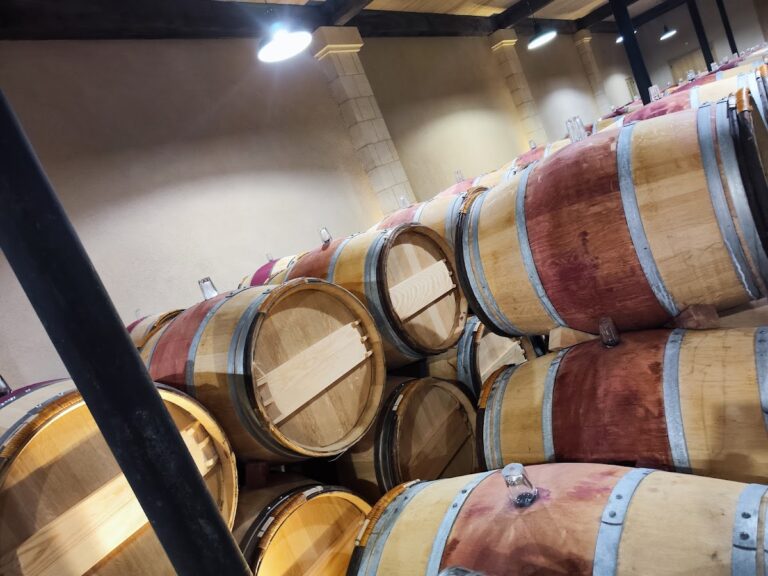
Since the 2014 harvest, the wines have received no sulfur at tank filling. The first addition is made after malolactic fermentation, the process that converts malic acid into softer lactic acid. The wines are clarified with egg white, moved by gravity and bottled at the château. Château Palmer is aged for 20 to 22 months, first in 225-litre Bordeaux barrels, 50 to 60 percent of them new, and then in 30-hectolitre wooden vats. Alter Ego follows the same overall period, with 25 to 35 percent new oak in its barrel stage, and uses grapes from lighter gravel parcels.
The blend of Château Palmer changes considerably between vintages. Examples include 52 percent Merlot, 30 percent Cabernet Sauvignon, 5 percent Cabernet Franc and 13 percent Petit Verdot in 1961; 42 percent Merlot, 48 percent Cabernet Sauvignon, 7 percent Cabernet Franc and 3 percent Petit Verdot in 1982; and 47 percent Merlot with 53 percent Cabernet Sauvignon in 2000. Cabernet Franc was used through 1996, while Petit Verdot was omitted from the listed blends for 2000 and 2011. Château Palmer produces about 100,000 bottles annually and Alter Ego about 80,000, with the latter intended for younger consumption.
White wine and mixed agricultural landscape
Vin Blanc de Château Palmer is made mainly from Muscadelle, with Sauvignon Gris and Lozet. These varieties, described as nearly extinct, were brought back into cultivation for the estate’s white wine. Production is limited to approximately 100 cases per year.
The modern agricultural landscape includes more than a thousand trees planted irregularly among the vines, at roughly fifteen trees per hectare. The project began in 2016 with 100 fruit trees and more than a kilometre of hedgerows. Planting totals included 450 trees in 2020, 710 in 2021 and 110 in 2022. Species are matched to the soils, with Reinette de Bayeux apples on clay and Napoléon cherries, Williams pears, Mirabelle de Nancy plums, Bergeron apricots and blackthorn on sandier ground.
Trees and hedges help moderate heat, drain excess water and reduce runoff, while providing habitat for birds, bats and beneficial insects. Their roots also support microbial life in the rhizosphere, the zone of soil directly influenced by plant roots. Willow and oak bark are used for their stated soil and plant-health benefits.
A vegetable garden was established on a fallow parcel in 2020 and reached about 3,200 square metres by 2024. It occupies several plots and uses heirloom seeds selected for flavour rather than yield. Since late 2014, the estate has also kept Bordelaise cattle, Gascon pigs, Landes sheep and Pyrenean goats. Their manure is combined with vine cuttings and grape pomace to produce compost, linking the livestock, garden and vineyards within the estate’s partly autonomous farming system.