Château de Bouthéon: A Historic Castle in France


Site at a Glance
- Rating
- 4.3
- Popularity
- Low
- Country
- France
- Primary era
- Medieval
- External website
- Open
- Eras represented
- Medieval, Early Modern, Modern
- Civilizations
- French
- Site type
- Domestic
- Remains
- Castle
On this page10 sections
History
Château de Bouthéon is a castle in France, in Andrézieux-Bouthéon, whose origins as a medieval stronghold date from at least the thirteenth century. Known formerly as Bothéon, it occupied a strategic position overlooking the Loire River, the Forez plain and mountains, the Lyonnais mountains, and the Pilat. The historic Forez is a territory centered on the Loire plain and surrounding mountains in what is now the Loire département.
Medieval Lords and Dynastic Transfers
The counts of Forez held the castle during the thirteenth and fourteenth centuries. In the fourteenth century it passed to Gaudemar de Reveux and his heirs, the lords of Reveux and Fay, and then to Robert de Chalus in 1386. Around 1420, Louis II de Joyeuse acquired it.
On 15 January 1423, Marshal Gilbert III Motier de La Fayette married Jeanne de Joyeuse at Bouthéon, and she brought the castle as her dowry. Their second son, Antoine Motier, used the title lord of Bothéon, while Jeanne’s cousin Tanneguy de Joyeuse also claimed it. The dispute ended around 1479–1480. Tanneguy’s younger son, Louis de Joyeuse, then transmitted the Bouthéon lands to his son François and granddaughter Jeanne de Joyeuse.
The Bourbon Connection
In 1462, Jean II, Duke of Bourbon, bought the castle but not the associated lordship. He installed his mistress, Marguerite de Bruant, there, and their son Mathieu de Bourbon later became its owner. Mathieu, an illegitimate son of a Capetian duke and a close associate of King Charles VIII, held Bouthéon from 1486 until his death in 1505. He probably commissioned the north wing after returning from the First Italian War in 1495.
After Mathieu’s death, the castle passed to his cousin Suzanne, Duchess of Bourbon. Through her mother, Anne of France, she sold it in 1519 to Jean II de Saint-Chamond. In July 1523, the Constable Charles III of Bourbon dined at Bouthéon with Antoine de Chabannes, Bishop of Le Puy; Jacques Hurault de Cheverny, Bishop of Autun; Hector d’Angeray, lord of Saint-Bonnet; and Jean de Poitiers, lord of Saint-Vallier. The gathering took place shortly before Charles III met an envoy of Charles V at Montbrison.
Guillaume de Gadagne and Later Aristocratic Ownership
Guillaume de Gadagne purchased the castle and 189 hectares of land from Gaspard de Montmorin-Saint-Hérem in 1561. He made Bouthéon his principal residence, hosted writers and artists there with his wife, Jeanne de Sugny, and adopted the designation “Monsieur de Bothéon.” The estate included 82 hectares of arable land. On 19 May 1704, Marquis Gabriel-Alphonse de Sassenage married Catherine Ferdinande d’Hostun de La Baume at the castle.
At the end of the eighteenth century, the Count of Pons, a descendant and heir of the Gadagne d’Hostun family, sold the castle and its then 642 hectares of surrounding land to Claude Antoine Praire de Neysieux, a ribbon manufacturer. Praire de Neysieux was executed in 1793 after the Siege of Lyon, the military campaign that followed the city’s revolt during the French Revolution. The castle was resold in 1803 to Grailhe, later Baron de Montaima, while the lands, woods, and ponds were subsequently divided among several purchasers.
Industrial Ownership and Public Use
Claude Coignet, a ribbon manufacturer from Saint-Étienne, acquired Bouthéon in 1878 and extensively remodeled the north wing. From 1 September 1914 to 31 December 1915, on the initiative of François Calemard, the castle operated as Voluntary Hospital HB 27bis, with 32 beds for soldiers recovering from service. In 1938, the Coignet-Calemard-Allimant family sold the estate to the Saint-Étienne Civil Hospices, which intended to establish a psychiatric hospital there. During the Second World War, the castle instead housed refugees from Lorraine in 1940.
The industrialist Paul Grousset became the owner in 1961. The city of Andrézieux-Bouthéon purchased the estate in 1995, restored it, and adapted it for public use from 2006–2007 onward. Its successive roles have included medieval stronghold, Renaissance residence, leisure residence, bourgeois apartments, and cultural and visitor site. Today the estate combines a museum and cultural venue with an aquarium, an animal and botanical park, and spaces for business seminars.
Remains
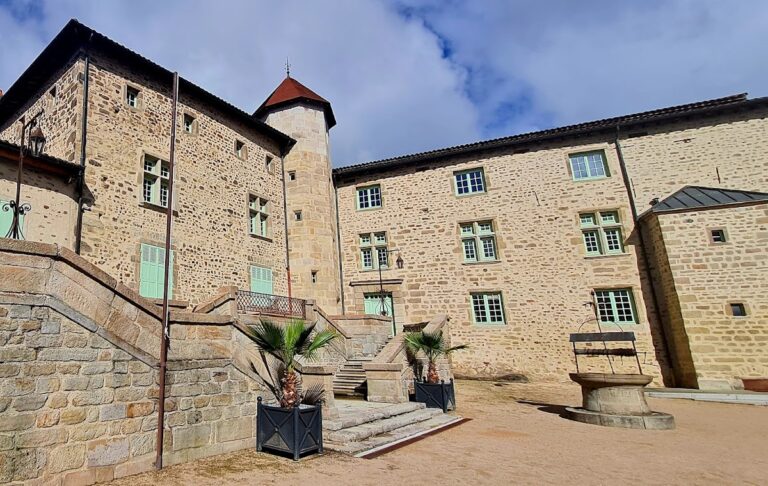
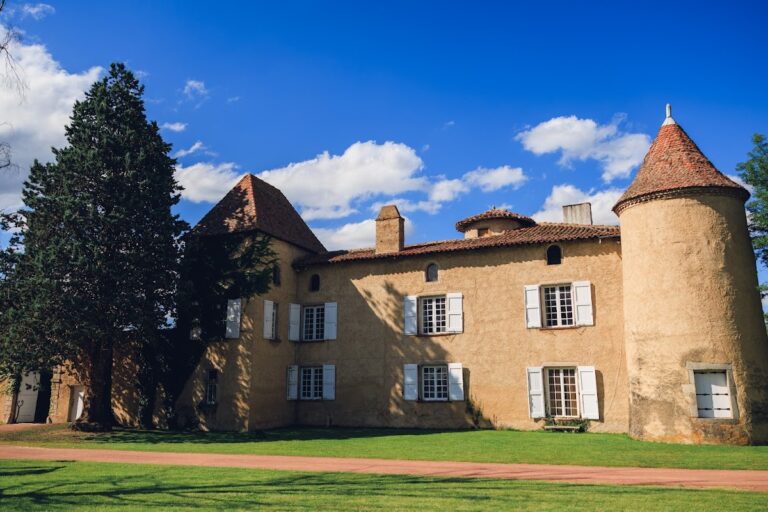
Château de Bouthéon stands on a promontory in the Forez plain overlooking the Loire River and the Chambons market-gardening area. The present castle is arranged as two long, parallel buildings facing a large main courtyard. A belvedere tower looks across the plain toward the Forez, Pilat, and Lyonnais mountains and the Loire gorges regional nature reserve. From it, 27 church towers and landmarks such as Château d’Essalois, Château de Montrond, and the priory of Saint-Romain-le-Puy can be seen.
The North Building
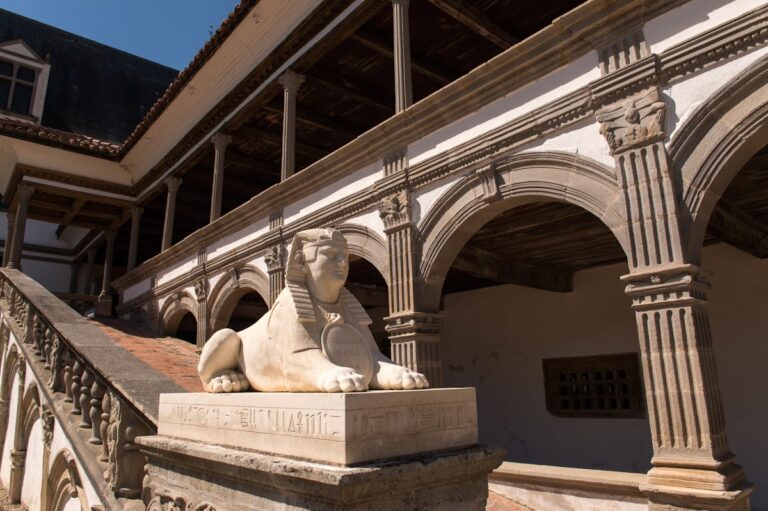
The north building ends in two tall towers and was probably constructed in the late fifteenth century for Mathieu de Bourbon. Claude Coignet remodeled it extensively in the nineteenth century in a Neo-Gothic style. Its surviving features include an honor staircase, a chapel with an altar, and a ceiling honoring Pierre II of Bourbon and Anne of France. Coignet’s work also introduced mosaic floors, wood paneling, and decorated beams. Other elements were brought from separate buildings, including a bust of Marcus Aurelius, later returned to Château de la Bastie d’Urfé, and the monumental fireplace in the small salon, originally from the Castle of the Bishops of Le Puy at Monistrol-sur-Loire. An emblem of King Charles VIII and an Atlantean figure, a sculpted male architectural support, also form part of the decoration. The figure is associated with the well in the main courtyard.
The South Building
The south building terminates at one end in a greenhouse and at the other in the entrance tower. Its Loire-pebble facade, roof, and exterior finish give it a newer appearance than the north building, but it is the oldest part of the castle. It incorporates remains of the medieval keep, while its present appearance probably dates from the sixteenth century and is associated with Guillaume de Gadagne’s ownership.
Lower Courtyard and Defensive Works
The south side of the lower courtyard contains working and service spaces, including a tack room, forge, shelters for a cart, carriage, threshing machine, and still, as well as storage boxes and a heating room. Restoration work in 2004 uncovered a probably fifteenth-century small caponier beneath the fixed bridge leading to the main courtyard. A caponier is a fortified work in or beside a moat from which defenders could fire along the surrounding defenses. This example was built to protect the castle and may have housed hook-mounted arquebuses, early portable firearms supported by projecting hooks to reduce recoil. It lies in the middle of the dry moat rather than attached to the scarp, and the visible fixed bridge was probably added later.
Animal and Botanical Park
The associated animal and botanical park covers approximately ten hectares and contains several architectural features. These include Château Gaillard, a stone pleasure pavilion with a lead covering over a wooden roof; hexagonal wooden shelters with flat-tile roofs, including a rose-garden kiosk and animal shelters; a reproduction of the castle chapel tower; and a Forez farm with a rammed-earth facade wall. Rammed earth, also called pisé, is made by compacting damp earth within formwork.
Nearby sites