Oberburg Driedorf: A Medieval Castle Ruin in Germany

Site at a Glance
- Rating
- 5
- Popularity
- Very Low
- Country
- Germany
- Primary era
- Medieval
- Eras represented
- Medieval, Early Modern
- Civilizations
- Holy Roman Empire
- Site type
- Military
- Remains
- Castle
On this page8 sections
History
Oberburg Driedorf is the ruin of a high-noble castle in Driedorf, Germany, whose construction is dated either to around 1305 or to the late thirteenth century. It formed part of the town’s defensive system and was probably connected with the Nassau lordship of Driedorf.
Origins and Nassau rule
One interpretation links the castle’s construction with King Albert I of Austria, a Habsburg ruler who was king of the Romans, the title commonly used for the elected German king before imperial coronation. Around 1305, Albert granted Driedorf town rights. After the Ottonian Nassau territories were divided, Emich I, the second son of Otto I of Nassau, received the Nassau share of the lordship. He established the older Nassau-Hadamar line and resided at the Junkernschloss in Driedorf. The Oberburg was probably built to help secure the town wall.
A different interpretation, based on heritage-conservation analysis, places the castle’s construction toward the end of the thirteenth century and attributes it to Count Otto. The differing dates reflect two explanations for the castle’s origins rather than a continuous construction period.
Disputed inheritance and renewal
After Heinrich of Nassau-Hadamar died in 1368, his brother Emich III was considered unable to govern. Heinrich’s brother-in-law, Count Ruprecht of Nassau-Sonnenberg, a member of another branch of the House of Nassau, became Emich’s guardian. With help from Heinrich II of Hesse, Ruprecht took possession of the inheritance. Driedorf was treated as a Hessian fief believed to have reverted to its superior lord, and it was granted to Ruprecht. Johann I of Nassau-Dillenburg also claimed the territory, producing serious disputes.
Ruprecht died in 1390. His widow, Anna of Nassau-Hadamar, later married Diether VIII of Katzenelnbogen, who acquired one-third of Driedorf through the marriage. After Diether died in 1402, Landgrave Hermann II of Hesse and Johann IV of Katzenelnbogen, Diether’s son from his first marriage, held the castle jointly and renewed it. A landgrave was a high-ranking territorial ruler in the Holy Roman Empire.
Later ownership and destruction
When the Counts of Katzenelnbogen died out, Driedorf passed in 1479 to Heinrich III of Hesse-Marburg. Following prolonged legal disputes, it returned to the House of Nassau in 1557. The castle was renewed again in 1604.
Major town fires, including those of 1635 and 1672, progressively damaged the castle. Another fire in 1812 reduced it to a ruin. It was not rebuilt, and continued deterioration followed. Later expansion of Driedorf covered parts of the remains. The surviving ruin has since been repaired and is protected as a cultural monument of Hesse.
Remains
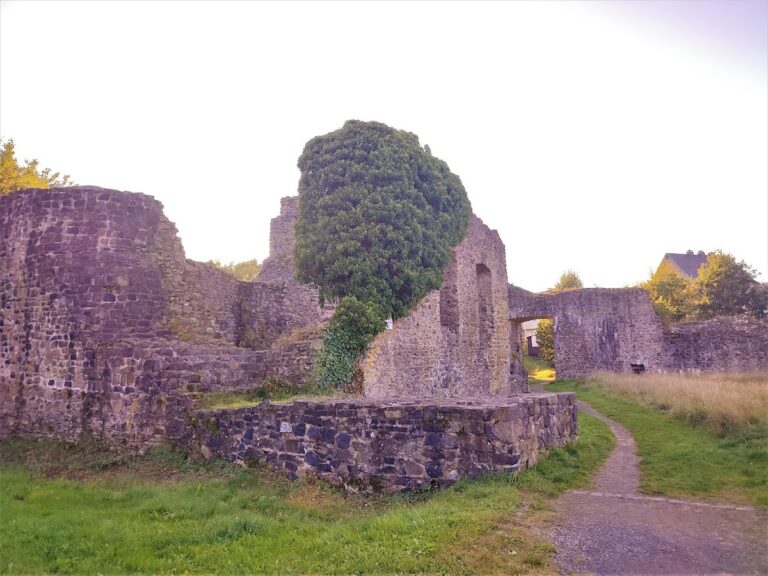
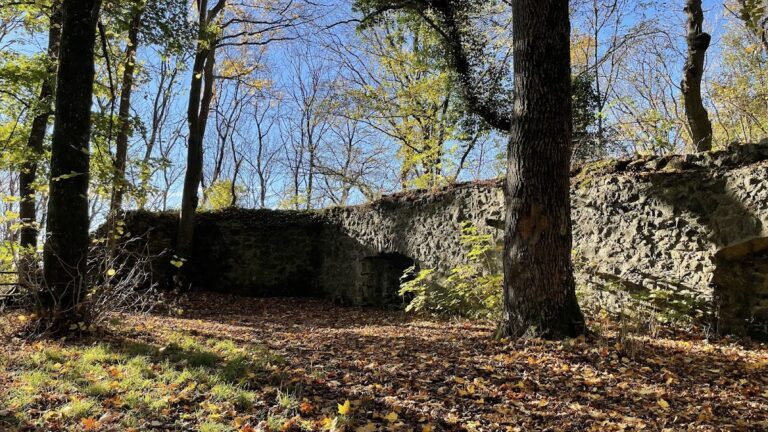
Oberburg formed part of Driedorf’s defensive layout. Its ring wall joined the town wall, while the castle complex contained five towers. The surviving remains lie at the northwestern edge of the town and consist chiefly of a rectangular principal tower connected with the town fortifications, together with fragments of the enclosing defensive wall.
Fortifications
Upper tower
The rectangular keep, or principal fortified tower used for defense and residence, is known as the upper tower. It survives as a ruin at the northwestern edge of Driedorf and remains connected to the town’s defensive works.
Walls and towers
Remnants of the surrounding defensive perimeter survive with the upper tower. The original complex had five towers, and its ring wall formed a direct connection with Driedorf’s town wall. Other parts of the castle have been covered by later expansion of the town.