Burgstall Schwarzenschwall: Medieval Castle Site in Bavaria
Site at a Glance
- Rating
- 5
- Popularity
- Very Low
- Country
- Germany
- Primary era
- Medieval
- Eras represented
- Medieval
- Civilizations
- Holy Roman Empire
- Site type
- Military
- Remains
- Castle
On this page5 sections
History
Burgstall Schwarzenschwall is a former medieval castle site in Germany, located near Falkenberg in Bavaria. Probably built during the thirteenth century by the Lords of Falkenberg, it served as a ministerial residence, the seat of a member of the service nobility who held administrative or military duties for a higher lord.
Origins and changing ownership
The Lords of Falkenberg were a medieval noble house known from at least 1154, when Pilegrin de Valkenberch was named as an early member of the lineage. In 1274, the castle passed to the Lords of Leuchtenberg through the marriage of Gebhardt VI von Leuchtenberg and Jutta.
The name Schwarzenschwall first appears in 1294. In that same year, the Lords of Leuchtenberg sold the castle to Waldsassen Abbey, a Cistercian monastery and an important ecclesiastical landholder in the Upper Palatinate. The property later passed through further hands. Marquard von Redwitz acquired it and pledged it to Peter Pfreimder, who sold it back to Waldsassen Abbey in 1401.
Ruin and later record
By 1363, the castle was already a ruin. It was nevertheless mentioned again as Schwarzenschwall Castle in 1513, after which the site ceased to appear in records from the seventeenth century onward. Today, the Bavarian State Office for Monument Protection lists it as the archaeological monument D-3-6139-0027, “Medieval Castle Site Schwarzenschwall.”
Remains
Hilltop fortification
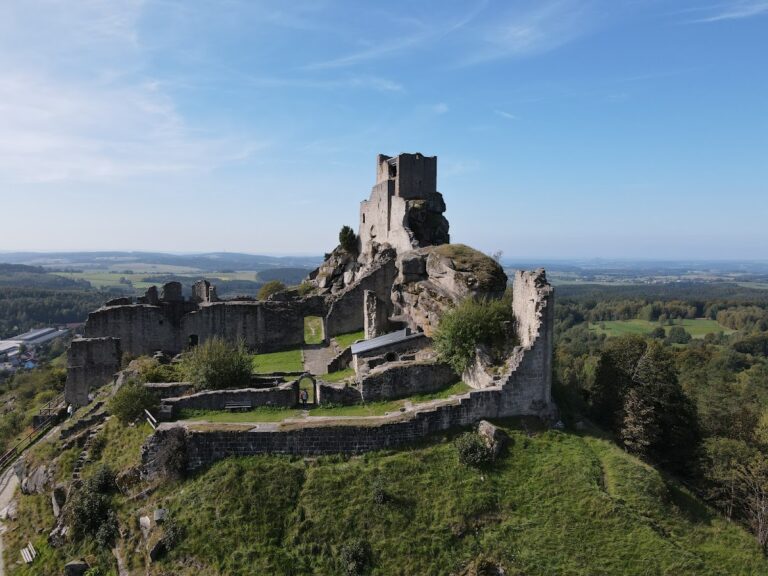
The former castle was a hilltop spur castle, a fortification built on a projecting ridge or rocky spur. It occupied a granite rock at approximately 470 metres above sea level on the right side of the Waldnaab valley, in the Falkenberg Forest south of Falkenberg in the Tirschenreuth district of Bavaria.
The surviving castle site is defined by two section ditches. Each section ditch cut across the spur, separating the fortified area from the surrounding ground and helping to defend the approach. The rocky tip of the spur marks the area occupied by the castle, while the buildings themselves have largely disappeared. The term Burgstall describes this type of former castle site, where little of the original construction remains above ground.