Castillo de Andilla: A Medieval Route-Control Fortress in Spain


Site at a Glance
- Rating
- 5
- Popularity
- Very Low
- Country
- Spain
- Primary era
- Medieval
- Eras represented
- Medieval
- Civilizations
- Crown of Aragon
- Site type
- Military
- Remains
- Castle
On this page6 sections
History
Castillo de Andilla is a medieval fortress of Muslim origin in Andilla, Spain, probably built in the eleventh century to control the Camino Real, the principal royal route linking Valencia with Aragon. The settlement below it began as a Muslim community, while archaeological sites in the municipality point to human occupation since the Mesolithic, the prehistoric period between the Paleolithic and Neolithic associated with hunter-gatherer communities.
From Muslim settlement to feudal lordship
After the Christian conquest of Valencia, the fortress and settlement entered a new political order. James I of Aragon, the thirteenth-century monarch who led that conquest, donated Andilla and the castle to Eiximen Pérez de Arenós in a deed issued at Zaragoza on 27 December 1237, before Valencia was conquered. The lordship later passed through several owners and families, including the Prades and Heredia, before coming to the Marcilla and Santa Cruz families.
The castle’s position continued to give it value to the feudal lords who controlled the surrounding territory. Over time, however, the fortress was gradually abandoned. Its defensive importance returned during the civil conflicts of the nineteenth and twentieth centuries.
War, destruction, and archaeological investigation
During the Carlist Wars, nineteenth-century Spanish civil conflicts caused by competing claims to the throne and opposing political visions, the fortress helped control routes from Valencia toward Castellón and Teruel. These wars, together with the Spanish Civil War of 1936, destroyed practically all of the remaining fortress structures. At the beginning of the twentieth century, the castle reportedly still retained many elements, including three standing towers.
Archaeological work in 1994 at Plaza de la Muralla uncovered a surviving section of the town wall. The castle and town walls were designated Assets of Cultural Interest, a protected heritage status under Spanish law, on 6 June 2001.
Remains
Hilltop fortress
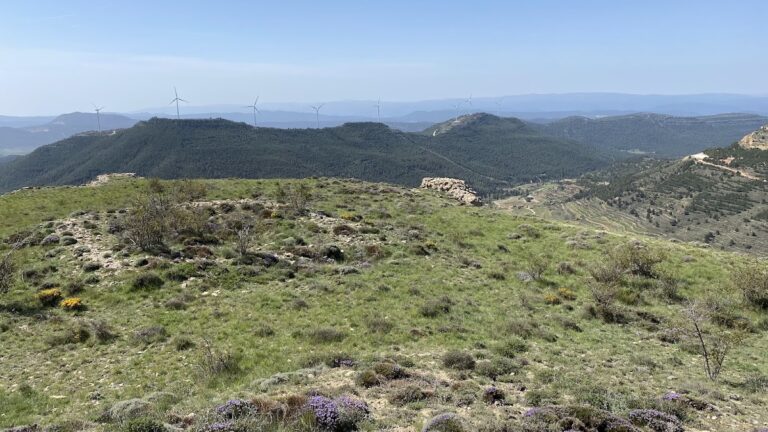
The castle ruins occupy the summit of a hill almost 900 metres high overlooking Andilla, beside the Chapel of Santa Inés. The hill and its fortress form a characteristic element of the town’s landscape. Isolated wall sections and scattered remains survive on the slopes and within the castle area, including remnants of the three towers that still stood near the beginning of the twentieth century.
Town walls and western portal
A separate walled enclosure once surrounded the settlement. Most of its walls have disappeared or have been incorporated into houses built against them, but excavation at Plaza de la Muralla exposed a surviving section. A portal, probably the principal entrance, remains in very good condition on the western side of the town.
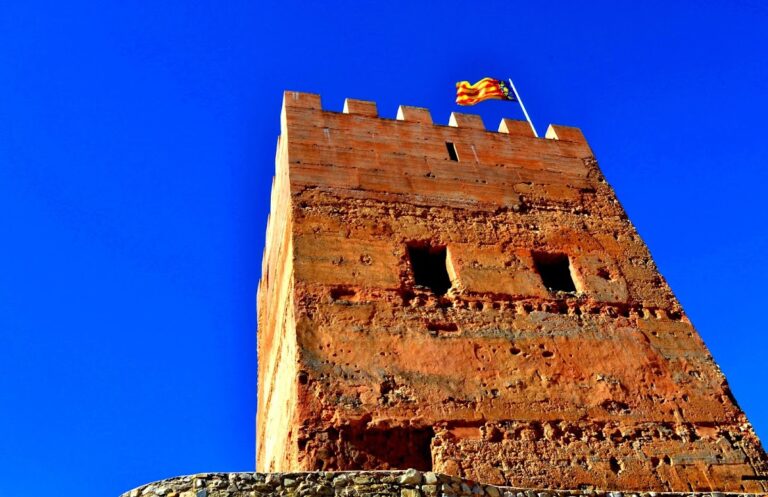
The portal lies beneath a fourteenth-century medieval tower that now houses the Municipal Archaeological Museum. The tower and entrance are built from ashlar, regularly cut and finished stone blocks. The broad semicircular arch is formed by large voussoirs, the wedge-shaped stones that make up an arch, and its keystone bears the noble coat of arms of Manuel Díez de Vilanova and his wife, Blanca de Calatayud. Manuel Díez de Vilanova served as steward to Alfonso V of Aragon, while Blanca de Calatayud was his wife.