Château de Boissezon: A Medieval Seigneurial Residence in France


Site at a Glance
- Rating
- 5
- Popularity
- Very Low
- Country
- France
- Primary era
- Medieval
- Eras represented
- Medieval
- Civilizations
- French
- Site type
- Military
- Remains
- Castle
On this page16 sections
History
Château de Boissezon is a medieval fortified seigneurial residence in France, at Boissezon de Masviel, now within Murat-sur-Vèbre in the Tarn. Built and developed by successive medieval lords, it served as the château of the former Ancien Régime community of Boissezon de Matviel, the monarchy and social order that governed France before the Revolution of 1789. That community comprised the four parishes of Sainte-Marie de Boissezon, Saint-Pierre de Canac, Saint-Étienne de Murat, and Saint-Pierre-Saint-Paul de La Bessière.
Medieval territory and lordship
Murat and a place called Boissezon appear in the 966 testament of Matfred, Viscount of Narbonne, and his wife Adelaïde. The Boissezon named in that document may have been Boissezon d’Augmontel or Boissezon de Masviel, and its identification with the latter remains a proposal associated with the archivist Émile Jolibois. The seigneurial territory, meaning a lord’s domain of land, revenues, justice, and dependent communities, was later mentioned in an agreement of 1112 between Bernard Aton IV Trencavel, Viscount of Albi, and Raimond-Bérenger III, Count of Barcelona.
Boissezon formed part of the Trencavel-controlled Viscounty of Albi until the lands of the Trencavels in the Diocese of Albi were granted as a fief to Philippe de Montfort under the Treaty of Paris in April 1229. The Trencavels were a powerful medieval dynasty of southern France whose territories were reduced during the political and military consequences of the Albigensian Crusade, the thirteenth-century campaign against Catharism and its political supporters. In 1268, Philippe II de Montfort granted the lordship of Boissezon as a fief to Jean de Manicort, his brothers, and their successors.
Later successions reduced the territory, but the wider country between Castres, Lacaune, and Boissezon de Matviel remained within the county created in 1356. The area also became part of the Seneschalship of Carcassonne and Béziers, a major administrative and judicial district. By the end of the thirteenth century, the rights of the lordship were divided between a principal lord who lived at the château and held two shares, and a co-lord who held the remaining share. This co-lordship repeatedly produced disputes and legal proceedings.
An agreement in 1292 regulated the division of revenues, and another settlement followed in 1329. In that year, Guilhaume de l’Estendart and his brothers Gaston and Roger, who held two-thirds of the rights, reached an agreement with Déodat de Caylus, co-lord of the baronies of Caylus and Olargues. The Estendarts had acquired further rights from Ayméric du Pont de Camarès in 1326. Pierre de l’Estendart is said to have obtained the lordship from Jeanne de Saint-Feriol, wife of Hughes de Massilian, Lord of Camarès.
The Peyrusse inheritance
In the early fifteenth century, the Peyrusse family acquired parts of the lordship. Azémar, or Adhémar, Paternac reportedly married Jeanne de l’Estendart in 1404 and obtained a share from Marguerite de l’Estendart in 1418. Five generations of Peyrusse thereafter held two shares of the lordship, the château, and the seigneurial justice. Although members of the family temporarily lived at Lombers, their principal revenues came from rights levied in Boissezon de Matviel.
Bringuier de Peyrusse became the highest-earning vassal of the Count of Castres in the Lacaune Mountains. His revenues were 414 livres, compared with 182 livres for the lord of Brassac and 7,000 livres for the count. The château thus stood at the center of a lordship whose importance rested not only on its buildings but also on the collection of revenues and exercise of justice across the surrounding communities.
Religion and the Wars of Religion
Antoine de Peyrusse, who was probably raised in the Protestant faith, established a Reformed church at the château in May 1570. It served the communities of Boissezon, Murat, Canac, Arnac, and La Moline Basse. The Peyrusse family became involved in the Wars of Religion, the French conflicts between Catholic and Protestant forces from 1562 to 1598.
During a truce between Protestant forces associated with the Montmorency family and Catholic forces associated with the Joyeuse family, Pierre de Peyrusse was ordered to restore order at the château of Olargues. In 1585, he lured the captain Pierre to Boissezon on the pretext of serving as godfather at a baptism. Pierre was disarmed and killed during a meal at the château. The following year, Pierre de Peyrusse himself died from arquebus fire, an arquebus being an early firearm, while attacking a nearby fort at Belmont.
After his death in 1586, the lordship passed to his sister Aldonce, who had married Guillaume de Génibrouse at the château in May 1575. Guillaume died in early June 1593 at the nearby château of Canac, where the family had withdrawn after Catholics captured their château of Saint-Amans. When peace returned, Aldonce went back to Boissezon and wished to be buried in the Reformed cemetery in front of the château.
The Génibrouse succession
Nicolas de Génibrouse inherited the lordships of Saint-Amans and Boissezon. He joined the Duke of Rohan during the final Huguenot revolts in Languedoc, renewed Protestant uprisings in the early seventeenth century, and later supported Gaston d’Orléans in his attempted uprising against Richelieu’s policies. He consequently lost Boissezon temporarily between 1633 and 1637, while his château of Saint-Amans was razed. After his rights were restored, he designated his son Jacques as heir and requested burial in a chapel newly built near the château.
Jacques de Génibrouse reconstructed the Peyrusse lordship by purchasing Canac from his nephew and additional rights from his cousin Jean de Caylus, although he was heavily indebted. In 1687, his eldest son Charles married the daughter of Thomas de Thésan, co-lord of Boissezon, Viscount of Poujol, Lord of Nages, and lieutenant of the king in Guyenne. This marriage brought the lordship into the Thésan-Poujol family.
Charles de Génibrouse died young, complicating the transfer. His brother Bernard secured the restitution of the family property in court in 1699. Repairs at the château were recorded in 1708, including four days of masonry work in the room of Bernard’s wife, Marguerite de Percin de Montgaillard. Bernard was buried in a chapel of Boissezon church around 1726.
The Thésan-Poujol family continued to hold one share of the lordship. Seigneurial justice was divided according to a precise arrangement: it was exercised at Boissezon for sixteen months on behalf of Monsieur de Saint-Amans and at Murat for eight months on behalf of Monsieur de Poujol. From the beginning of the eighteenth century, the Génibrouse-Boissezon family increasingly withdrew from the château and lived mainly in residences belonging to their wives, including the castle of Lédergues and the castle of Roquefeuil, Lord of La Salle and Padiès.
Political and economic influence shifted toward Murat. Its parish contained nearly three-quarters of the population, and the notary, lieutenant of the bourgeois guard, and master surgeon were based there. Around 1739, Jacques, Marquis of Boissezon and eldest son of Bernard, undertook major repairs at the château. The work included rebuilding a wall, renewing floors, fitting doors and windows, constructing a staircase, repairing 64 canes of roofing, and plastering the walls.
Revolutionary sale and destruction
During the Revolution, noble property was sold. The estate of Gabriel-Maurice de Génibrouse, Count of Boissezon, who died in 1797, was divided in January 1799 between his heirs and the Republic. The Republic retained the share belonging to his émigré son. The château archives were preserved locally before being transferred to the archives in Toulouse and later forming the Génibrouse Collection, much of which can be consulted in the departmental archives of Tarn-et-Garonne.
On 15 May 1807, the municipal council requested the sale of Poux Wood, a noble property omitted from the earlier sale, and referred to the château as the “collapsed château.” During the nineteenth century, the promontory was progressively quarried to supply a lime kiln used extensively to lime agricultural meadows. The ruins also provided building material for the departmental road that replaced the older route along the mountain heights.
In 2005, the municipality of Murat-sur-Vèbre began safeguarding work with financial support from the Monts de Lacaune community of communes. A threatened gargoyle was removed from the surviving tower and placed in the municipal archaeological collection. The remains of the last lime kiln were restored and given an interpretive presentation of the château’s history and appearance before its destruction.
Remains
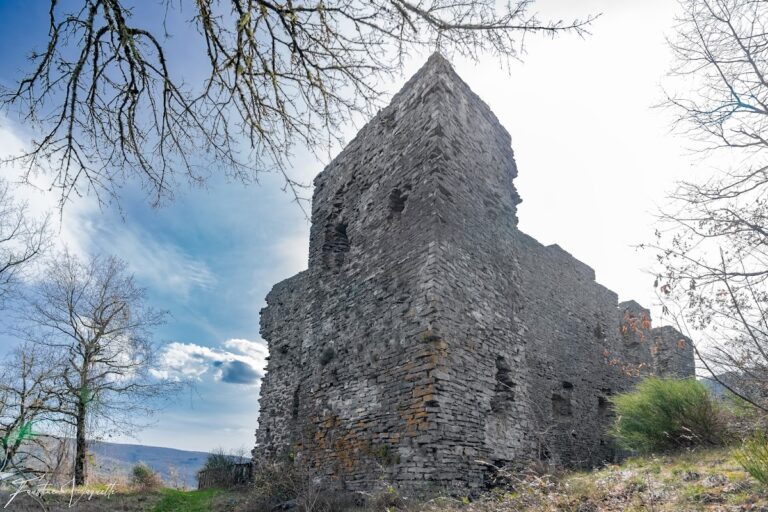
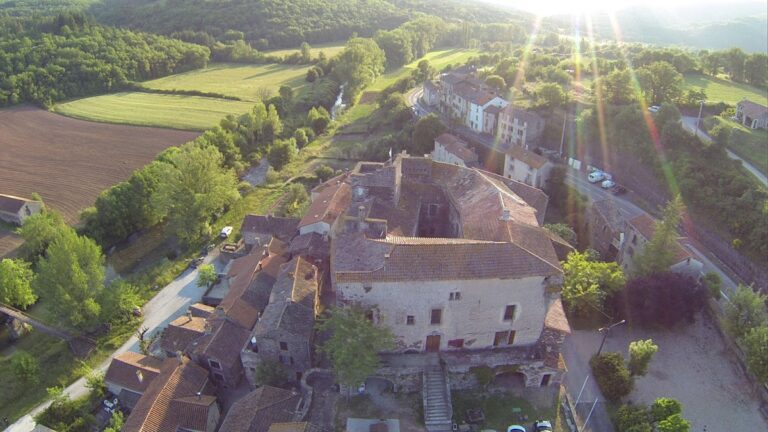
Château de Boissezon stood on a promontory inside a bend of the Rieu-Pourquié stream. The surviving site is now a ruin, with one ruined but safeguarded tower as its principal standing remnant. Earlier descriptions, land records, and archaeological discoveries allow the former fortified settlement to be reconstructed as a small castral community, a settlement organized around a fortified lordly residence.
The fortified settlement
Castle and defensive front
A description from 1397 calls the site “the fort of Boissazo” and presents it as a settlement of about ten dwellings. One stone-built residence stood partly within enclosing walls and had a gate belonging to the lord. Other houses and outbuildings lay beyond the enclosure or in the surrounding settlement. Gardens stood behind a hospital, a cemetery for the poor occupied part of the community, and a mill operated on the Rieu-Pourquié. A census of 1377 counted nineteen hearths.
The medieval château was probably built or substantially developed by the Peyrusse family. A document of 1476 records the sale to Béranger de Peyrusse, a squire, of a granary and ground floor within the château. In the nineteenth century, the castle was described as having five round towers connected by massive buildings. An outer gate opened beneath a dark vaulted passage, leading to a drawbridge and then to a second gate that gave access to the château. The defensive front formed a crescent, with the surviving tower at its southern end and another tower at the opposite end, both founded on solid rock.
Surviving tower and gargoyle
The surviving tower formerly carried a gargoyle made from the pink sandstone of the Rougier. The carved waterspout became dangerous because it threatened to fall, so the 2005 safeguarding work removed it from the tower and placed it in the municipal archaeological collection. The tower itself remains the only ruined but safeguarded standing part of the château.
The fortification could not withstand the firearms introduced into the region during the Wars of Religion. The development of artillery and the use of petards, small metal charges filled with gunpowder for damaging gates and fortifications, contributed to Guillaume de Génibrouse’s preference for the more isolated fortified residence at Canac rather than retreating to Boissezon.
Courtyards, boundaries, and land records
Seventeenth-century enclosure
A description from 1672 places the noble château on elevated ground near Boissezon and mentions towers, a lower courtyard, warrens, ditches, and gardens covering three cesterées. A warren was an enclosed or managed area for keeping or hunting rabbits and other game. The Rieu-Pourquié bordered the property to the east and north, the road from Boissezon to the château formed the southern boundary, and the lands of the heirs of Guillaume Viala lay to the west.
Eighteenth-century measurements
A land register of 1719 lists the château, stables, and courtyard. The château site measured 70 canes, the stables 24 canes, and the courtyard 28 canes. A cane was a historical local unit of length whose value varied by place and period. The stream bordered the property to the east and south.
Burials and industrial remains
Former cemetery and ossuary
A cemetery in front of the château was identified on the strip of land leading to the site. It contained more than thirty skeletons and coins from the reigns of Philippe IV, Philippe VI of Valois, Louis XI, and the last Valois rulers. The coins were transferred to the Toulouse-Lautrec Museum in Albi. A separate excavation near the surviving tower revealed an ossuary consisting of a mass of human bones.
Lime kiln and reused sandstone
Remains of the final lime kiln survive at the site. The building was restored in 2005 and now presents a reconstruction of the château’s history and its appearance before destruction. Pink sandstone cut from the château was also reused during the nineteenth century as door and window surrounds in several houses rebuilt in the hamlet.
Nearby sites