Fetteresso Castle: A Medieval Tower House and Palladian Manor in Scotland


Site at a Glance
- Rating
- 5
- Popularity
- Very Low
- Country
- United Kingdom
- Primary era
- Early Modern
- External website
- Open
- Eras represented
- Bronze Age, Medieval, Early Modern, Modern
- Civilizations
- Kingdom of Scotland
- Site type
- Domestic
- Remains
- Manor House
On this page10 sections
History
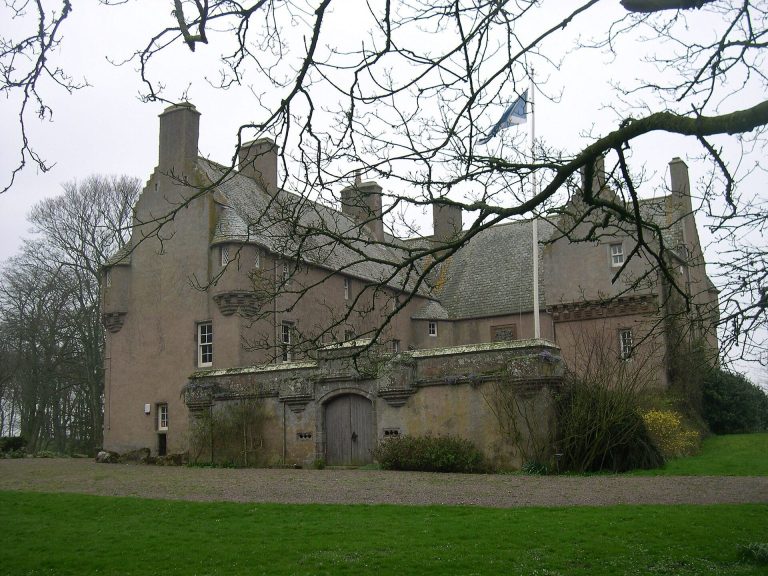
Fetteresso Castle is a medieval Scottish tower house in the United Kingdom, immediately west of Stonehaven in Aberdeenshire. The original tower was built by the Keith Earls Marischal in the fourteenth century, and the site was later enlarged into a Palladian manor in the Scottish Gothic style. Its history also reaches back to prehistoric activity, while later records connect it with royal visits, witchcraft accusations, artistic work, and changing patterns of estate ownership.
Prehistoric and early medieval setting
The castle stands in an area with evidence of prehistoric use. Cropmarks in the managed grounds indicate a ring ditch at the northern end of a cursus, a prehistoric monument formed by long parallel banks or ditches whose original purpose remains uncertain. A cairn found near the castle in 1822 contained human remains. Its unhewn whinstone construction and chamber identify it as a Bronze Age burial structure, and the associated mound is known as Malcolm’s Mount.
Malcolm’s Mount was traditionally linked with Malcolm I, the tenth-century king of Scotland who was recorded as having been killed at Fetteresso in AD 954. The burial, however, is probably much older than that event. A Beaker-culture burial urn, associated with a later third-millennium BC prehistoric tradition known for distinctive pottery and burials, was found at Fetteresso Castle in 1998. The wider district also includes Raedykes, a Roman marching camp several miles to the north-west, which formed part of a chain of camps linking Angus and Moray.
Medieval lordship and the Keiths
The estate was associated with the Strachan family before the fourteenth century. During the Wars of Scottish Independence, the conflict between the Balliol and Comyn factions and Robert the Bruce, king of Scots from 1306 to 1329, brought changes to the family’s position. Bruce burned Castlehill of Strachan, and around 1316 the Barony of Strachan was taken from the de Strachans and granted to Sir Alexander Fraser. The Strachans had supported and were related to John Comyn, Earl of Buchan.
The barony later passed to William Keith, Earl Marischal of Scotland, through his mother, a daughter of Sir Alexander Fraser. The Earl Marischal was a senior hereditary officeholder with ceremonial and military duties at the Scottish royal court. The Keith family, a major landowning dynasty in northeastern Scotland, held nearby Dunnottar Castle as well as Fetteresso. In the fourteenth century, the Keith Earls Marischal established the original tower house at Fetteresso.
Early modern life and estate expansion
James VI hunted in the woods at Fetteresso on 20 June 1580 while staying at Dunnottar Castle. During the seventeenth century, Jean Hunter lived at Fetteresso. She was accused of witchcraft and hanged at her home in 1659. Between 1671 and 1678, Alexander Charles, an artist and wright, worked at the castle as an overseer and later published his drawings in at least one book.
By the late seventeenth century, the Duff family controlled the estate and had expanded the buildings around the earlier tower house. The complex was later transformed into a Palladian manor in the Scottish Gothic style, although the precise date of this conversion is uncertain. This enlargement preserved the medieval core while giving the estate a broader manor-house character.
Twentieth-century change
In the 1940s, Fetteresso Castle belonged to Maurice Simpson and Geraldine Simpson, née Pringle, heir to the Pringle knitwear fortune. The Simpsons later acquired nearby Muchalls Castle and moved there. After their tenure, Fetteresso remained without a roof for a period beginning around 1954. A local landowner subsequently purchased the castle and left it to the Don family in his will.
During the latter part of the twentieth century, the building was restored and divided into seven residential units. This work established its present residential form, while the castle remained in private ownership. In 2020, one of the units, known as Number Seven, was placed on the market.
Remains
Prehistoric features and burials
The physical setting includes the cropmark of a ring ditch at the northern end of a prehistoric cursus within the surrounding policies. The nearby burial cairn, known as Malcolm’s Mount, was built from hard, dark whinstone that was left unhewn. Its chamber is Bronze Age in form and contained human remains when the cairn was found in 1822. The Beaker-culture burial urn recovered at the castle in 1998 provides a further prehistoric object from the site.
Castle complex
Medieval tower and later manor
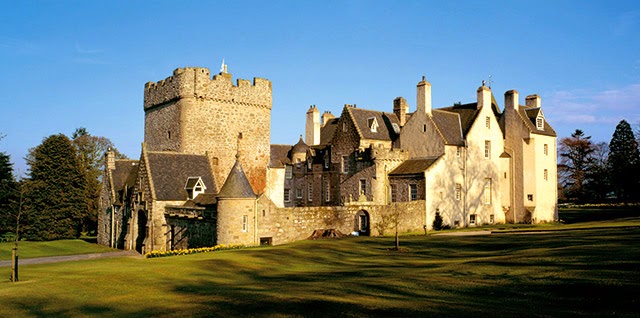
The surviving castle incorporates the fourteenth-century tower house built by the Keith Earls Marischal. It was enlarged into a larger manor complex around the medieval core and later took the form of a Palladian manor in the Scottish Gothic style. Crow-stepped gables, whose edges rise in a series of steps, and battlement crenellations, the raised sections alternating with notches along a defensive wall, are among its Scottish architectural features. The building was restored in the later twentieth century after its roof had been absent for a period beginning around 1954, and it was physically divided into seven homes.
Seventeenth-century dovecote
A tall dovecote stands south of the castle. Built during the seventeenth century, it was a purpose-built structure for keeping domestic pigeons or doves and forms part of the estate buildings associated with the later development of the castle complex.