Schloss Honhardt: A Former Moated Castle and Administrative Seat in Germany


Site at a Glance
- Rating
- 4.7
- Popularity
- Very Low
- Country
- Germany
- Primary era
- Early Modern
- Eras represented
- Medieval, Early Modern
- Civilizations
- Holy Roman Empire
- Site type
- Military
- Remains
- Castle
On this page8 sections
History
Early Fortification and Hohenlohe Rule
Schloss Honhardt is a former moated castle in Germany, whose oldest surviving part dates to the eleventh century and belongs to the high medieval period. The settlement of Honhardt is thought to have originated in the eighth century and was first mentioned in a charter issued by Emperor Henry II in 1024. A predecessor fortification probably arose during the same period. Honhardt initially served as one of the two principal centers, together with Crailsheim, of the Lordship of Lohr.
Around 1300, Honhardt passed for several years to the Counts of Oettingen. In 1314, it came under the rule of the House of Hohenlohe, a noble dynasty of the German lands. During the fourteenth century, the castle became the center of the Hohenlohe office of Honhardt and remained under Hohenlohe control until the end of that century. The Counts of Flügelau also held property in the district, while the lower-noble Lords of Honhardt served from the thirteenth to the fifteenth century as ministerials, members of the medieval service nobility, first for Flügelau and later for Hohenlohe.
Transfer to Hall and the Bebenburg Feud
In 1398, Ulrich of Hohenlohe sold feudal authority over Honhardt to Brandenburg-Ansbach, a Franconian principality of the House of Hohenzollern. He sold the settlement itself to the imperial cities of Hall, Dinkelsbühl, and Rothenburg. Imperial cities held their authority directly from the Holy Roman Emperor rather than from a territorial prince. In 1399, ownership of Honhardt passed entirely to Hall, which transferred it to two patrician families living in the city.
In 1413, those families sold Honhardt and its castle to the Lords of Bebenburg, who were ministerials of the Margrave of Ansbach. A margrave was a territorial ruler or nobleman, historically associated with a frontier territory known as a march. The sale removed the castle from Hall’s sphere of authority, but this change was short-lived.
During the Bebenburg Feud in 1444, a war between the imperial cities and the surrounding noble lordships, troops from Hall captured Honhardt Castle. They burned and destroyed it. A legal settlement reached in 1446 led Hall to purchase the Honhardt office and the destroyed castle from the Bebenburg family for substantial compensation. In the same year, Hall transferred authority over Honhardt to its city hospital.
Rebuilding and Hall Administration
In the second half of the fifteenth century, the hospital built a castle-like residential building on the site of the earlier castle. The new complex served as the hospital office and as the seat of Hall’s Honhardt office. Hall strengthened the castle with palisades and renewed its fortifications in 1677.
The present main building was newly constructed in 1700. That date appears in the building’s timberwork, on the Gothic-style fireplace on the first upper floor, and on the southern corner stone. Around 1730, an elaborate stucco ceiling was completed on the principal floor of the second upper floor. Its central dove represents the Holy Spirit, the divine spirit in Christian theology, and reflects the dedication of the hospital that administered the estate.
Württemberg Ownership and Private Use
When the imperial city of Hall ended in 1803, Schloss Honhardt passed into Württemberg state ownership. For several years, it served as the administrative seat of the Württemberg Oberamt of Honhardt, a higher-level administrative district. That district was incorporated into the Oberamt of Crailsheim in 1810.
The castle was sold to private citizens in 1815. Until 1980, the complex and its ancillary buildings formed an agricultural property with livestock, stables, and barns. A historically accurate renovation followed in 1981, and the project received an award for exemplary building from the Chamber of Architects of Baden-Württemberg. An art dealer acquired the castle in 2009 and reconstructed it, removing alterations associated with its agricultural and other later uses. The complex now contains the owner’s private arms collection and sales rooms and is not open to the public.
Remains
Fortified Core and Water Defences
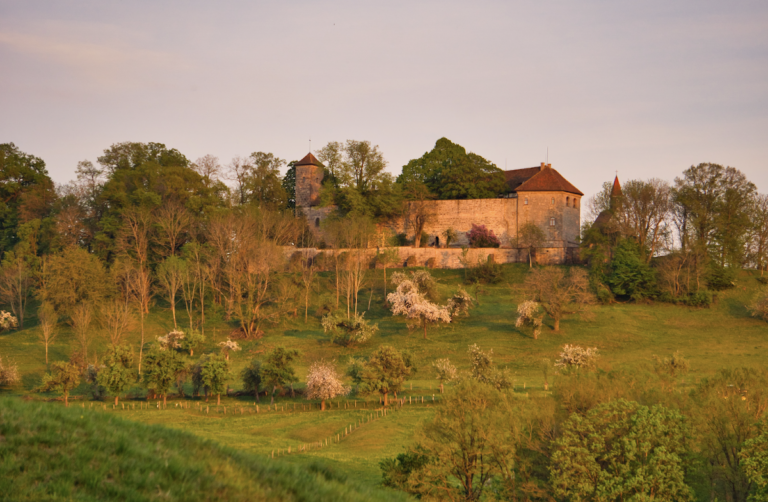
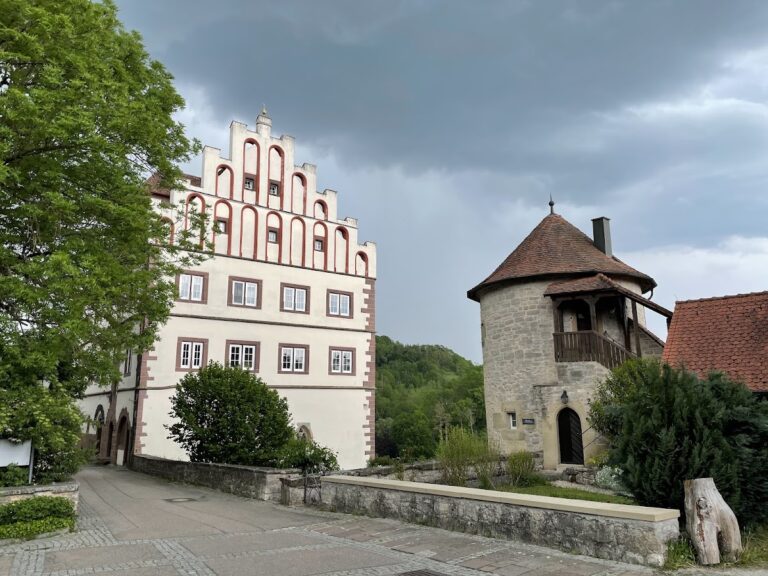
Schloss Honhardt stands on natural rock in the center of Honhardt as a closed defensive complex. Its earliest fortification consisted of the surviving bergfried, the principal fortified tower of a medieval German castle, which functioned as a residential tower and dates to the eleventh century. It was originally protected only by a palisade fence. The fortification later grew to include a main building, a ring wall with a defended wall walk, a moat, an outer defensive bank, and a drawbridge.
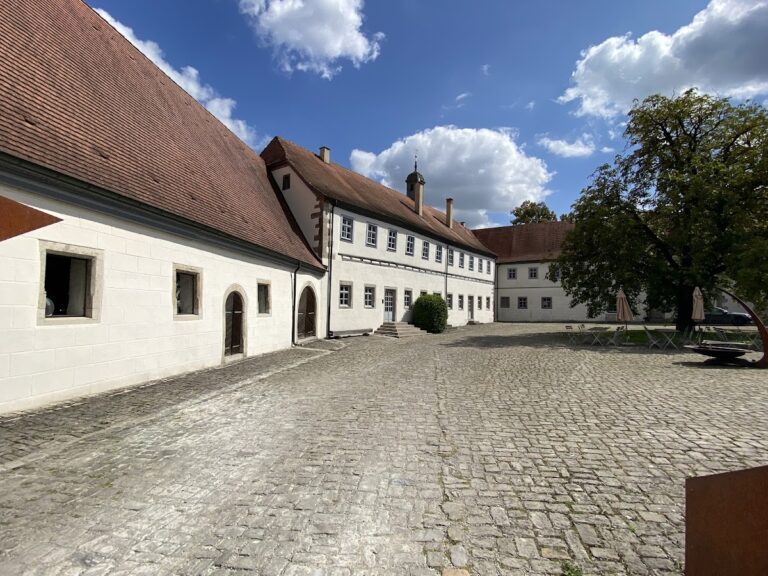
The surviving arrangement brings together the main building, an ancillary wing, the wall walk running around the complex, an enclosed courtyard, and the bergfried. The wall walk is a protected passage along the defensive wall. These elements preserve the basic organization of the castle as an enclosed, fortified residence surrounded by water defences and approached across a drawbridge.
Main Building and Interior Features
The present main building belongs to the reconstruction of 1700. Its timberwork, the Gothic-style fireplace on the first upper floor, and the southern corner stone all carry that date. The building therefore retains physical markers that identify its principal rebuilding phase within the older fortified enclosure.
On the second upper floor, the principal floor contains an elaborate stucco ceiling completed around 1730. A dove occupies its center as a Christian symbol of the Holy Spirit. The ceiling remains a distinctive interior feature of the later building and connects the surviving decoration with the former hospital administration of the castle.
Nearby sites