Wasserschloss Erkenbrechtshausen: A Water Castle in Crailsheim, Germany


Site at a Glance
- Rating
- 4.6
- Popularity
- Low
- Country
- Germany
- Primary era
- Early Modern
- External website
- Open
- Eras represented
- Medieval, Early Modern
- Civilizations
- Holy Roman Empire
- Site type
- Military
- Remains
- Castle
On this page10 sections
History
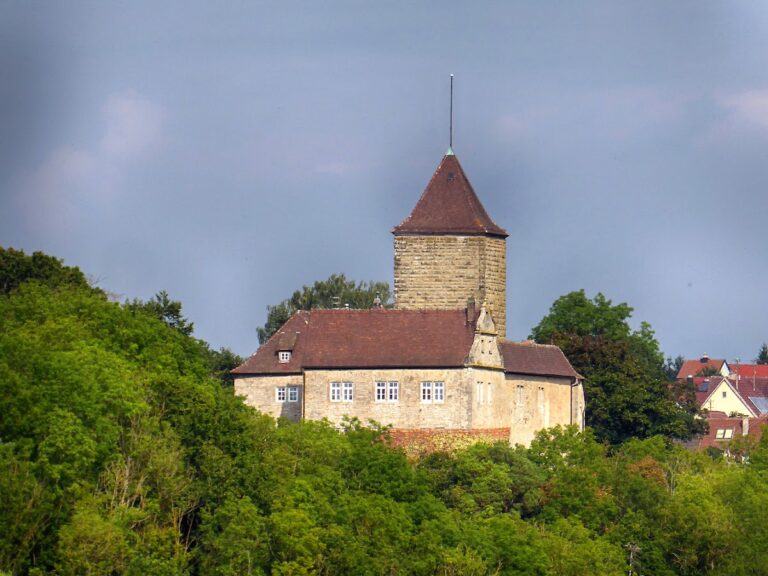
Wasserschloss Erkenbrechtshausen is a water castle in Germany, near Crailsheim in Baden-Württemberg, first mentioned in 1278 and rebuilt in rectangular form during the mid-sixteenth century. It is regarded as the oldest seat of the Crailsheim noble family.
Medieval origins
The castle appears in a 1278 document belonging to the Johanniter Hospital of Schwäbisch Hall. The Johanniter were the German branch of the Order of St John, a Catholic religious and military order that also operated hospitals and charitable institutions. At this time, the property belonged to the Lords of Crailsheim.
Destruction and rebuilding
During the German Peasants’ War, a major uprising of peasants and other lower-status groups in the Holy Roman Empire during 1524 and 1525, the castle was completely destroyed in May 1525. A local legend says that the Crailsheim peasants forced its lord, Kaspar von Crailsheim, to join their movement.
The castle was rebuilt as a rectangular complex in the middle of the sixteenth century. Members of the Franconian noble family of Seckendorff later altered and enlarged the buildings around 1760 and 1780. The family had owned part of the castle since 1647 and acquired the entire property in 1759.
The Seckendorff estate and later preservation
After Carl von Seckendorff, the last lord of the Seckendorff seniorate, a family succession arrangement assigning authority or property to its senior member, died in 1948, ownership passed to his daughters. Carl’s wife, Ida, Baroness von Seckendorff-Aberdar, died in 1960. Their burial place lies within the castle grounds.
By the mid-1980s, the complex had become dilapidated. A new private owner planned a comprehensive renovation, including the proposed use of part of the castle for cultural events. Financing had been secured, but the owner died unexpectedly in 1994, leaving the work unfinished. After the unused complex remained difficult to sell because of complicated ownership arrangements, a Hohenlohe entrepreneur began its renovation in 2007 with support from the Baden-Württemberg Monument Foundation, a regional heritage organization dedicated to preserving historic monuments and buildings. In May 2011, the foundation selected Wasserschloss Erkenbrechtshausen as its “Monument of the Month.”
Legends associated with the castle
A local tradition links the castle with the fourteenth-century robber knight Eppelein von Gailingen. According to the story, he tried to rob the wealthy castle lord Fritz Gaymann von Crailsheim, but the attack failed and he fled empty-handed. Pursuers later cornered him near Beierlesstein in the Jagst Valley. The legend says that Eppelein cried “Appel hopp!” before jumping with his horse into the Jagst, where both supposedly emerged unharmed. It also claims that a horseshoe mark remained visible for centuries on a large rock in the river.
Remains
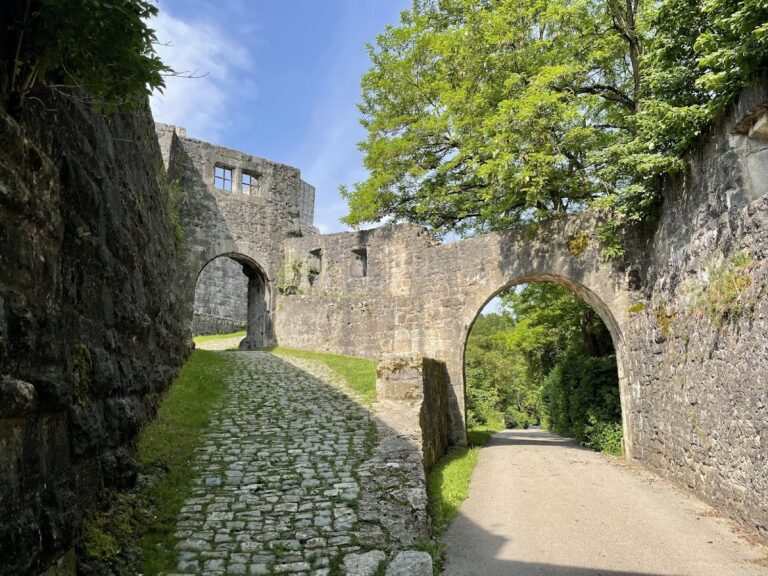
Wasserschloss Erkenbrechtshausen stands approximately six kilometres northwest of central Crailsheim, opposite the hamlet of Erkenbrechtshausen on the left-hand slope of the Rotbach valley. The term Wasserschloss describes a castle or manor house protected partly by surrounding or adjacent water. Here, the Rotbach runs between the castle and the settlement toward the Grundbach, and is dammed beside the castle to form a pond of approximately 0.25 hectares.
Layout and associated features
Rectangular castle complex
The main complex has a rectangular form created during its mid-sixteenth-century rebuilding. Its buildings were subsequently altered and enlarged around 1760 and 1780, reflecting the later development of the property under the Seckendorff family.
Burial place
The graves of Carl von Seckendorff and Ida, Baroness von Seckendorff-Aberdar, are located within the castle grounds. Their burial place forms part of the surviving estate landscape and preserves the connection between the property and its last Seckendorff owners.
Beierlesstein
Beierlesstein lies approximately 900 metres from the castle and is described as a nearby viewpoint. It is also associated with the legend of Eppelein von Gailingen and his supposed escape into the Jagst Valley.
Nearby sites