Château de Messac, Laroquebrou: A Late-Medieval Seigneurial Residence


Site at a Glance
- Rating
- 5
- Popularity
- Very Low
- Country
- France
- Primary era
- Medieval
- Eras represented
- Medieval
- Civilizations
- French
- Site type
- Domestic
- Remains
- Manor House
On this page8 sections
History
Château de Messac is a late-fifteenth-century seigneurial residence at Laroquebrou in France’s Cantal, built for the noble Sermur family and regarded as an example of late-medieval civil architecture with Renaissance characteristics. A seigneurial residence served as both the home and administrative center of a lord who held land and associated rights.
The Sermur Foundation
A family named Messac held a fief at Reilhac in the thirteenth century. The Sermur family acquired Messac after a lawsuit between Guy de Sermur and the heirs of Rigal de Messac ended in a compromise in 1478. Guy and his brother Amaury were the lords of Glénat and Montvert, while their father, Pierre I de Sermur, also known as Pierre de Tillet, already lived at Laroquebrou and was co-lord of Glénat, Saint-Victor, and Montvert.
Amaury received permission from Guillaume de Montal, baron of Laroquebrou, on 22 August 1480 to complete the residence in accordance with an arbitration by the baron of Castelnau. The planned house comprised three levels and an attic. This late-fifteenth-century building established the château as the family’s residence at Messac.
From the Sermurs to the Beauclairs
Ownership passed through Pierre II de Sermur, lord of Messac and La Besserette and co-lord of Glénat, Saint-Victor, and Montvert. His son Jean de Sermur lived at Labesserette rather than Messac. He sold the lordship of Montvert and, in 1539, transferred the land and château of Messac to Jean Canet. Canet’s daughter, Antoinette, later transmitted the property to her son Durand Palach.
Durand Palach lived at Messac, acquired further property there on 12 February 1590, and left the estate to his younger sister Anne in his 1596 will. Anne de Palach married Petre-Jean de Beauclair on 3 August 1598, bringing the château into the Beauclair family. She made her will at Messac on 15 May 1620 and died without children.
Petre-Jean, lord of Messac through his first marriage, married Jacquette de Cat on 1 April 1621. Jacquette was Protestant before formally renouncing her faith in the château chapel on 13 September 1626. Petre-Jean died in 1642 after having five children.
The Beauclair Lords
Their son Jean-Pons de Beauclair became lord of Messac and La Grelière. He served as a cornette in the Noailles Cavalry Regiment, a mounted officer whose title originally referred to carrying a unit’s standard. He married Antoinette de Saint-Nectaire on 28 November 1658 and, in 1670, rendered homage for La Grelière to Charles d’Escars, marquis of Merville and lord of Laroquebrou.
Jean-Baptiste de Beauclair, born at Glénat in 1690, later held Messac and La Grelière and was co-lord of Glénat. His marriage to Marie-Claude de Boschâtel took place on 31 July 1714. Their son Marc-Antoine de Beauclair became lord of Caillac and Messac. He lived at Caillac, where he had the château modernized, and died at Aurillac in 1787 without children.
Later Ownership and Protection
Château de Messac is now owned by the La Rocque de Sévérac family and remains a private residence. It has been protected as a French historic monument since 28 July 1972. In France, this status, known as a monument historique, provides legal recognition for heritage sites and structures valued for their historical or architectural importance.
Remains
The Manor House
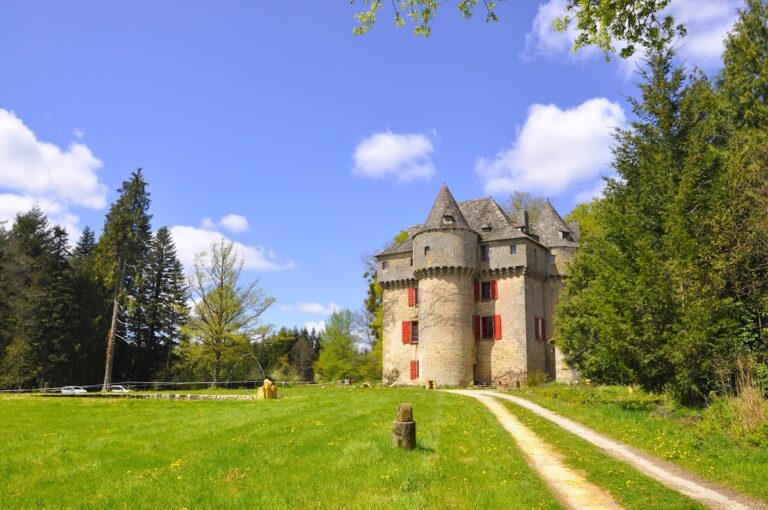
The château is arranged as two wings meeting at a right angle around a stair turret. Its late-medieval construction includes a ground floor, two upper floors, and an attic, creating the three-level arrangement authorized in 1480. The building combines medieval features with Renaissance elements and is considered representative of late-medieval civil architecture in the Cantal.
Each floor contains two large stone fireplaces, providing a repeated interior feature throughout the residence. The property also includes a notable kitchen garden, while a chapel is associated with the château as part of its domestic and religious setting.
The Chapel and Heraldic Associations
The chapel is linked to the Beauclair family’s history through Jacquette de Cat’s abjuration there in 1626. The Beauclair arms are described as gold with three red chevrons and a silver chief bearing five black ermine spots. The later La Rocque de Sévérac arms are described as blue with two confronted silver greyhounds and a silver chief bearing two black rooks.
Nearby sites