Tours de Merle: A Medieval Fortified Settlement in France


Site at a Glance
- Rating
- 4.6
- Popularity
- Medium
- Country
- France
- Primary era
- Medieval
- External website
- Open
- Eras represented
- Medieval
- Civilizations
- Unclassified
- Site type
- Military
- Remains
- Fortified Town
On this page11 sections
History
Tours de Merle is a medieval fortified settlement in France, located at Saint-Geniez-ô-Merle in Corrèze. Construction began in the twelfth century, and the site developed as a castrum, a fortified settlement containing residences, defenses, religious buildings, and a village rather than a single castle. It became the center of a co-seigneury, a lordship held jointly by several families, and a châtellenie, a territorial jurisdiction administered from a fortified center.
Origins and the co-seigneury
The name Merle appears from 1219, while a family bearing that name is known from the late eleventh century. The name may have referred to the bird or to a merlon, the solid raised section of a battlement between two openings. The Merle family was probably the first aristocratic lineage established at the site. In time, inheritance divisions produced at least three branches, each holding shared rights in the settlement, and the family seems eventually to have become subordinate to the Carbonnières family.
Merle stood at a toll station on the frontier between the Duchy of Aquitaine, the County of Auvergne, and the County of Toulouse. It also lay between two dioceses. This position encouraged several noble families to occupy the rocky stronghold and to succeed one another there. The Merle, Veyrac, Pesteils, Carbonnières, Noailles, Saint-Bauzile, and d’Alboy families were associated with the co-seigneury. Their separate square towers allowed the families to maintain individual residences while preserving their shared position at the site.
The Pesteils family, probably from Cantal, established itself at Merle in the early thirteenth century through the marriage of Aymeric de Pesteil and Hélis de Merle. The Pesteils paid homage to the Carbonnières in 1270, a relationship renewed in 1347. Other marriages brought the Saint-Bauzile and Rochedragon families into the joint lordship. During the Middle Ages, members of the Merle family also received occasional acts of homage from other families, including the Veilhan family.
Growth and military conflict
From the twelfth through the fifteenth century, the seigneurial lineages added towers, residences, and enclosing walls, gradually forming the castrum. By the fourteenth century, Merle comprised seven fortified houses, two chapels, and a village held jointly by seven lords linked to the Merle, Carbonnières, Veyrac, and Pesteils families. One chapel was dedicated to Saint Léger, the seventh-century bishop and Christian saint also known as Saint Leodegar.
In 1350, the settlement included more than one hundred peasants and nobles living in a village of about thirty thatched houses, with gardens and orchards. Its population included woodcutters, artisans, peasants, priests, and legal professionals. The Hundred Years’ War, the prolonged conflict between the English and French crowns that affected much of France from the fourteenth into the fifteenth century, brought direct military danger. English forces besieged and occupied Merle in 1371, taking one tower and one castle before later returning them.
The site’s military effectiveness declined as artillery developed. Because the surrounding heights allowed the settlement to be bombarded, its elevated fortifications became increasingly vulnerable. Peace after the Hundred Years’ War helped bring prosperity from 1475, but renewed conflict followed during the Wars of Religion, the sixteenth-century struggles between Catholic and Protestant factions in France. Protestant forces seized Merle in 1574 and installed a garrison. The co-lords expelled them two years later.
Abandonment and later history
The co-lords eventually left Merle for places they considered more pleasant and accessible. After the settlement lost their protection, its village population dispersed at the end of the seventeenth century. The châtellenie gradually fell into obscurity, although people continued to live in the village below the rock until the beginning of the twentieth century.
Tours de Merle was classified as a French historic monument by decree on July 30, 1927. The commune of Saint-Geniez-ô-Merle now owns the ruined site. Its later cultural presence also includes Louis-Olivier Vitté’s historical novel Guinotte et le chevalier, set in the twelfth century, and Jean-Luc Marcastel’s fantasy series Louis le Galoup, especially its third volume, Le Maître des Tours de Merle.
Remains
Rocky spur and fortified layout
The remains occupy a naturally defended rocky spur within a meander of the Maronne River, in the historic region of Xaintrie around the upper Dordogne and Maronne valleys. The spur is approximately 30 metres high, 40 metres wide, and 200 metres long. The visitable area extends across a 10-hectare park, while the core of the settlement follows the narrow elevated rock.
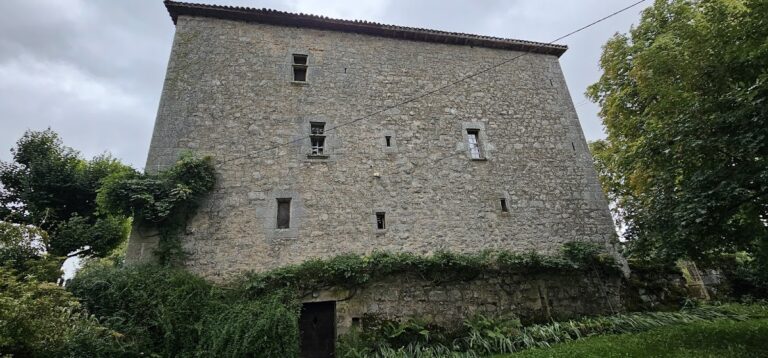
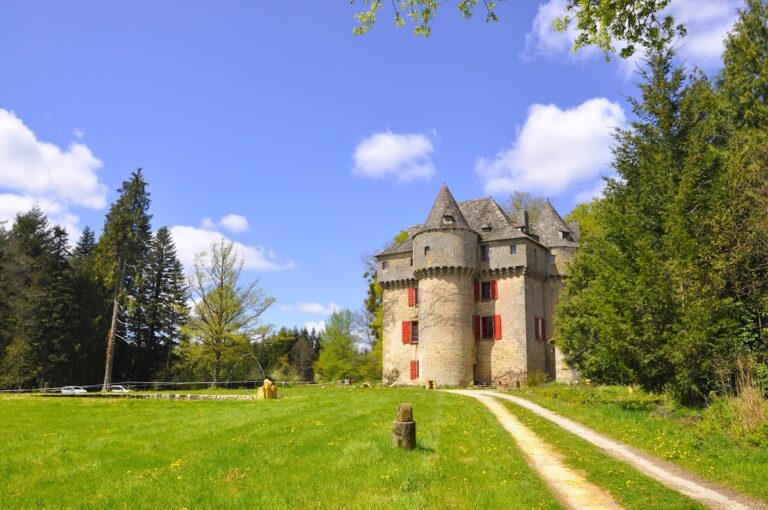
Tours de Merle was formed as a complex of several castles and fortified residences. Surviving elements include towers, strong houses, and enclosing walls dating from the fourteenth century or earlier. The defensive arrangement also included a bridge guardhouse, whose ruined piers remain, and the location of the Veilhan drawbridge. These features belonged to a settlement in which separate aristocratic residences were gathered within a common fortified enclosure.
Residential and defensive buildings
Noailles and Pesteils towers
The Noailles Tower and the Pesteils towers, also called the Pestel towers, survive as named components of the fortified complex. They belong to the group of tower residences associated with the families that shared control of Merle.
Merle family houses
The ruins preserve the locations or remains of several residential buildings linked to the Merle lineage. These include the house of Fulcon de Merle, known from 1365, together with the houses of Pierre de Merle, Hugues de Merle, and Cofolenc. The location of the house known as Veilhan is also identified within the settlement.
Saint-Léger and Saint-Basile defenses
The complex includes the remains of the commander’s tower of Saint-Léger and the Fort of Saint-Basile. The remains of the Carbonnière castle form another part of the fortified group, preserving the physical presence of a family whose authority was closely connected with the development of the co-seigneury.
Religious remains
The site contains the remains of two chapels associated with the medieval settlement and its later history. One was dedicated to Saint Léger. The location of a second chapel, built in 1674, is identified among the ruins, showing that religious construction continued after the main medieval period of fortification and expansion.