Castello di Colle Massari: A Fortified Rural Estate in Tuscany
Site at a Glance
- Rating
- 4.5
- Popularity
- Very Low
- Country
- Italy
- Primary era
- Medieval
- Eras represented
- Medieval, Early Modern
- Civilizations
- Grand Duchy of Tuscany, Republic of Siena
- Site type
- Military
- Remains
- Castle
On this page7 sections
History
Castello di Colle Massari is a medieval fortified rural complex in Italy, near Cinigiano in the province of Grosseto. Its origins are uncertain, but it is generally considered to have begun in the medieval period, possibly in the thirteenth century as a rural house that was later fortified. Another interpretation connects its earliest phase with the Abbey of San Galgano, a Cistercian monastic institution near Siena, which also controlled the neighboring Castle of Sabatina. Under this chronology, the complex was later transformed into a convent near an older parish church.
Early religious and feudal connections
The earlier religious setting is associated with Sant’Ippolito a Martura at Santa Marta. A record from 1148 names the church, which depended on the Benedictine nunnery of Sant’Ambrogio at Montecelso, a women’s monastic community following the Rule of Saint Benedict. A small settlement probably grew around the church and was later incorporated into the fortified complex. The parish church remained active at least until the end of the fourteenth century.
Colle Massari formed part of the wider network of medieval settlements and defensive holdings in the Grosseto countryside. Many of these properties were linked with the Aldobrandeschi, a powerful feudal family whose influence extended across much of the Maremma. During the thirteenth century, as Aldobrandeschi power declined, the Republic of Siena took control of properties and fortifications in the area.
Sienese rule and aristocratic ownership
A deed from 1294 records the transfer of properties between Santa Marta, Sasso, and Vicarello to the Municipality of Siena. The same transaction involved the acquisition of other holdings, including Colle Massari, by Gullielmino Buonsignori, a member of an important Sienese family with extensive possessions in the Maremma.
Sienese rule lasted until the mid-sixteenth century. The castle then passed to the Alidori family and afterward to the Perugian count Ercole della Penna. Fabio Piccolomini del Mandolo acquired the estate in 1574. In 1587, Francesco I de Medici assigned it to his stepson, Don Antonio de Medici.
In 1630, the estate passed to the Patrizi marquises. Their ownership began a long period of agricultural prosperity that continued until the start of the nineteenth century. During the second half of that century, after the Patrizi line became extinct, the estate was inherited by the Roman-branch marquis Chigi Montoro through his marriage to Maria Virginia Patrizi. He continued a feudal-style administration of the land even after Pietro Leopoldo, the grand duke of Tuscany associated with the abolition of feudal privileges in the grand duchy, had ended the feudal system.
Decline, abandonment, and recovery
The estate later passed to the Sienese Agostino Masotti and, during the last decade of the nineteenth century, to Domenico Pizzetti, a physician from Grosseto. It was subsequently acquired by the Ginanneschi family of Castel del Piano, which continued to develop its agricultural production until the Second World War, when German troops occupied the property.
After the war, management was entrusted to a farm manager from the Ginanneschi family. The estate gradually deteriorated and was eventually abandoned. At the beginning of the twenty-first century, a family of entrepreneurs purchased the complex and began a program of recovery, structural consolidation, and conservation restoration under the direction of architect Edoardo Milesi. The restored complex now houses the Colle Massari agricultural enterprise.
The name “Massari,” or “massaro,” comes from the Vulgar Latin massarius. In the medieval period, the term referred to an administrator of an agricultural estate centered on a farmhouse or landed holding. The massaro ranked below officials such as viscounts and gastalds and probably managed a small property dependent on the nearby Castle of Sasso d’Ombrone.
Remains
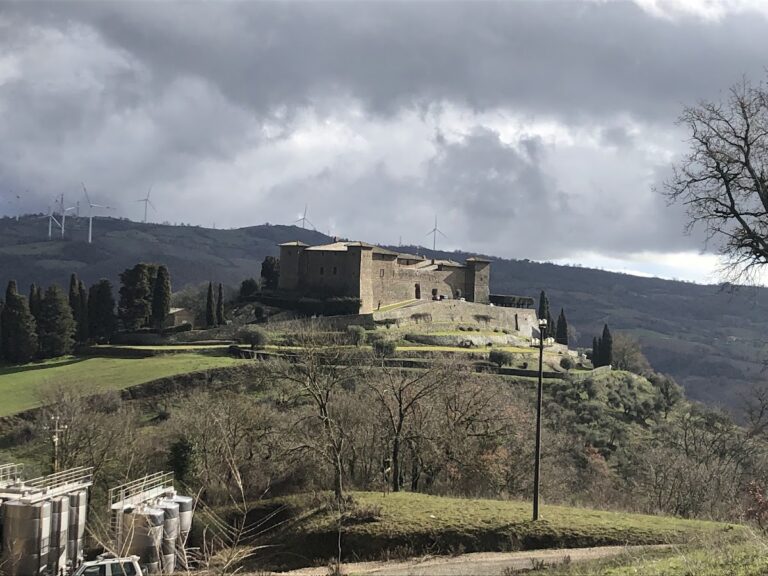
Castello di Colle Massari stands at about 310 metres above sea level on elevated ground south of Sasso d’Ombrone, between Poggi del Sasso and Vicarello. The site occupies rolling terrain above broad valleys drained by the Trisolla stream to the north, the Cortilla stream to the west, and the Melacce stream farther south, all of which flow into the Ombrone River. Its surviving form is that of a grancia, a fortified agricultural estate used to manage land and gather produce, rather than simply the residence of a feudal lord.
Courtyard and defenses
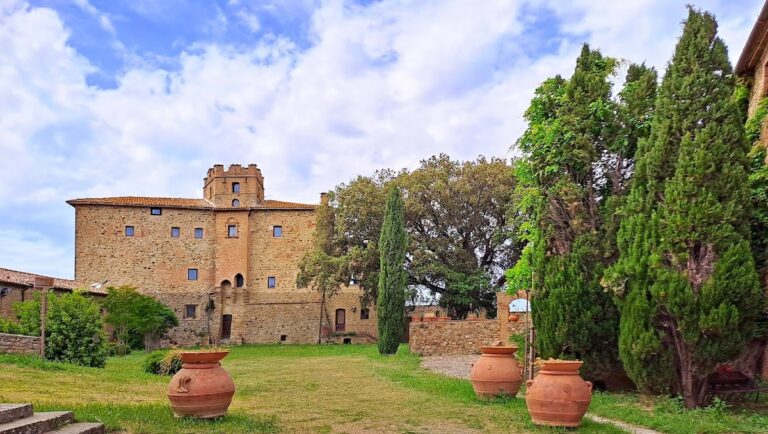
Three building wings enclose three sides of a quadrangular internal courtyard. A curtain wall closes the fourth side and contains the complex’s characteristic arched entrance. Four towers originally occupied the corners as lookout structures. Two remain well preserved, while the other two have been altered. The southeast tower collapsed during the nineteenth century after a landslide, leaving only traces. The appearance of the complex was shaped especially by restructuring and restoration in the seventeenth century, followed by the recovery, consolidation, and conservation work undertaken in the twenty-first century.
Chapel of Santa Marta
The Chapel of Santa Marta is the family chapel within the castle. Built during the seventeenth century, it replaced the older parish church of Sant’Ippolito a Martura, which had disappeared by that time. Its presence preserves the religious connection associated with the earlier settlement while forming part of the later fortified estate.
Nearby sites