Staward Peel: A Medieval Fortified Site in Northumberland


Site at a Glance
- Rating
- 4.8
- Popularity
- Very Low
- Country
- United Kingdom
- Primary era
- Medieval
- Eras represented
- Medieval
- Civilizations
- English
- Site type
- Military
- Remains
- Castle
On this page8 sections
History
Staward Peel is a ruined fortified site in the United Kingdom, at Haydon Bridge in Northumberland. Its documented medieval history began with a timber pele, a fortified tower used for defence and refuge, built by Anthony de Lucy of Langley in 1316. The site may have earlier origins, since a shrine probably stood here around 1271 and its beginnings may have been Roman, although the dates of the shrine’s construction and demolition are unknown.
From pele to castle
Anthony de Lucy stationed 15 men-at-arms and 15 hobelars at the timber pele. Hobelars were mounted soldiers who generally used light horses in medieval military service. In 1326, King Edward II annexed the western part of de Lucy’s estate, including Staward Peel. Thomas II de Featherstonehaugh later built a full-scale castle on the site of the original pele, replacing the earlier timber structure with a larger fortified complex.
Philippa of Hainault, queen consort of Edward III, purchased the site in 1373 from John Darci le Cocin and Nicholas de Swinburne. It subsequently passed to Edmund, Duke of York, a member of the English royal family, whose family leased it to Hexham Priory from 1385 until the Dissolution of the Monasteries. This process, initiated under Henry VIII in the 1530s, suppressed England’s monasteries and transferred or sold their property.
Later ownership and demolition
After the Dissolution, Staward Peel passed to the Crown. In 1603 it was transferred to the Earl of Dunbar, and in 1613 King James I gave it to Lord Howard of Walden. Howard later transferred the property to John Sanderson of Healey, who sold it in 1664 for £450 to George Bacon of Broadwood Hall.
The nearby Staward Manor House contains a 1668 lintel bearing the initials of George Bacon and his wife, Cecilia Robson. The couple founded the Bacon family of “Stewart Pile,” Styford, and Newton Cap. A plan made in 1759 recorded the ruins and showed that the site had developed into a castle. The castle was demolished before 1856, after which surviving rubble appears to have been taken from the site during or after the demolition.
Staward Peel is now a ruined site within the National Trust property of Allen Banks and Staward Gorge. The National Trust is a British conservation organization that manages historic places and landscapes. The surviving masonry, ditch, and earthworks preserve the remains of the former fortified complex.
Remains
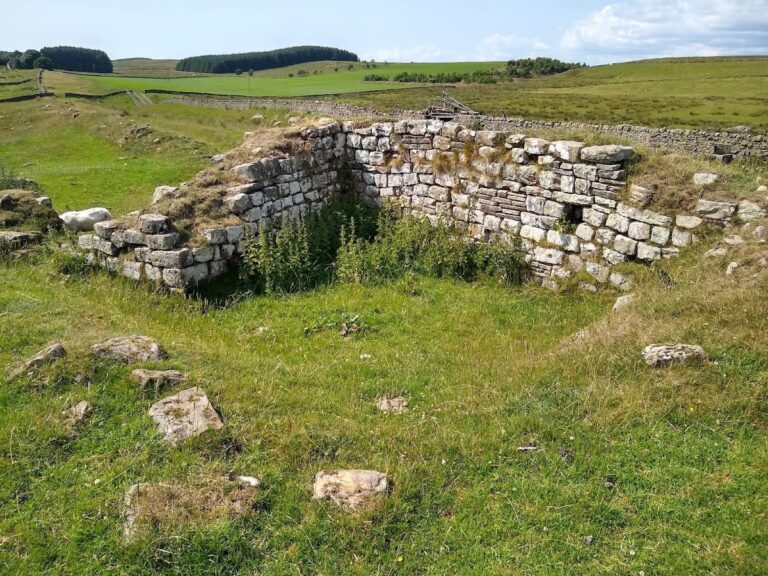
The surviving remains consist of masonry from the gatehouse, together with a ditch and associated earthworks that mark the former fortified complex. The 1759 plan shows a gatehouse, a curtain wall, and a keep-like feature. A curtain wall was a defensive wall enclosing a castle or fortified compound, while a keep was its principal stronghold. Together, these features indicate that the later structure was probably a full-scale castle rather than simply a pele tower.
Castle structures and earthworks
Gatehouse
Only masonry ruins of three outer walls of the gatehouse survive. They form the clearest surviving structural remains of the castle and represent part of the entrance building shown on the 1759 plan.
Ditch and earthworks
A ditch and associated earthworks remain around the ruined masonry. These features belonged to the wider defensive arrangement and survive alongside the fragments of the gatehouse walls.
Roman altar
A Roman altar, a religious monument associated with Roman ritual, had been incorporated near the top of the structure. It fell in 1947–48 and was later moved to Low Staward Manor. Its earlier incorporation into the building reflects the presence of an ancient object within the later fortified site.