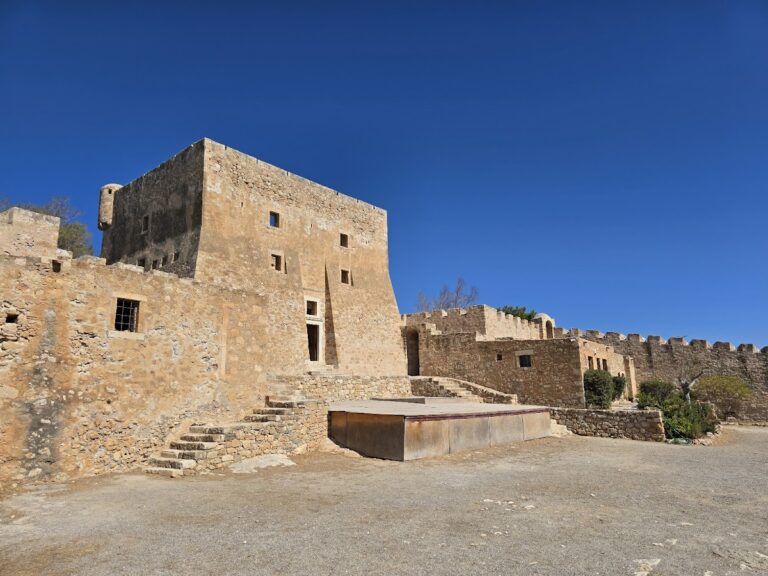
Spinalonga Fort: A Venetian Fortress and Leprosy Settlement in Greece


Site at a Glance
- Rating
- 4.6
- Popularity
- High
- Country
- Greece
- Primary era
- Early Modern
- External website
- Open
- Eras represented
- Classical, Early Modern, Modern
- Civilizations
- Ancient Greek, Ottoman, Venetian
- Site type
- Military
- Remains
- Fort
On this page8 sections
History
Spinalonga Fort is a Venetian fortress in Greece, built in 1586 on Spinalonga Island near Elounda in Crete. Its bastion-style design formed part of the Republic of Venice’s coastal defenses and protected the important port of Olous.
Venetian Foundation
According to the Venetian cartographer Vincenzo Coronelli, the Venetians cut through part of the isthmus in 1526, separating the peninsula from the mainland and creating the island on which the fortress was later established. Fortification work took place from 1579 to 1586 under the direction of the engineer Genese Bressani. The new defenses incorporated earlier defensive works associated with a Hellenistic-period acropolis, an ancient fortified settlement from the era after Alexander the Great’s conquests.
During the Candian War from 1645 to 1669, the conflict in which the Ottoman Empire conquered most of Venetian Crete, Greek rebels used Spinalonga for planning and logistical support in operations against the Ottomans. Venice retained the fortress until 1715, when Ottoman forces captured it during the Seventh Ottoman-Venetian War, fought from 1714 to 1718. Alongside Souda and Gramvousa, Spinalonga was among the last Cretan fortresses to remain under Venetian rule.
Ottoman Community
During the final period of Ottoman rule, Ottoman families lived within the fortress, as they also did at the Fortress of Ierapetra, because they feared reprisals from the Greek population. In 1881, 1,112 Turks lived on Spinalonga and formed a separate community. By 1903, they had all left the island.
Leprosy Settlement
From 1904 to 1957, Spinalonga served as an isolated settlement for people with leprosy, a chronic infectious disease historically associated with enforced separation from wider society. The first 251 residents arrived on 14 December 1904. After 1913, people came from throughout Greece as well as from Crete. Although the formal settlement period ended in 1957, its last resident, a priest of the Church of Saint Panteleimon, left in 1962.
Food and supplies reached the island by boat, and residents were often supported by relatives. Tobacco and alcohol were also smuggled to them. From the 1930s, a generator provided electricity, and a newer unit replaced it in the 1950s. The settlement developed a hospital, library, chapels, public laundry, bars, shops, theatre, and cinema. By the 1950s, the hospital had medical specialists including a microbiologist, neurologist, pathologist, and dentist.
Epameinondas Remoundakis, a patient at Spinalonga, founded the theatre and cinema and installed loudspeakers that played classical music. He helped develop the settlement’s communal life, which also included barbers and shoemakers and a satirical magazine. Supplies from nearby settlements such as Vrouchas, Seles, Schinias, and Elounda improved the residents’ food provisions.
German forces did not occupy the fortress during the Second World War because they feared that the disease would spread. They nevertheless ensured that food continued to reach the island. Archaeological investigations and restoration work continue, and Spinalonga Fort is included on UNESCO’s Tentative World Heritage List.
Remains
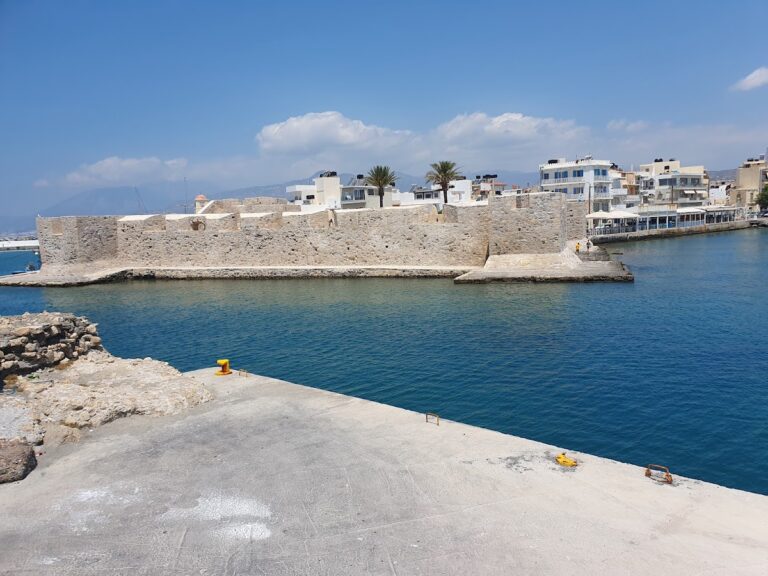
Spinalonga’s surviving remains combine an island-wide defensive ring, projecting bastions, and terraces of later residential and communal buildings. The fortifications reused stones from ancient Olous and were built over the earlier defenses of the Hellenistic acropolis. Streets and paths between the buildings are paved with pebbles, while the residential walls are whitewashed.
Fortifications
The defensive system consists of walls encircling the island, intended to prevent a naval landing, with two bastions placed at the highest points on the southern and northern sides. A bastion is a projecting part of a fortification that allows defenders to protect walls and nearby approaches with flanking fire. Saint Michael’s Bastion has an asymmetrical plan shaped by the natural terrain and the fortress’s defensive needs. In 1630, the fortress mounted 35 cannons.
Ottoman Residential Quarter
In the late nineteenth century, approximately 200 Ottoman houses occupied the western and southern sides of the fortress. They were arranged in terraces rising up the slopes and followed local and Balkan architectural traditions. The surviving buildings are in good condition, a state attributed to the quality of their materials.
Shops and Workshops
The island also contained 25 shops or workshops. Like the houses, these buildings reflected local and Balkan architectural traditions and formed part of the settled quarters within the fortified island.
Nearby sites