Vila Vella (Tossa de Mar): A Medieval Fortified Settlement on the Catalan Coast


Site at a Glance
- Rating
- 4.8
- Popularity
- Very High
- Country
- Spain
- Primary era
- Medieval
- External website
- Open
- Eras represented
- Medieval, Modern
- Civilizations
- Crown of Aragon, Spanish
- Site type
- Military
- Remains
- Fortified Town
On this page19 sections
History
Vila Vella is the fortified old town of Tossa de Mar in Spain, established as a medieval settlement under the lordship of the Benedictine Abbey of Santa Maria de Ripoll. Its first enclosure began in the late twelfth century after the granting of municipal rights, and the main medieval construction was completed during the fourteenth century. The settlement occupies a coastal promontory and is described as the only surviving example of a medieval fortified settlement on the Catalan coast.
Before the fortified settlement
The inhabitants of Tossa traditionally lived mainly in a fishing and farming settlement on the plain occupied by the modern town. Earlier activity, however, existed on and around the promontory. An Iberian settlement stood there, while a Roman settlement with an Iberian predecessor was discovered at the western edge of the modern town in 1914. A second Roman settlement within the fortified enclosure is considered possible.
In 966, Count Miró of Barcelona transferred the area to Santa Maria de Ripoll, a Benedictine abbey governed according to the Rule of Saint Benedict. The abbey retained formal lordship over Tossa and the surrounding territory until the end of feudalism in Spain in 1835. Its authority over fishing revenues was particularly strict, giving the monastery an important economic as well as legal role in the town.
Foundation and medieval development
The abbot of Ripoll granted Tossa de Mar municipal rights and a settlement charter in 1187. The charter allowed construction both inside and outside the fortified enclosure and established the conditions for Vila Vella to develop as a defended settlement. The first enclosure was begun in the late twelfth century in connection with these rights.
A document of 1240 refers to the enclosure as the castrum de Torsa in connection with grazing rights. The settlement was devastated in 1285 during the French Crusade against the Crown of Aragon, a military expedition directed against the Aragonese realm. The walls were rebuilt during the fourteenth century, including work associated with Abbot Descatllar of Ripoll, and the principal medieval construction was completed in that period.
A hearth census from 1365 to 1370 counted eighty-one households at Tossa, all belonging to the abbot of Ripoll. In 1371, the castellan Arnau de Soler sold Tossa to Pere de Riera, and fortification work was recorded in the same year. These changes took place while the enclosure continued to serve as the defended centre of the settlement.
Coastal defence and decline
After the end of the Reconquista in 1492, conventionally associated with the Christian conquest of Granada, the fortifications lost their principal role in defence against inland Spanish enemies. Their military function shifted toward protection from Barbary corsairs, privateering seamen operating from North African ports and active in the Mediterranean during the late medieval and early modern periods. The defensive network was supplemented by the Agulla de Pola watchtower about four kilometres to the north and by the nearby Torre des Moros, both of which remained in visual contact with Vila Vella.
As the corsair threat declined, Tossa expanded beyond the walls. The shift away from the old town became especially clear when the foundation stone of the new Sant Vicenç church was laid in the modern town in 1755. The new church was built in 1778. The older church within Vila Vella was then abandoned and gradually deteriorated, while the fortified enclosure increasingly lost its practical military purpose.
Modern preservation and interpretation
From the nineteenth century, the walls were no longer militarily important and were not maintained. Tossa was a theatre of war during the Spanish Civil War of 1936 to 1939. The new church and the modern town were damaged, while the medieval walls remained intact. The enclosure had already been declared a National Artistic-Historical Monument in 1931 and remains legally protected.
In 1951, Vila Vella provided the setting for Pandora and the Flying Dutchman, starring Ava Gardner and James Mason. The film brought international attention to Tossa de Mar and stimulated tourism. Damaged sections of the walls were subsequently repaired, and paths and lighting were installed. In 1974, the former Governor’s House became the Museu Municipal de Tossa de Mar after the municipality acquired it from private owners. The museum presents artworks connected with Tossa and archaeological finds from the town.
Remains
Vila Vella occupies a peninsula linked to the mainland by a narrow strip between the mouth of the Tossa River and the small cove of Es Codolar. The peninsula rises toward Mont Guardí, where steep coastal cliffs provide natural protection. On the landward side, the wall follows the line of the cliffs and encloses the old town. The fortified perimeter measures approximately 300 metres, and almost the entire original circuit survives. Inside it, irregular narrow streets follow the slopes of the hill.
Walls, towers, and entrances
Fortified circuit
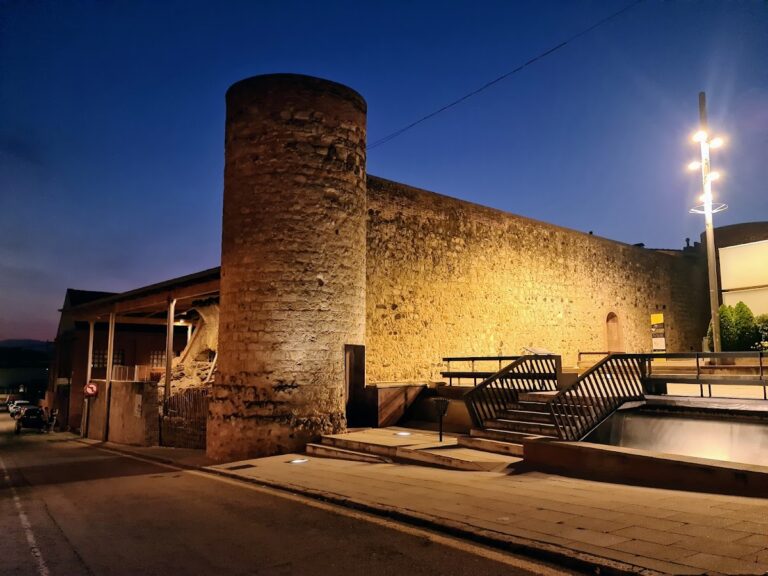
The enclosure is built mainly from locally abundant granite bonded with lime-and-sand mortar. Differences in the masonry reflect repeated phases of construction, repair, and restoration. Roughly dressed stones are visible in the lower wall surfaces, while much of the surviving enclosure belongs to the fourteenth-century rebuilding. The wall crown has rectangular crenellations, the regularly spaced notches of a defensive parapet. Small corbels and arrow slits are incorporated into the corner structures.
A wall-walk, or protected patrol passage, runs around the enclosure at the level of the arrow slits. An internal stairway gives access to it from the settlement. The circuit turns at Torre des Codolar, where it secured the possible ascent from Es Codolar, and ends against the cliffs beside the cove. On the opposite side, the wall descends toward Platja Gran, rises again toward Torre d’en Joanàs, and ends near the old church, where the natural slopes formerly contributed to the defence.
Round towers
Seven round towers are incorporated into the walls. Three are taller and retain upper structures supported by corbels and small round arches. Some also preserve crenellated crowns. Torre des Codolar, also called Torre del Homenaje, stands at the western end; Torre de les Hores, or Torre del Reloj, is near the main entrance; and Torre d’en Joanàs occupies the eastern end above the sea.
Four smaller towers are set along the curtain wall, with three between Torre d’en Joanàs and Torre de les Hores and one between Torre de les Hores and Torre des Codolar. The larger towers probably had three levels covered by stone vaults. Their interiors were entered through doors opening from the wall-walk, and these entrances are now closed by iron grilles.
Gates and forecourt
The main portal stands beside Torre de les Hores. It has a double round-arched doorway fitted with a vertically sliding portcullis, or defensive grille. Its wedge-shaped arch stones and finely cut ashlar masonry distinguish the entrance from the rougher masonry of much of the enclosure. A second entrance is reached from the Passeig de la Vila Vella near Torre d’en Joanàs. Another opening near Torre des Codolar now gives access from the direction of Es Codolar, although this opening was not part of the formerly closed wall.
The entrance area leads into a square that retains the character of a forecourt. An internal stairway beside the wall connects the square with the wall-walk. The former Governor’s House dominates the space at the junction of Carrer d’Ignasi Melé, Carrer de l’Abat Oliba, and Carrer Vincenc Olivier. In front of Torre des Codolar, a viewing platform contains the sculpture A la dona del pescador.
Buildings within the enclosure
Former Governor’s House
The former Governor’s House is a three-storey building attached to the inner side of the wall beside Torre des Codolar. Dating from the fourteenth century, it was used by governors of the Ripoll monastery. Since 1974 it has housed the Museu Municipal de Tossa de Mar, whose collections include artworks associated with Tossa and archaeological finds from the town.
Ca na Marieta Xerach
Ca na Marieta Xerach is a two-storey house opposite the main entrance at Placa d’Armes 2. The building was formerly divided into two houses, one of which served as the old parish house.
Medieval houses
Other houses along the narrow streets include buildings from the fifteenth and sixteenth centuries with Gothic elements. The former Governor’s Palace, now used as the municipal museum, is among the buildings associated with this later residential fabric.
Church and hilltop defences
Old church of Sant Vicenç
The old parish church of Sant Vicenç is a Gothic ruin on the hill. It began as a single-nave church with two side chapels that formed a cross-shaped plan. A square bell tower and a sacristy were added later, while only the apse survives. Architectural fragments suggest an association with Pere Oller, a Catalan sculptor active in the late medieval period in Girona and Ripoll. The ruin is now used as a setting for open-air performances.
The first documentary reference to a church dedicated to Saint Vincent dates from 966. Its relics and baptismal font were later transferred to the new church in the modern town, and the cemetery was relocated there. The confined hilltop site permitted only a small church, while its exposed position contributed to the deterioration of the building.
Torre del Castel
Above the church ruin stands Torre del Castel, the remains of a round tower that formed part of the old castle’s defences. The castle occupied the summit where the lighthouse now stands, but very little of the castle survives.
El Far lighthouse
El Far lighthouse stands on the summit about 60 metres above sea level. Its square tower is 11 metres high, and its ground floor contains an information centre. A small square structure measuring 4 by 4 metres rises above the main tower and supports a cylindrical housing for the light.
The lighthouse replaced a windmill that stood on the summit after the castle had lost its military importance. The mill was demolished for the lighthouse and its service road. José March Docet designed the lighthouse, whose construction was approved on 5 December 1912 and completed in 1917. It entered service on 29 August 1917, initially using light petroleum. The system changed to acetylene generated from calcium carbide in 1922 and became electrically operated in April 1929.
Later commemorative features
A life-size bronze statue of Ava Gardner stands on a hilltop viewpoint along the Passeig de la Vila Vella. Created by the Catalan sculptor Ció Abellí, it depicts Gardner as Pandora looking toward the sea and the ship of the Flying Dutchman, linking the modern history of the enclosure with the film that brought Tossa de Mar international attention.