Guthrie Castle: A Fifteenth-Century Tower House and Scottish Baronial Country House

Site at a Glance
- Rating
- 5
- Popularity
- Very Low
- Country
- United Kingdom
- Primary era
- Medieval
- External website
- Open
- Eras represented
- Medieval, Modern
- Civilizations
- British, Kingdom of Scotland
- Site type
- Domestic
- Remains
- Castle
On this page9 sections
History
Medieval origins
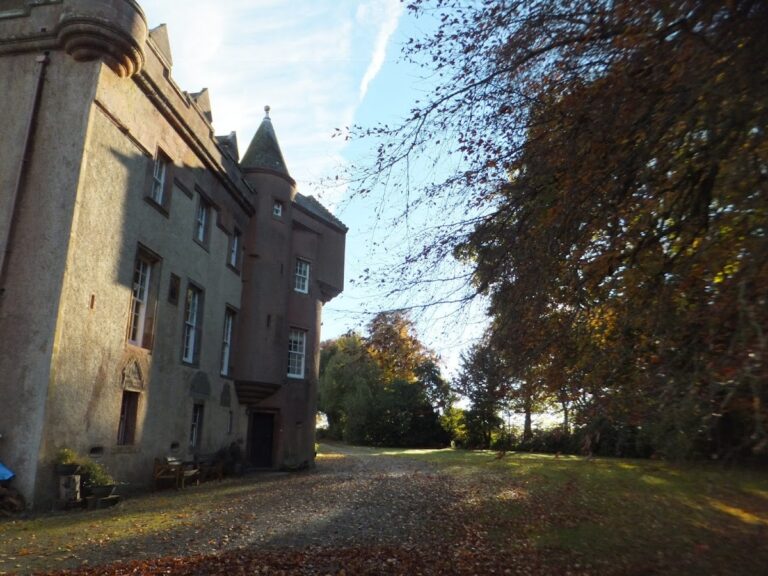
Guthrie Castle is a castle and country house in Scotland, United Kingdom, in the village of Guthrie near Forfar. Sir David Guthrie, Treasurer and Lord Justice-General of Scotland, had the original tower house built in 1468. A tower house was a fortified residence arranged around a substantial tower that provided accommodation as well as protection.
The Guthrie family retained the historic tower and later added a house beside it. Together, these buildings formed the earlier core of the present complex.
The nineteenth-century expansion
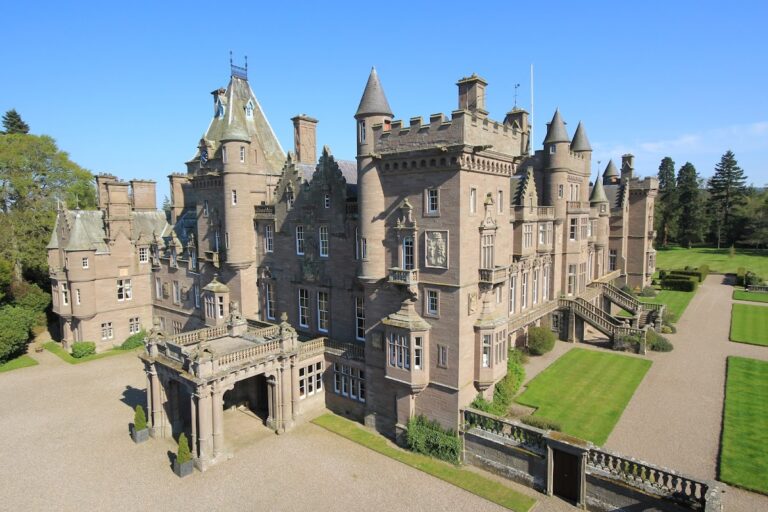
In 1848, the adjacent house and the medieval tower were joined by an expansion designed by David Bryce. The addition used the Scottish Baronial style, a nineteenth-century revival based on the forms and imagery of Scotland’s medieval and early-modern castles. This work gave Guthrie Castle its combined character as a historic tower house and a later country residence.
Later ownership and protection
The castle remained in the Guthrie family until 1983, when Colonel Ivan Guthrie, the family’s last heir, died. Daniel S. Peña Sr., an American businessman, bought the property in 1984 and restored the country house to its nineteenth-century condition. A golf course was created on the estate in 1994 and 1995.
Guthrie Castle and its grounds opened for weddings, corporate functions, and group events in 2003. The owners ended these activities in 2017, after which the property returned to exclusive private use. Historic Scotland designated the castle as a Category B listed historic building, a status generally applied to buildings of regional or greater-than-local architectural or historic importance. The garden entered the Inventory of Gardens and Designed Landscapes in Scotland, a national register for gardens and designed landscapes judged to have historic or artistic significance. Other features of the estate hold Category B or Category C listing, with Category C generally indicating local importance.
Remains
Castle complex
Fifteenth-century tower house
The oldest surviving element is the fifteenth-century tower house built for Sir David Guthrie in 1468. It forms the historic core of the complex and represents a fortified residential building designed to combine domestic accommodation with defensive protection.
Nineteenth-century country house
The tower stands beside a later country house, and the two buildings are connected by the 1848 expansion designed by David Bryce. The linking work is in the Scottish Baronial style, creating the present architectural combination of medieval tower, adjoining house, and nineteenth-century connecting range.
Estate features
The grounds include a garden, walled gardens, an icehouse, and a sundial. Access points and estate buildings include the east gateway, old garden gate, west gate, and west lodge. These surviving features form part of the wider historic setting of the castle and its designed grounds.