Kinnaird Castle, Brechin: A Scottish Aristocratic Country House and Historic Seat


Site at a Glance
- Rating
- 4.8
- Popularity
- Very Low
- Country
- United Kingdom
- Primary era
- Modern
- External website
- Open
- Eras represented
- Medieval, Early Modern, Modern
- Civilizations
- British, Kingdom of Scotland
- Site type
- Domestic
- Remains
- Castle
On this page7 sections
History
Kinnaird Castle, Brechin, is a historic castle and country house in Scotland, United Kingdom, whose origins reach back to the 15th century. The Carnegie family, the Earls of Southesk, held the estate and made Kinnaird their seat for more than 600 years.
Medieval origins and destruction
Charters indicate that a mansion stood on the property in the 14th century. By 1409, a tower house, a fortified residence combining domestic accommodation with defensive features, was recorded there. The estate was granted to Clan Carnegie in that year.
The castle was caught up in the conflict between Clan Carnegie and Alexander Lindsay, 4th Earl of Crawford. After the Battle of Brechin on 18 May 1452, Lindsay burned Kinnaird because the Carnegie family had supported King James II of Scotland. The castle was later rebuilt.
Royal and political associations
Kinnaird continued to serve as an important aristocratic residence. King James VI stayed there in 1617. He later became James I of England, while Kings Charles I and Charles II, successive Stuart monarchs of England, Scotland, and Ireland, also visited the castle. James Graham, 1st Marquess of Montrose, a Scottish nobleman and military commander associated with the Royalist cause during the Wars of the Three Kingdoms, spent three years at Kinnaird from 1629.
During the winter of 1715, James Francis Edward Stuart spent time at the castle. He was the Stuart claimant associated with the Jacobite rising of 1715, an attempt to restore the deposed Stuart line to the British throne. The Crown confiscated the Kinnaird estate as punishment for the Carnegie family’s support of the rising.
Transformation and restoration
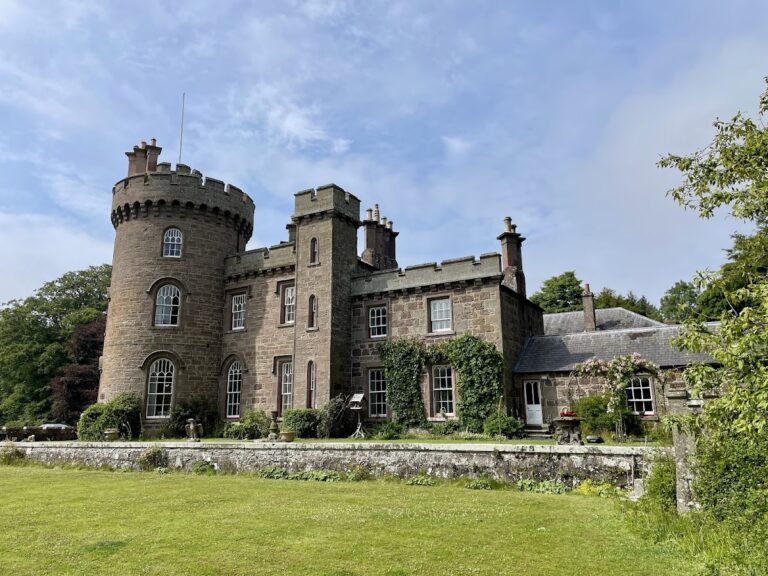
In 1791, architect James Playfair transformed the castle into a large country house. The estate returned to Carnegie ownership in 1855, and the house was subsequently remodelled in the Victorian baronial style, a 19th-century revival drawing on the towers, turrets, and irregular forms associated with Scottish fortified buildings.
A fire extensively damaged the house in 1921, after which it was rebuilt. Kinnaird Castle is now a Category B listed building, a designation for structures of regional or more than local importance. Its grounds are included in Scotland’s Inventory of Gardens and Designed Landscapes, which identifies significant historic designed landscapes and gardens.
Remains
The present building is a three-storey country house on a square plan, arranged around a courtyard that opens toward the rear. The stables occupy this open side, giving the surviving complex a combination of residential and service buildings.
Exterior elevations
The west facade is dominated by a central tower with tourelles, small turret-like structures projecting from the larger building. Two square-plan towers flank the central feature. On the north facade, a columned porch forms the principal architectural entrance feature.
Medieval fabric
Parts of the 15th-century tower house can still be identified in the south wing. These surviving elements connect the later country house with the fortified residence established at Kinnaird during the medieval period and retained within the rebuilt structure.