Finavon Castle: A Scottish Tower House and Country Estate


Site at a Glance
- Rating
- 3.2
- Popularity
- Very Low
- Country
- United Kingdom
- Primary era
- Early Modern
- Eras represented
- Medieval, Early Modern, Modern
- Civilizations
- British, Kingdom of Scotland
- Site type
- Military
- Remains
- Castle
On this page7 sections
History
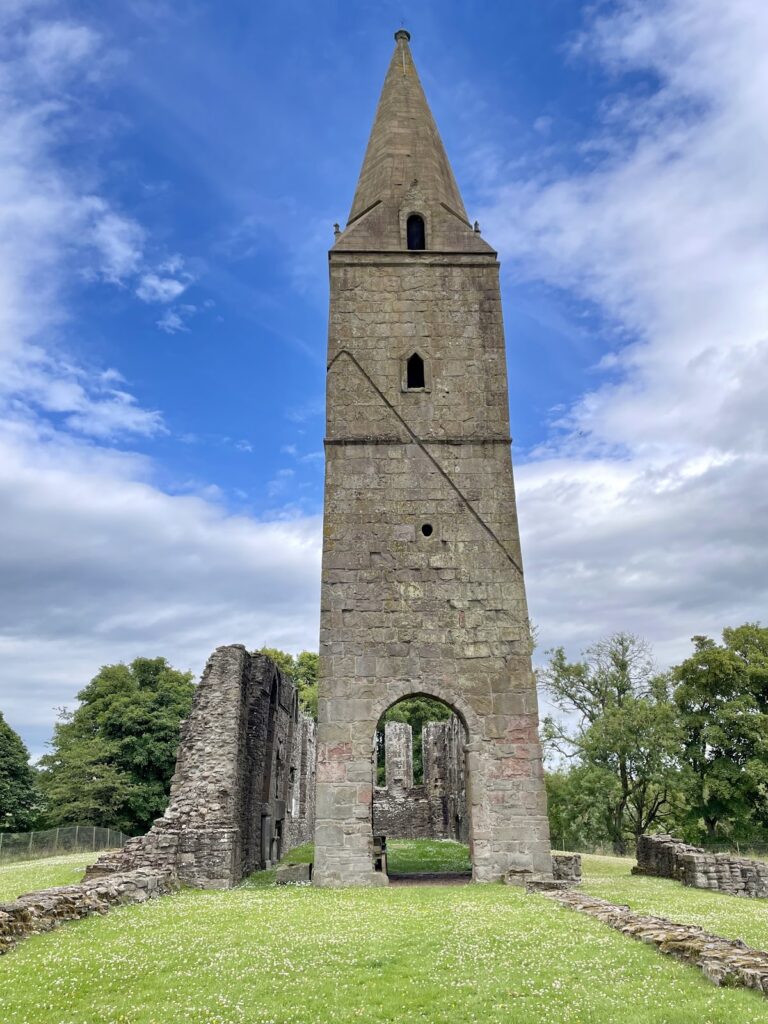
Finavon Castle is a historic site in the United Kingdom, near Forfar in Angus, comprising a ruined tower house dating from about 1600 and a later country house built in the Scottish Baronial style in 1865. Historically known as Finhaven, the estate belonged to the Lindsay Earls of Crawford from 1375, although excavation has shown that the visible tower formed part of a much older and more extensive medieval complex.
The Lindsay Earls of Crawford
The Lindsay family established the original castle on the estate after acquiring it in 1375. Finavon became a setting for important family events. In 1546, David Lindsay, 10th Earl of Crawford, married Margaret, the daughter of Cardinal David Beaton, there. An earl was a high-ranking Scottish and British nobleman, while Beaton was a senior Scottish Catholic churchman who held the rank of cardinal.
The household’s way of life combined martial exercises, hunting, baronial banquets, minstrels, and a court jester with chess, reading, music, and other pastimes. Women took part in morning sports and festivities, while also spinning and weaving tapestries. When the earl was away, his wife could manage his affairs, exercise authority over vassals, and defend the castle if it came under attack. Vassals were feudal dependents bound by obligations to a lord.
Transfer of the estate
Extravagant expenditure weakened the Crawford family’s finances. In 1625, the Barony of Finavon passed by forced sale to Alexander Lindsay, 2nd Lord Spynie. The estate later moved through the Carnegie family, the Gordon Earls of Aboyne, and the Gardyne family. Thomas Gardyne purchased the castle in 1843. Through an eighteenth-century marriage, he was related to the Lindsays, the estate’s original owners.
The nineteenth-century country house
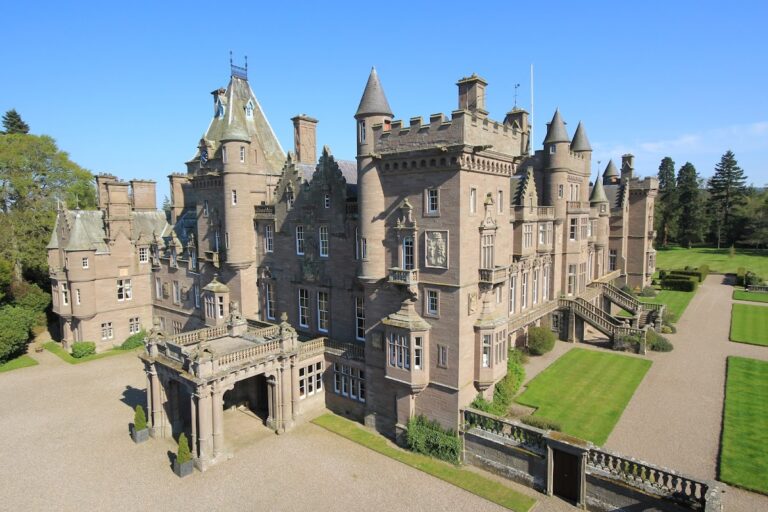
David Greenhill Gardyne, the laird at the time, commissioned a new country house in 1865 from the Arbroath architects Carver and Symon. A laird was a Scottish landed proprietor. The house was built about 130 metres west of the older tower and represents the nineteenth-century revival of Scottish castle architecture. Lieutenant-Colonel Alan David Greenhill Gardyne, a later descendant, died in 1953 and left the estate to his daughter, Susan Mazur.
Excavation clarified the relationship between the surviving tower and the earlier medieval complex. The tower-house ruin was designated Finavon Castle as a Scheduled Monument on 19 October 2000. This status provides legal protection for archaeological or historic sites considered nationally important. The nineteenth-century country house is listed as a Category C historic building by Historic Scotland, Scotland’s national heritage agency during the period concerned.
Remains
The site lies beside the River South Esk, about 400 metres south of Milton of Finavon and approximately 8 kilometres northeast of Forfar. Its surviving buildings are arranged as two separate elements: the ruined tower house and the nineteenth-century country house to its west. Excavation has also established that the tower was added to an earlier medieval complex that was more extensive than the visible ruin.
The tower house
The visible tower house dates from about 1600 and was built onto the northeast corner of the earlier medieval structure. It had an L-shaped plan, five full storeys, a garret, and a courtyard. A tower house was a fortified residence that combined domestic accommodation with defensive capacity, while a garret was an upper attic or loft level. Built of rubble stone, the tower survives in a ruinous condition.
The country house
The separate country house was built in 1865 in the Scottish Baronial style, a nineteenth-century revival using historic Scottish castle forms. It stands approximately 130 metres west of the tower ruin and forms the later architectural element of the Finavon estate.
Nearby sites