Castello di Las Plassas: A Medieval Frontier Fortress in Sardinia


Site at a Glance
- Rating
- 4.3
- Popularity
- Very Low
- Country
- Italy
- Primary era
- Medieval
- Eras represented
- Medieval
- Civilizations
- Unclassified
- Site type
- Military
- Remains
- Castle
On this page4 sections
History
Castello di Las Plassas is a medieval castle in Italy, associated with Sardinia’s giudicale period, the era of the island’s kingdoms ruled by judge-rulers, from roughly the tenth to the fifteenth centuries. Built before 1172, it served the Kingdom of Arborea as an important fortress on the kingdom’s frontier.
Arborean rule
The first surviving direct document concerning the castle dates from 1172, when it was ceded as a pledge to the Republic of Genoa. It remained connected with Arborea, the medieval Sardinian state that controlled much of west-central Sardinia and opposed the expansion of the Crown of Aragon.
The castle underwent several renovations. Its most substantial recorded intervention took place in the late thirteenth century during the reign of Mariano II of Arborea, a judge-ruler of that kingdom. During the war between Arborea and the Kingdom of Sardinia under the Crown of Aragon, the castle retained its strategic importance as a frontier stronghold.
Aragonese period and abandonment
After the Battle of Sanluri in 1409, Castello di Las Plassas definitively entered the Aragonese domains of the Kingdom of Sardinia. It remained functional for a little more than another century before being permanently abandoned.
The castle’s hill gave its name first to an Arborean administrative district, then to the surrounding territory, and ultimately to the geographical subregion of Marmilla. Archaeological excavation campaigns carried out under the archaeological superintendence responsible for the provinces of Cagliari and Oristano uncovered architectural elements and other finds, helping clarify the site’s medieval history.
Remains
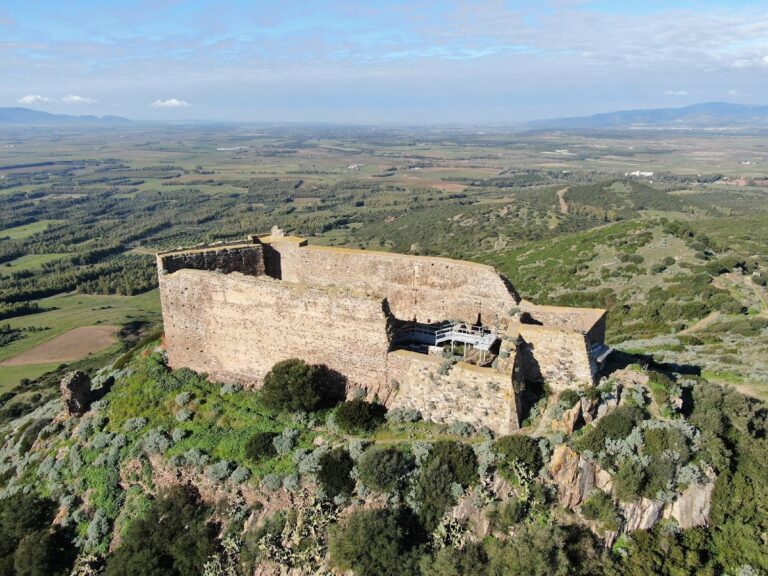
The castle survives as a ruin on a conical hill near Las Plassas. The hill has a breast-like form, an appearance reflected in the name Marmilla. The visible remains include sections of the castle walls and other ruined elements. A substantial consolidation intervention in 2000 helped preserve the surviving fabric.
Excavations brought parts of the castle’s architectural elements to light along with other archaeological finds. The recovered material is housed and displayed in MudA, the municipal multimedia museum associated with Las Plassas, rather than forming part of the surviving ruin fabric on the hill.